QUIET CRAFTSMANSHIP · LONGQUAN

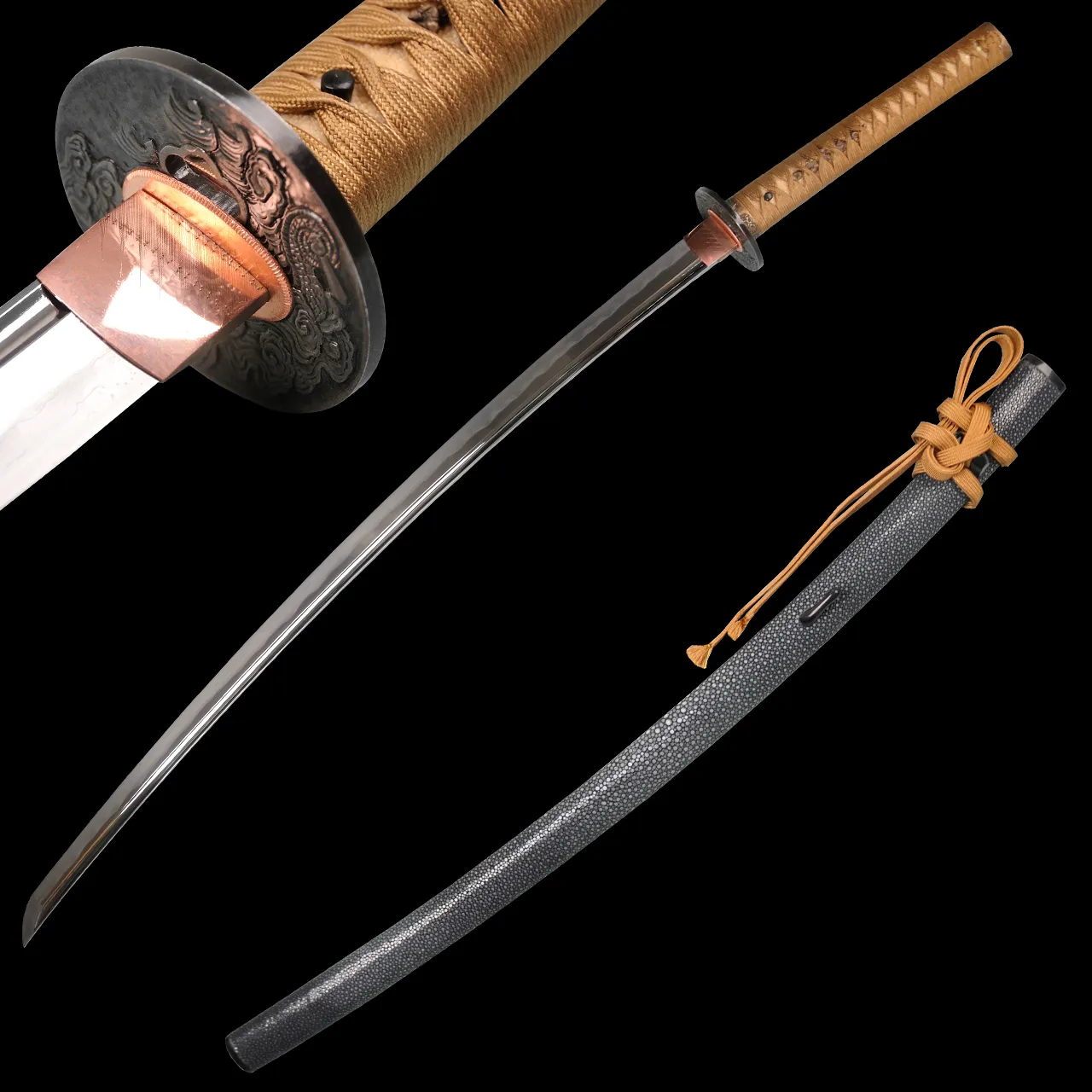
Kōsetsu Samonji Utsushi Katana

¥11,293.00

CUSTOMIZE THIS KATANA
Each katana is configured individually.
Multiple katana purchases are placed as separate orders.

KATANA CUSTOMIZER

Customize Your Katana.

Choose from the configuration options available for this katana.

WORKSHOP NOTES

Good morning, everyone. I’m Lao Yan.

Here is a quick look at a Kōsetsu Samonji utsushi that took about a year to complete.

The customer commissioned this particular piece a year ago.

It has been a full year. Part of the delay came from the shiage-togi polishing...

...but about half of that time was spent waiting for the tsuba to be hand-carved.

The customer had specifically requested...

...a hand-carved tsuba for this individual commission.

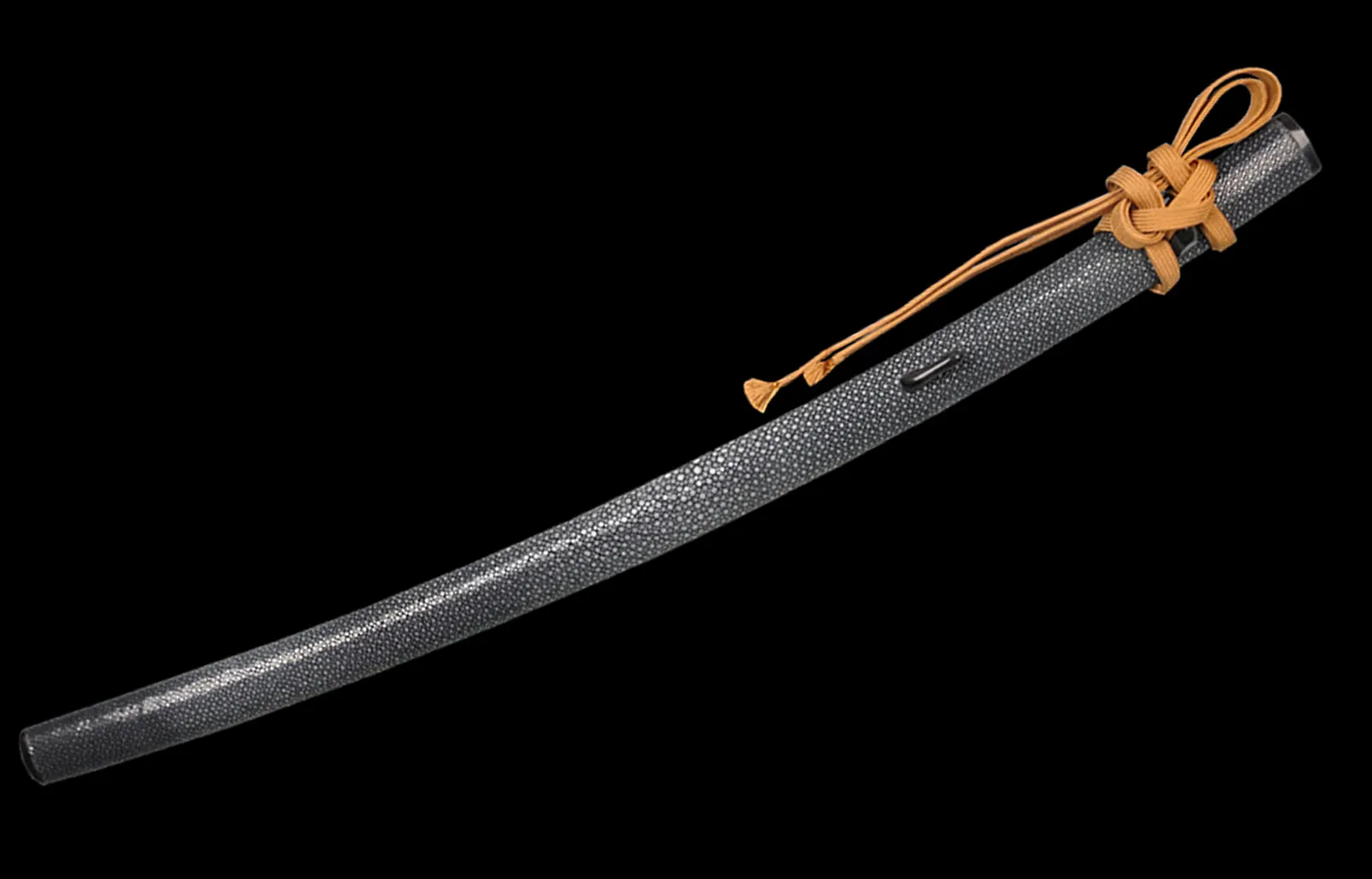
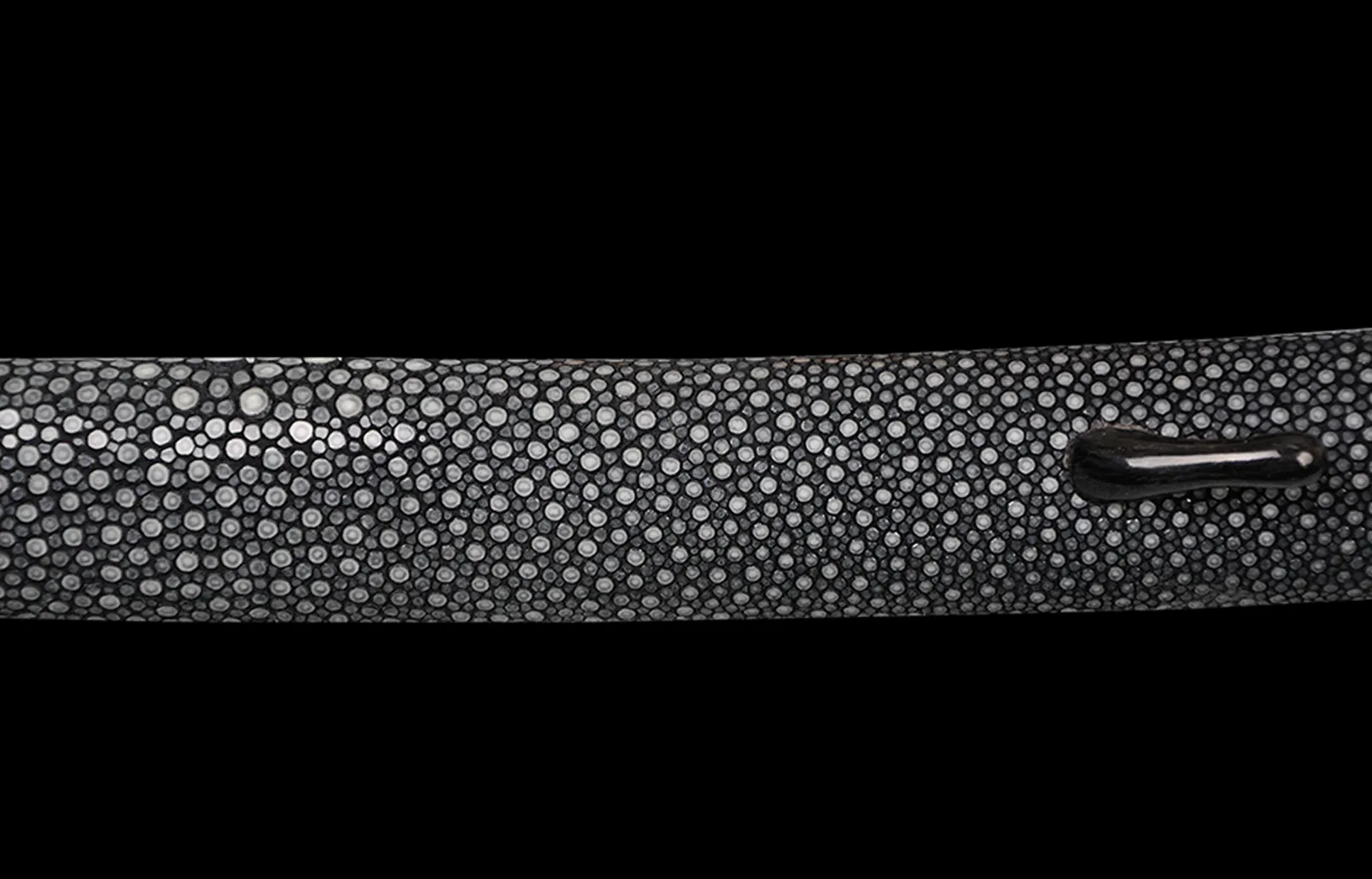
The rayskin used for the saya was expensive. It wasn’t the ordinary, untreated kind...

...but naturally black, tanned rayskin, prepared rather than left raw.

Its raised texture is very consistent across the surface.

Some people love this look; others find the dense texture a little overwhelming.

If you have trypophobia, you might want to look away! This is one continuous piece of rayskin, with no seams or joins.

That single sheet of rayskin cost about 1,800 yuan, if I remember correctly.

The hand-carved fittings were over 3,000 yuan. The rayskin and tsuba alone accounted for well over 4,000 yuan on this commission.

I have never presented this blade as steel smelted in our own workshop.

The outer jacket is folded T10 carbon steel, and the core is manganese steel.

It received shiage-togi polishing. As for the clay tempering, there is nothing especially unusual...

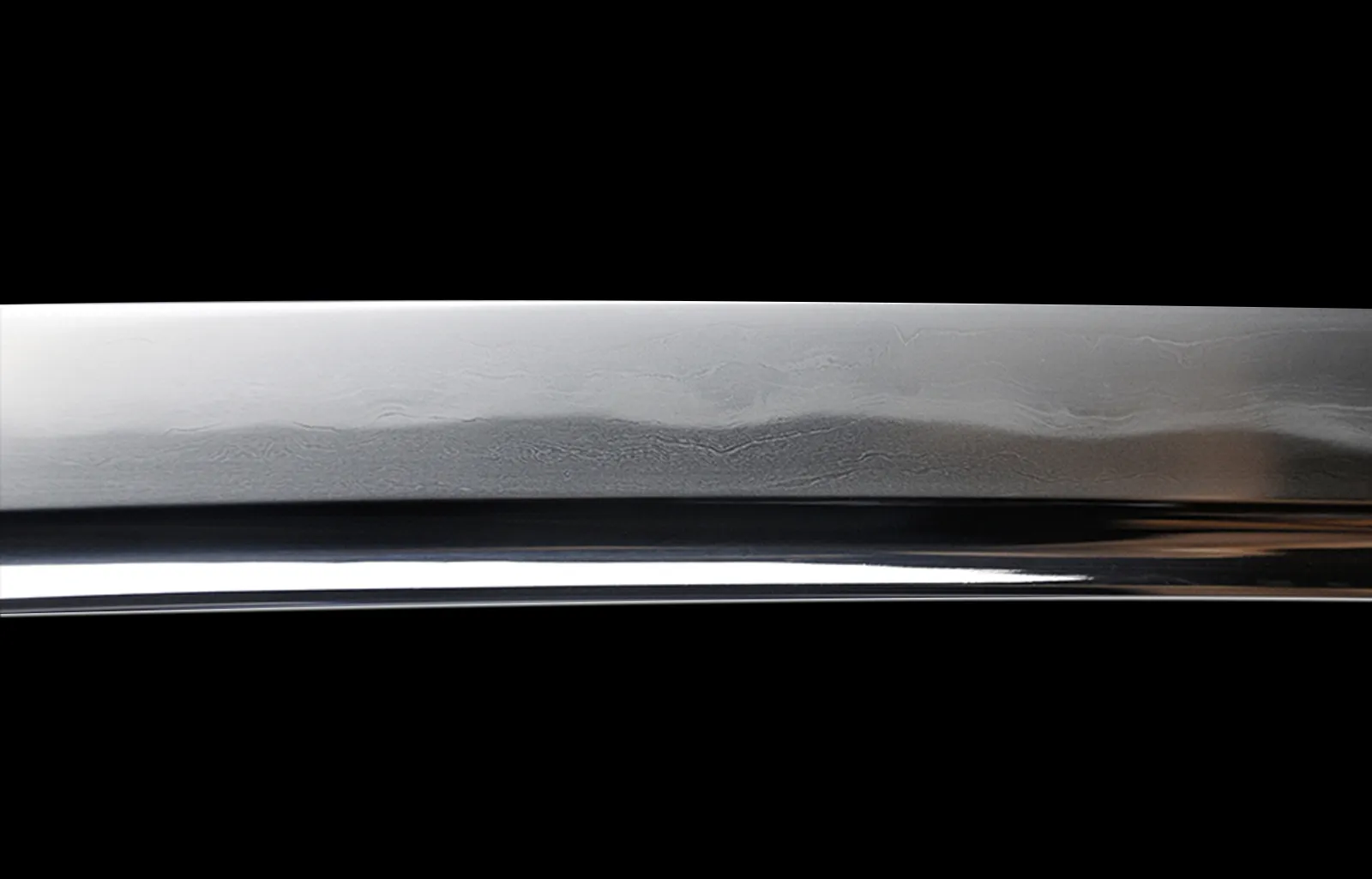
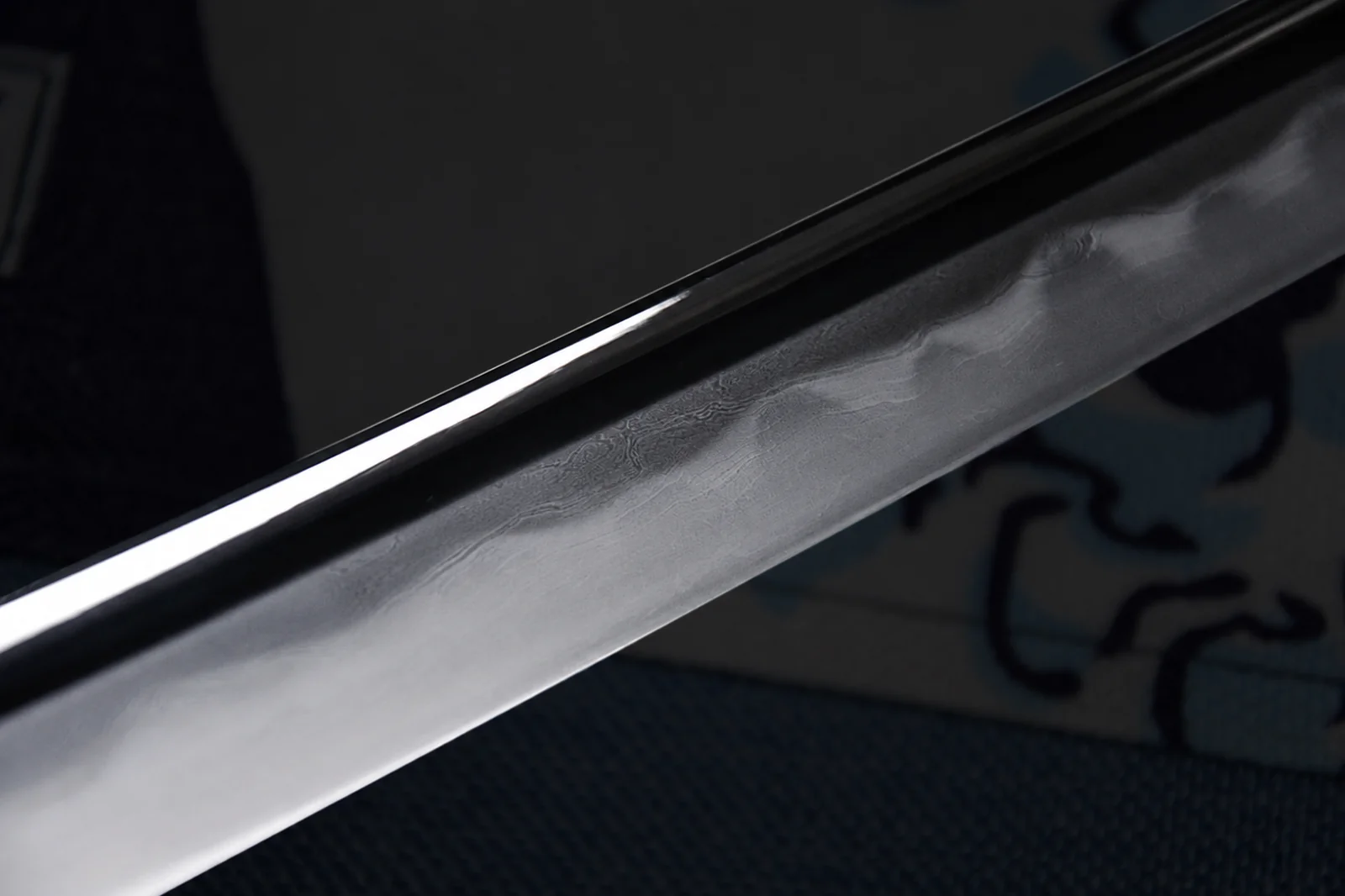
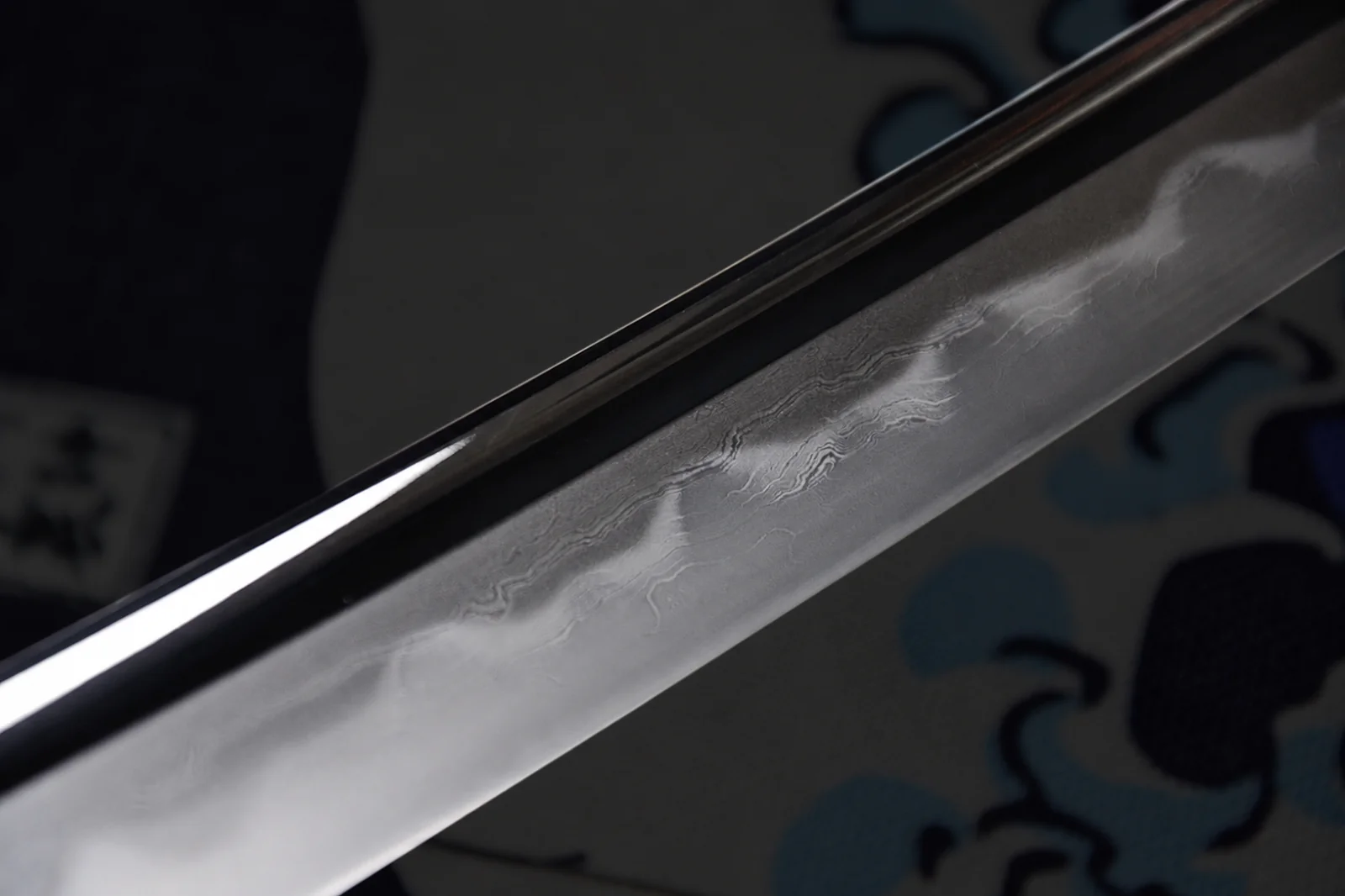
...just a straightforward Gunome hamon. What stands out is a grooved blade after shiage-togi polishing.

The finished blade has a really pleasing, balanced appearance.

Even the interior of the hi groove was polished. It is very satisfying to look at.

I have filmed the blade on its own before.

The cost of this individual piece was driven mainly by its metal fittings and saya.

Without those two elements, the cost would have been much more restrained. Together, they raised it considerably.

As for the tsuka handle—this build really did take a long time.

Originally the customer was going to cover the handle work, but I absorbed that expense.

The tsuka uses a full samegawa wrap, including prominent parent nodules.

You can recognize Mr. Shu’s handle work. It cost roughly six or seven hundred yuan.

There was another difference of over 500 yuan for the rayskin, and I did not charge the customer for that either.

I absorbed more than 1,000 yuan in additional cost because completion had taken so long. That is the background.

So here it is, a Kōsetsu Samonji utsushi. Personally, I think it turned out rather well.

One more detail: the hand-carving of the tsuba alone cost over 3,000 yuan.

It is an iron tsuba, which makes the carving more expensive. Much of the budget went into it.

That left a more limited budget for the fuchi, kashira and menuki...

...so those smaller fittings were kept relatively simple.

The carved tsuba itself is impressive. I would say it captures much of the reference piece’s character—perhaps around 80%.

The original reference piece was in Japan.

I remember how beautiful it looked in the photographs, but I can no longer find that listing.

Perhaps another collector acquired it. In any case, that is the story behind this piece.

This is a jacketed-steel blade: Kobuse construction.

It is finished with shiage-togi polishing...

...and paired with an exceptionally elaborate saya and Mr. Shu’s handle wrapping.

Let’s take one last look at the blade. A hi groove with shiage-togi polishing is especially satisfying.

Personally, I find it more distinctive than a blade without a groove.

The hi also contributes to a very pleasant handling feel.

The cutting length is close to 80 cm, yet the sword weighs only a little over 900 grams without the saya.

Without that groove, I would expect the unsheathed weight to exceed 1,000 grams—perhaps around 1,100. That is my estimate.

Thank you for watching. Goodbye, everyone!

Technical Overview

Core specifications.

Nagasa
780 mm
Motohaba
32 mm
Motokasane
7 mm
Tsuka Length
250 mm
Overall Length
1050 mm
Weight without Saya
920 g
Weight with Saya
1190 g
Handmade product dimensions may vary slightly.
Blade & Craft

Blade craftsmanship.

Outer Steel
Folded T10 Carbon Steel
Core Steel
Manganese Steel
Construction
Kobuse Construction
Heat Treatment
Clay Tempering
Hamon
Clay-Tempered Hamon
Hamon Pattern
Gunome
Polish
Shiage-togi
Blade Groove
Hi
Groove Finish
Polished Groove Interior

Beschreibung

STORY 01 / HISTORY & FORM

Kōsetsu Samonji

The fourteenth-century Kōsetsu Samonji is a signed tachi by Sa of Chikuzen. Its broad blade, pronounced curvature, and extended point reflect the proportions of the Nanbokuchō period and provide the starting point for this katana.

CHIKUZEN SA / 14TH CENTURY / HISTORICAL BLADE 78.2 CM
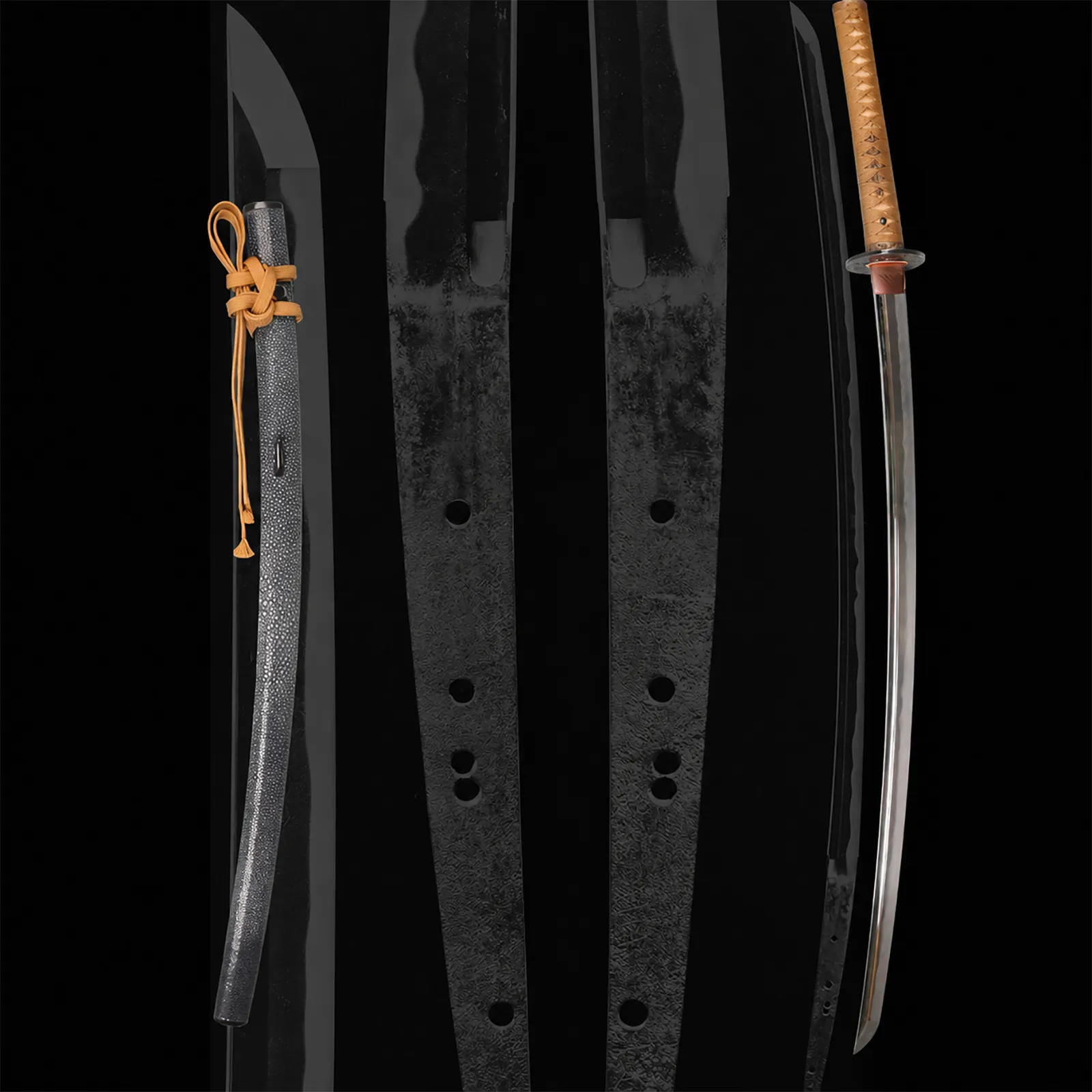
Kōsetsu Samonji katana displayed with its dark samegawa saya and comparative tang-profile imagery on a black background.
The mounted sword, blade silhouette, and tang profile.

THE HISTORICAL SWORD

The Name and Its History

Signed Chikushū-jū Sa, the sword takes its name from Itabeoka Kōsetsusai, a retainer of the Odawara Hōjō family. It later passed to Tokugawa Ieyasu and then to Tokugawa Yorinobu.

Recognized as a Japanese National Treasure, the original tachi is preserved at the Fukuyama Museum of Art.

SWORD PROFILE

Length, Curve, and Line

The historical blade measures 782 mm in length, with 27 mm of curvature. This katana has a 780 mm nagasa, giving the blade a closely comparable overall scale.

The design draws attention to the sugata: the sweep of the blade, the shape of the point, and the transition into the nakago beneath the mounting.

THE BLADE

Steel and Finish

Folded T10 carbon steel surrounds a manganese-steel core in Kobuse construction. Clay tempering forms a Gunome hamon; Shiage-togi polishing refines the surface, while a hi follows the length of the blade.

NEXT / BLADE CRAFTSMANSHIP — FORGING, HEAT TREATMENT & POLISH

STORY 02 / BLADE & KOSHIRAE

Steel, Temper & Detail

Folded T10 carbon steel forms the outer jacket around a manganese-steel core in Kobuse construction. Clay tempering produces the Gunome hamon, brought into view through Shiage-togi polishing.

A hi runs along the blade, with the interior of the groove polished as part of the finish.
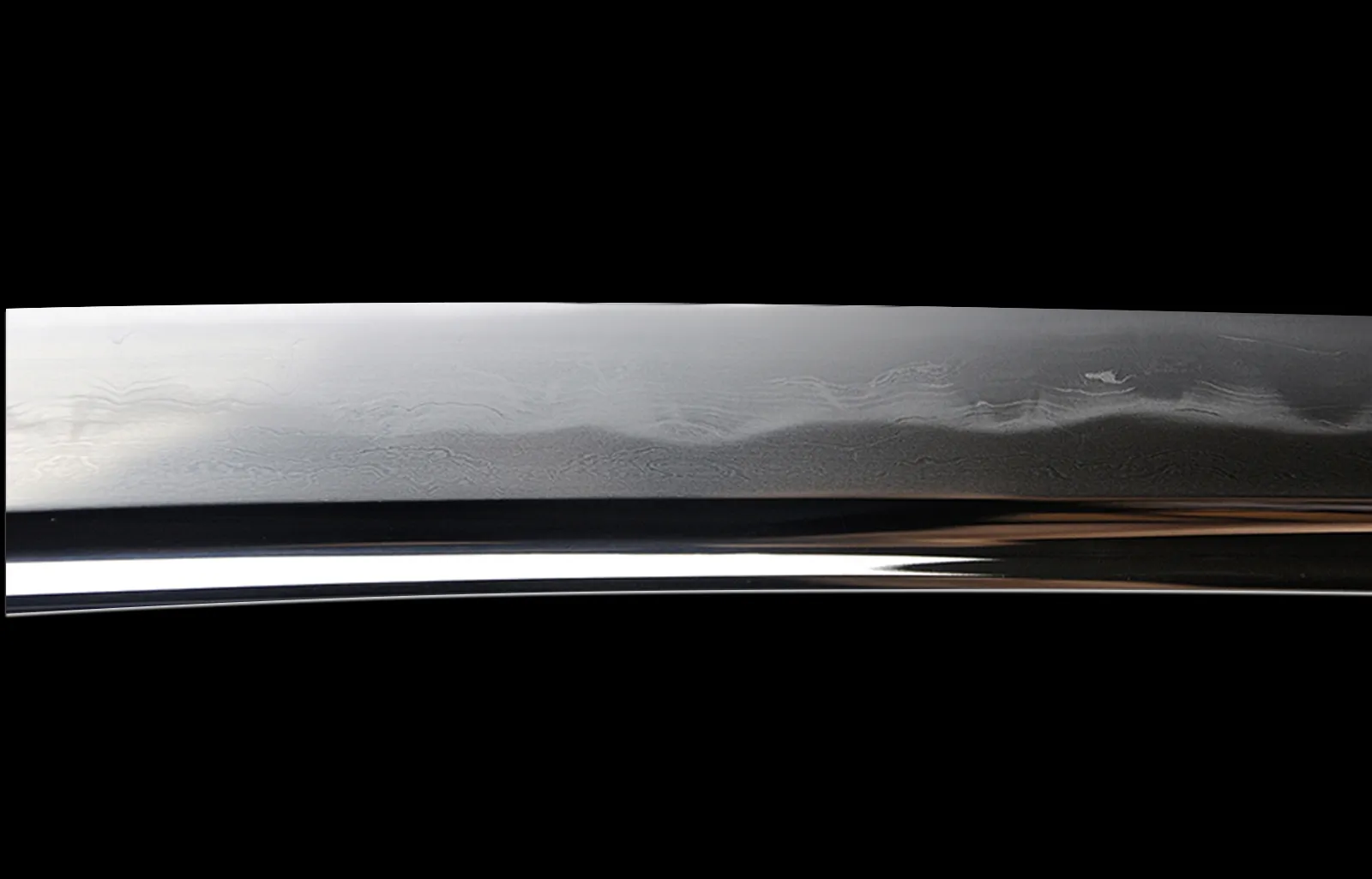
Close-up of the Kōsetsu Samonji katana blade showing the gunome hamon, polished surface, and fine steel texture against black.
Gunome hamon and the finished blade surface.
Close-up of the Kōsetsu Samonji katana blade showing its gently undulating gunome hamon and finely polished steel surface.

THE TEMPER LINE

Gunome in Close View

The hardened edge follows a sequence of soft, rounded undulations. The polish reveals the boundary of the hamon and the subtle variations across the steel.

THE FINISHED BLADE

Four views of the polished blade, following the hamon, its reflected light, and the lengthwise lines of the steel.
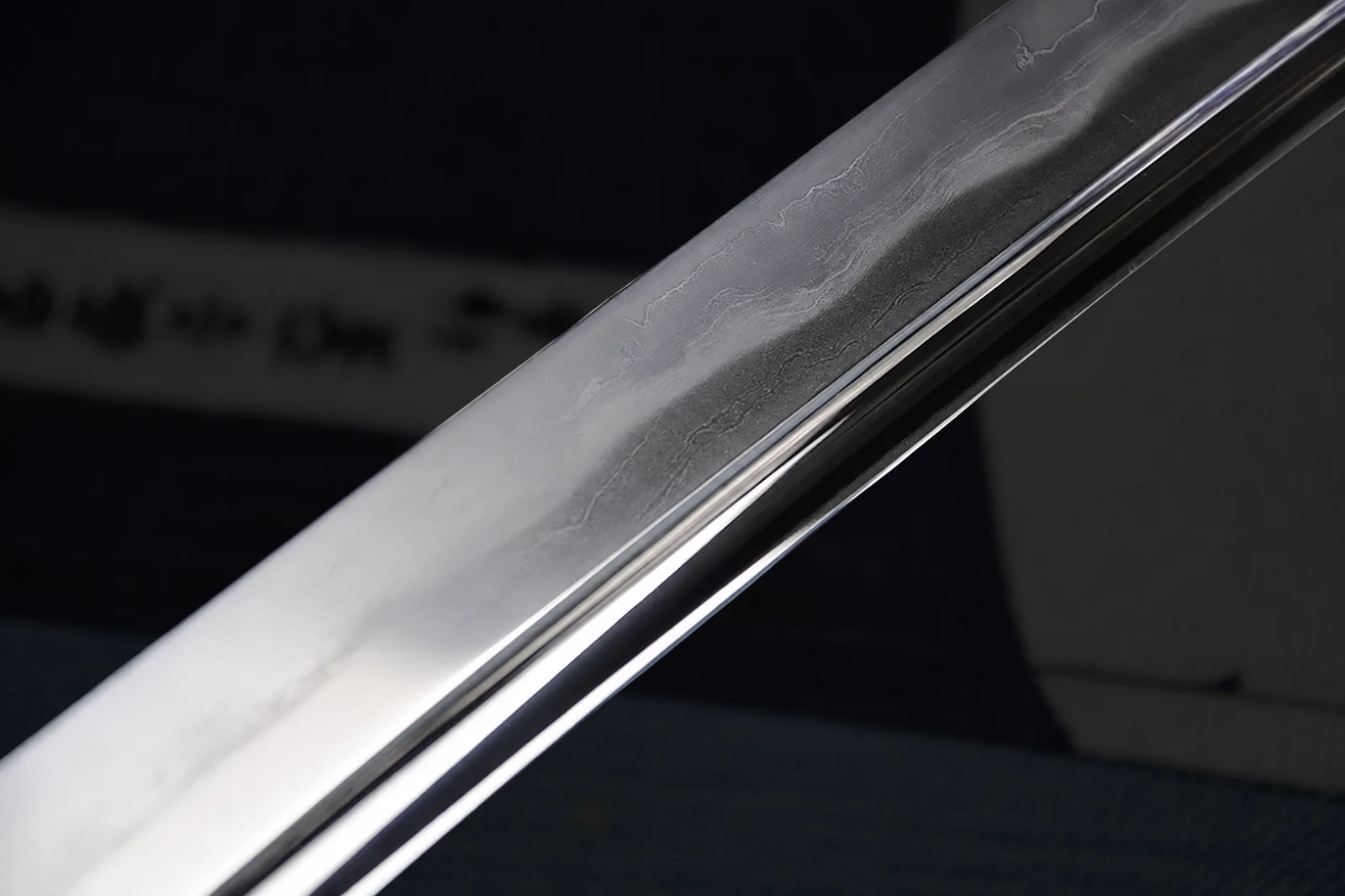
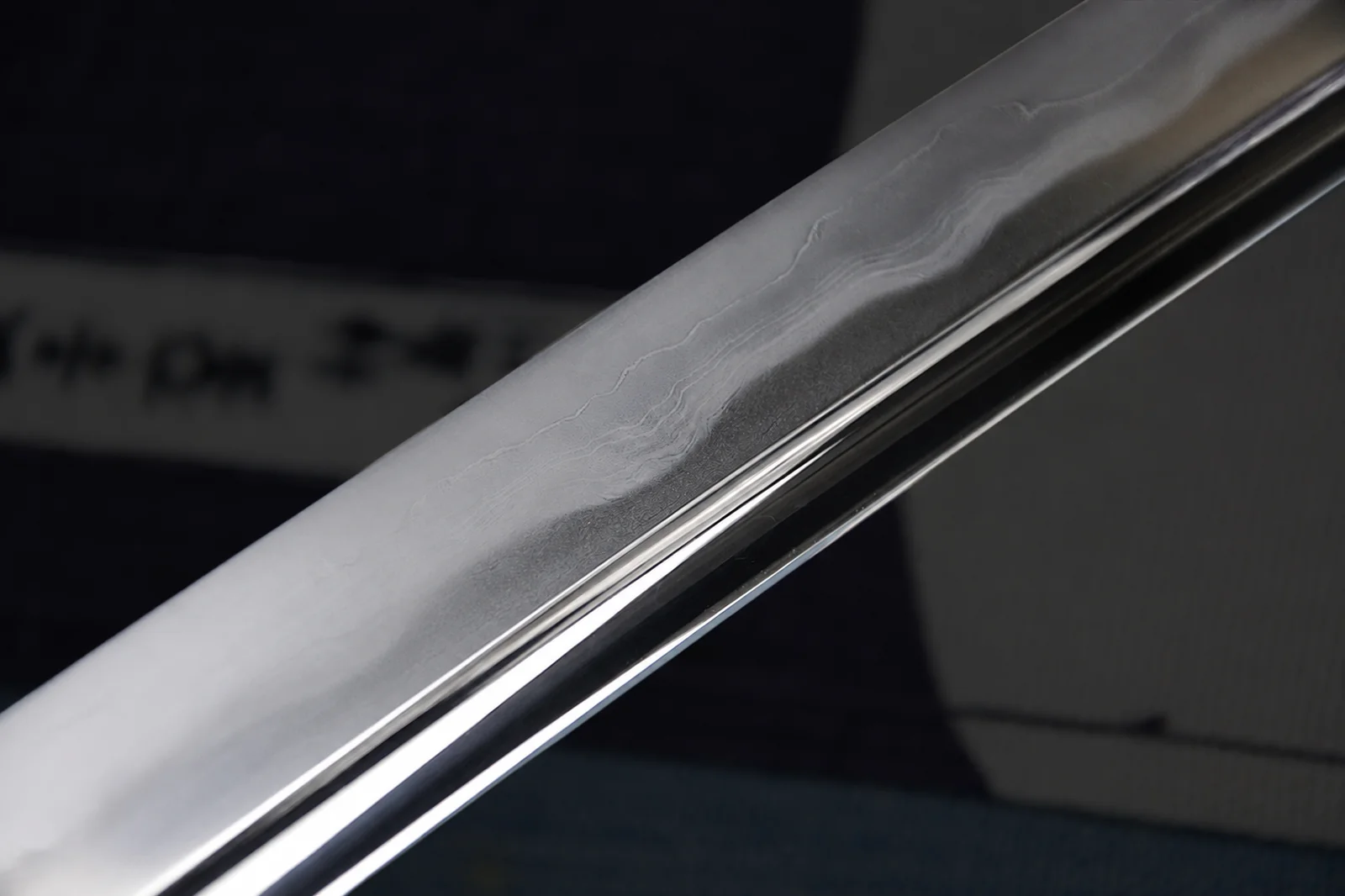
Angled close-up of the Kōsetsu Samonji katana blade showing the polished steel surface and visible temper line.
Polished blade / view 01
Second angled close-up of the Kōsetsu Samonji katana blade, showing reflections across the steel and the hamon.
Polished blade / view 02
Diagonal photograph of the Kōsetsu Samonji katana blade showing its wavy hamon and bright polished edge.
Polished blade / view 03
Close-up of the Kōsetsu Samonji katana blade highlighting the irregular gunome temper line and reflective polished edge.
Polished blade / view 04

THE MOUNTING

Craft in the Details

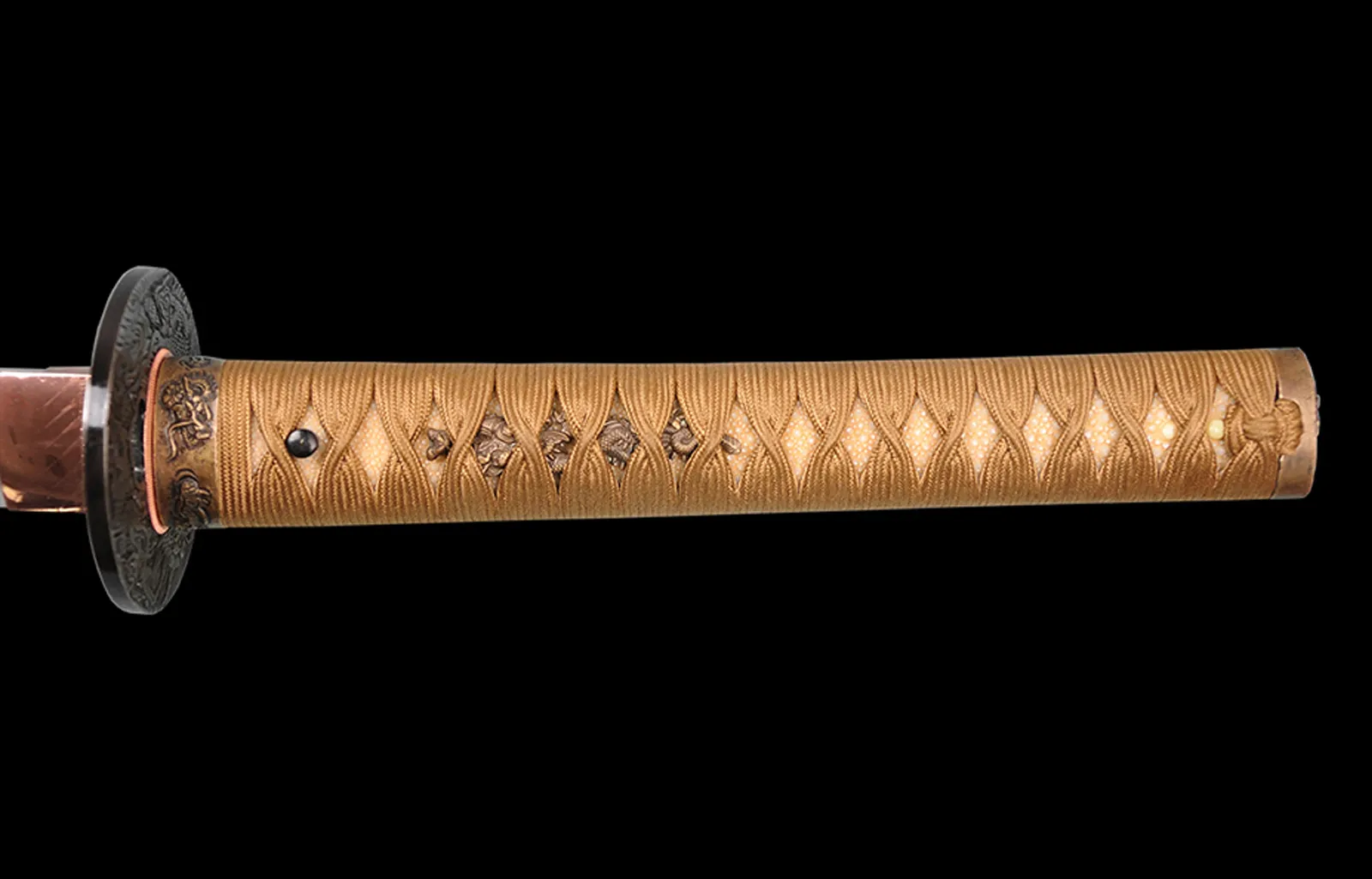
Carved iron, copper-toned fittings, a full-samegawa handle and black rayskin saya bring texture and contrast to the mounting.
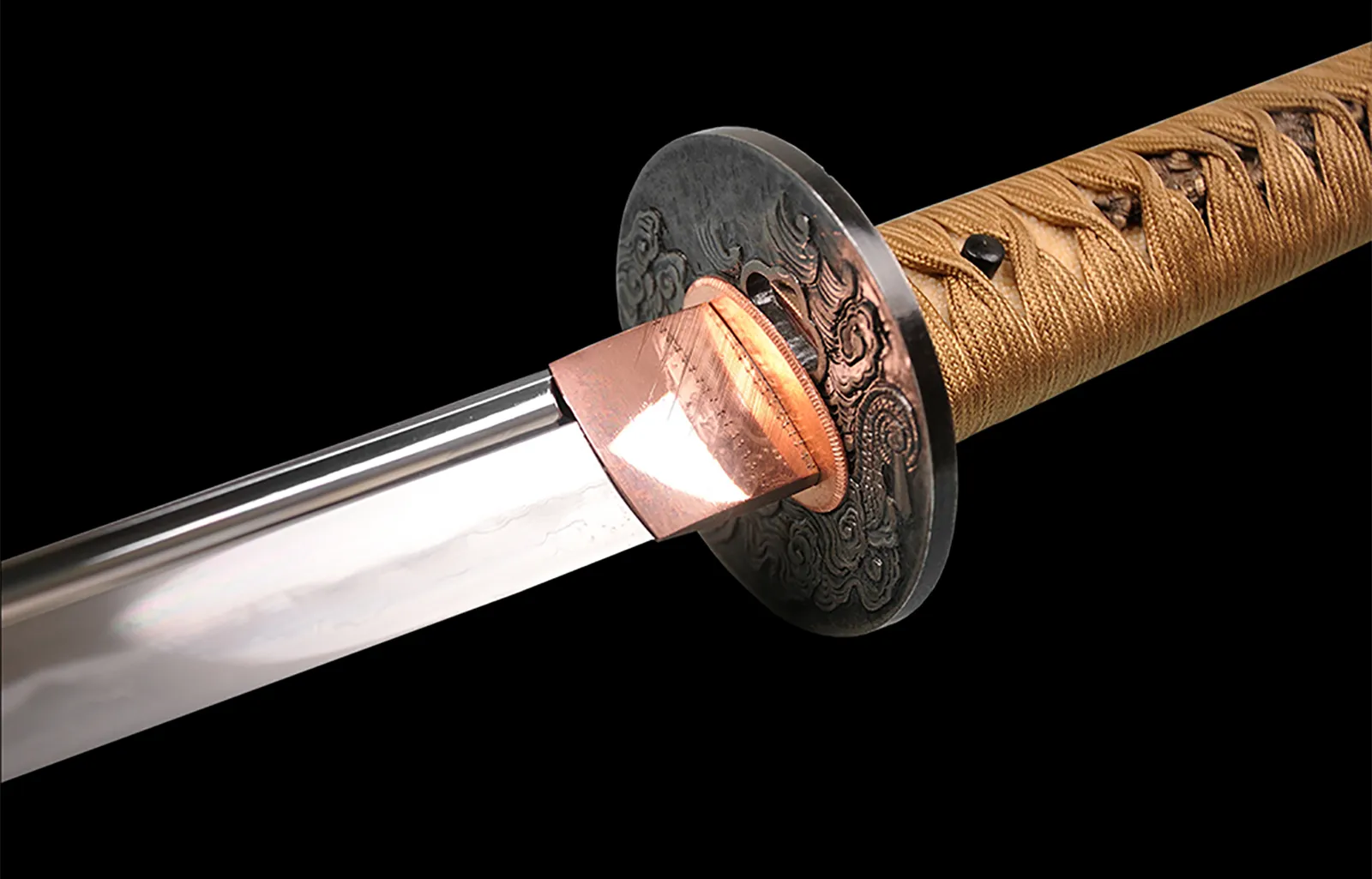
Close-up of the Kōsetsu Samonji katana showing its carved iron tsuba, copper-toned habaki, golden-brown handle wrap and polished blade.
Carved iron tsuba and copper-toned habaki.
Side view of the Kōsetsu Samonji katana tsuka with full samegawa, prominent oyatsubu nodes and gold-brown Morotsumami-maki wrapping.
Full samegawa, prominent oyatsubu and Morotsumami-maki wrapping.
Kōsetsu Samonji katana saya covered in black samegawa, with a gold-brown sageo tied at the scabbard opening.
Black samegawa saya with gold-brown sageo.
Macro close-up of black samegawa on the Kōsetsu Samonji katana saya, showing closely spaced natural rayskin nodes and the kurikata opening.
Natural node pattern across the black rayskin surface.

NEXT / COLLECTOR GALLERY — THE COMPLETE SWORD

STORY 03 / COLLECTOR GALLERY

The Finished Sword

The Kōsetsu Samonji mounting brings together a gold-brown handle wrap, a black samegawa-covered saya, and warm-toned fittings. These photographs move from the complete sword to the materials and details that define its appearance.

Full-length views, handle fittings, rayskin texture, and the tied sageo.
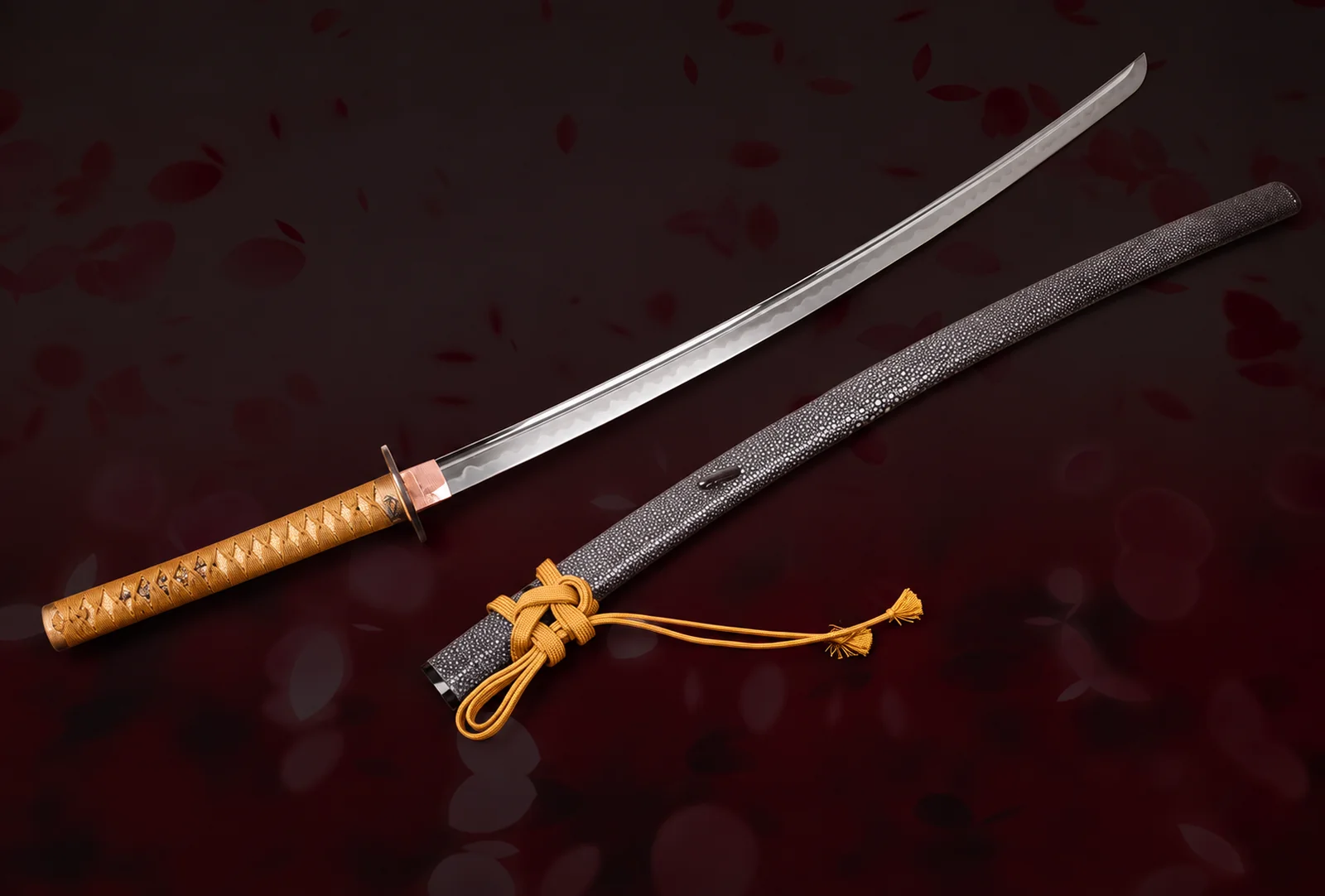
Kōsetsu Samonji katana displayed with its drawn blade, gold-brown wrapped handle, and black textured saya on a dark red background.
The drawn sword and its mounted scabbard.

COMPLETE VIEW

Blade, Handle & Saya

The bright blade and dark scabbard are framed by the gold-brown wrapping. Seen together, the fittings and mounting materials form a distinct contrast in color and texture.
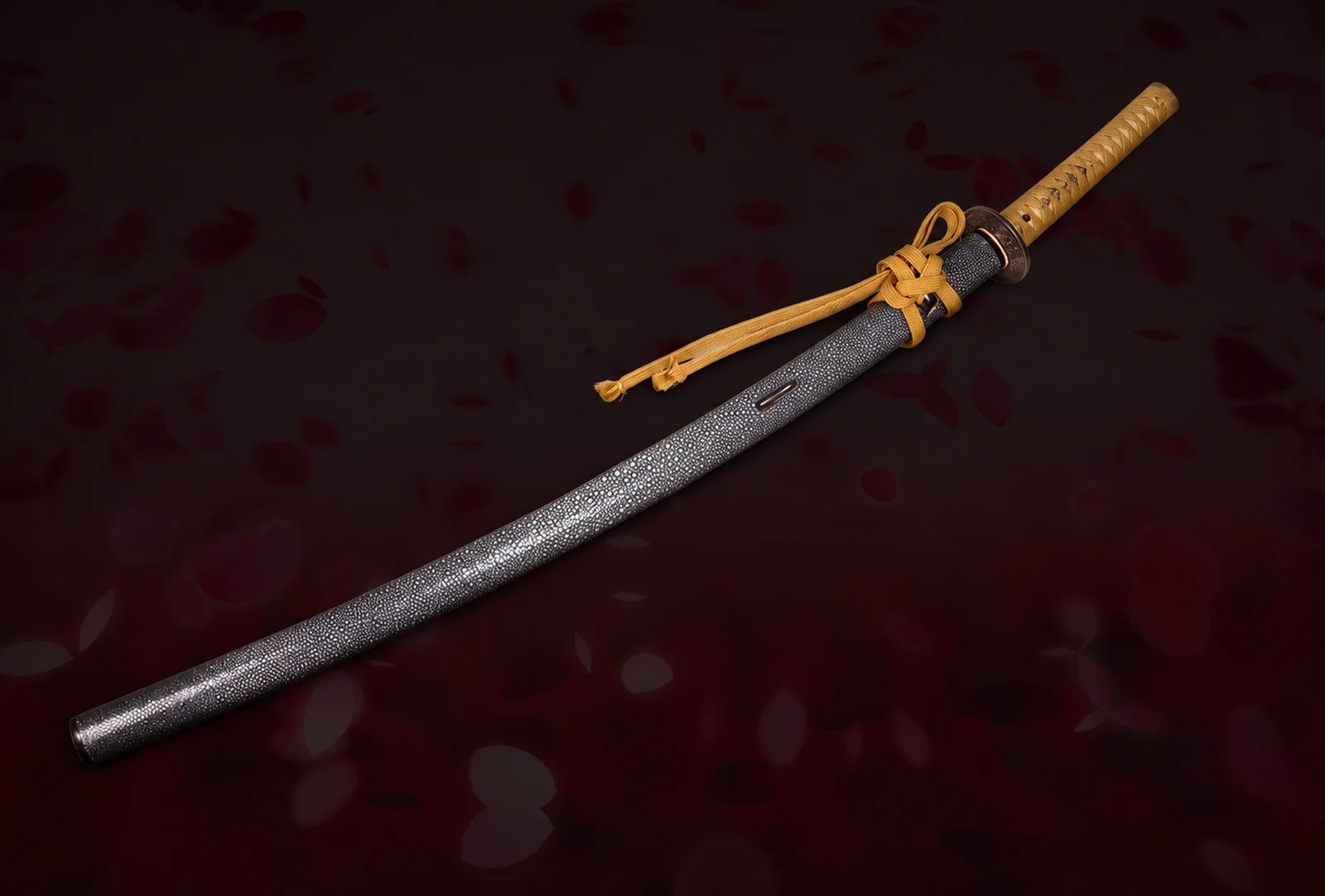
Full-length Kōsetsu Samonji katana with gold-brown tsuka wrap, dark samegawa saya, and polished blade arranged against a burgundy background.
A full-length view of the assembled sword and its saya.
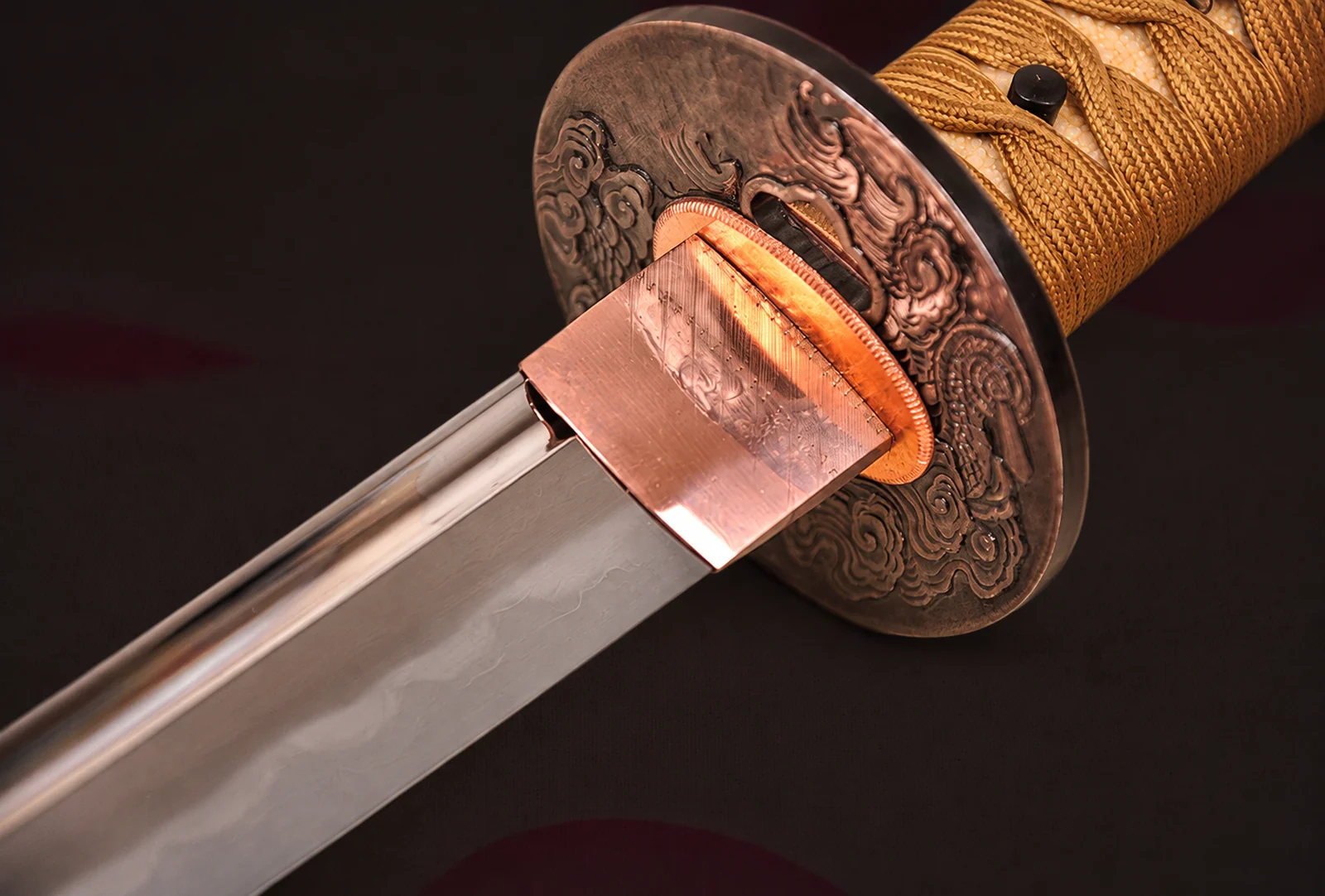
Close-up of the Kōsetsu Samonji sword mounting, showing the engraved iron tsuba, copper-toned habaki, wrapped tsuka, and polished blade.
Engraved iron tsuba and copper-toned habaki.

THE FITTINGS

Iron & Copper Tones

The engraved iron tsuba carries a dark, textured surface, set against the warmer finish of the habaki and the handle wrapping. The close view also shows the transition from the blade to the mounted tsuka.

THE HANDLE

Wrap & Rayskin

Gold-brown Morotsumami-maki follows the length of the handle. The diamond openings reveal the full samegawa beneath, including prominent oyatsubu nodes visible in the close views.
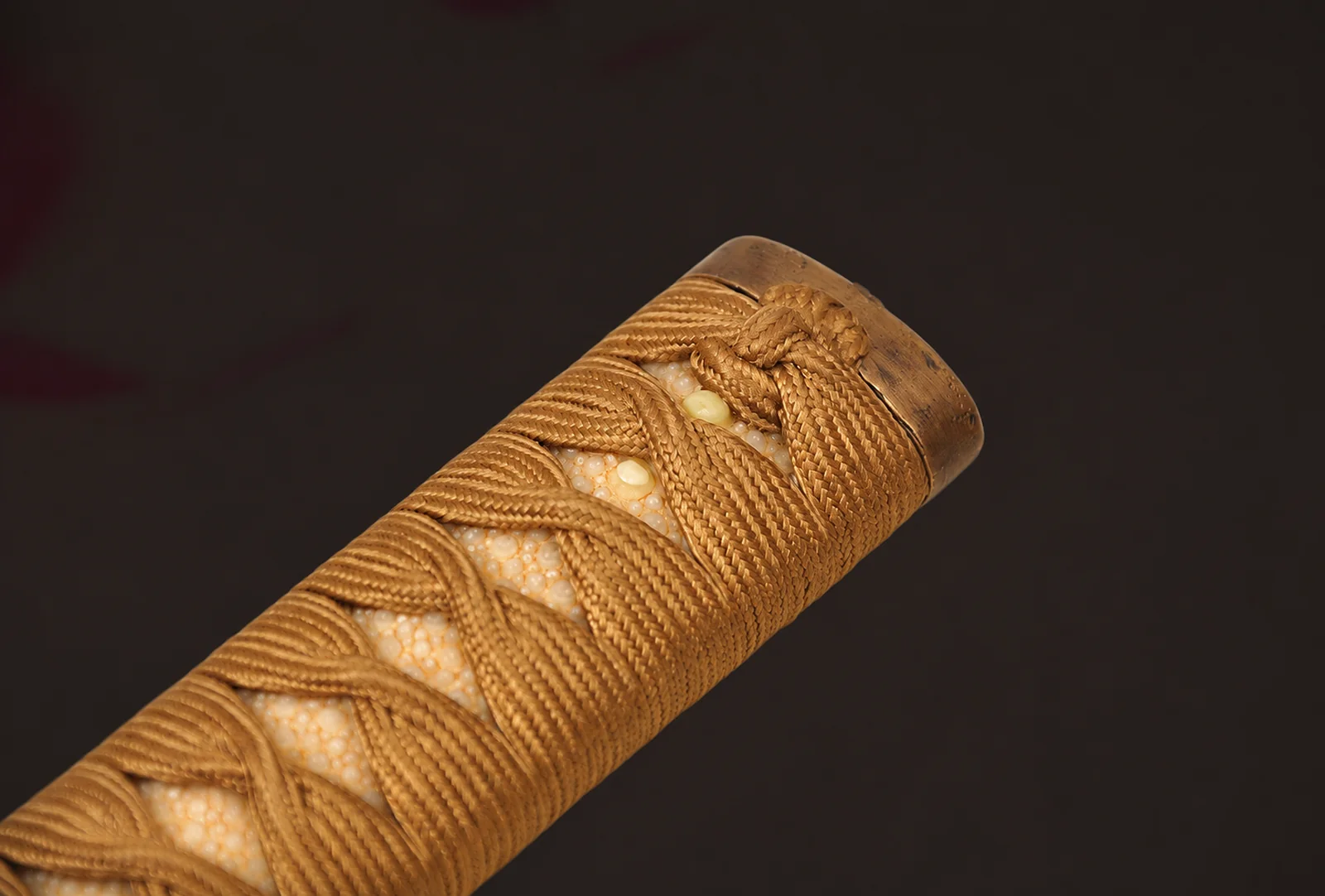
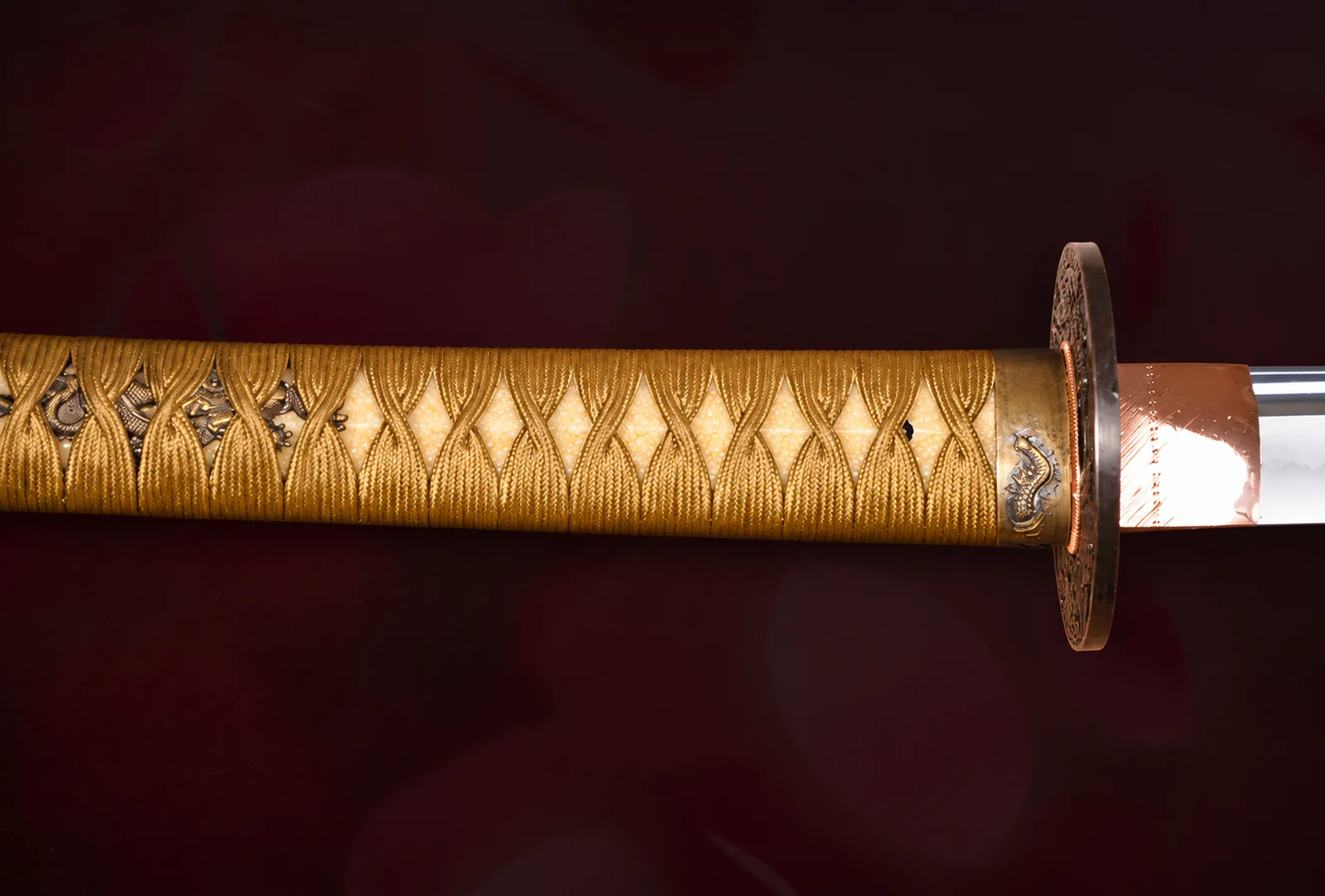
Close-up of the Kōsetsu Samonji tsuka showing the end of the gold-brown diamond-pattern handle wrap and exposed rayskin.
The handle wrap near the kashira.
Side view of the Kōsetsu Samonji katana handle with repeated gold-brown wrap diamonds, exposed samegawa, and fittings beside the blade.
Diamond-pattern wrapping along the full tsuka.

THE SCABBARD

Black Samegawa Saya

The black samegawa covering gives the saya a distinctly granular surface. A gold-brown sageo introduces a contrasting line of color at the scabbard opening, tying the exterior treatment back to the handle wrap.
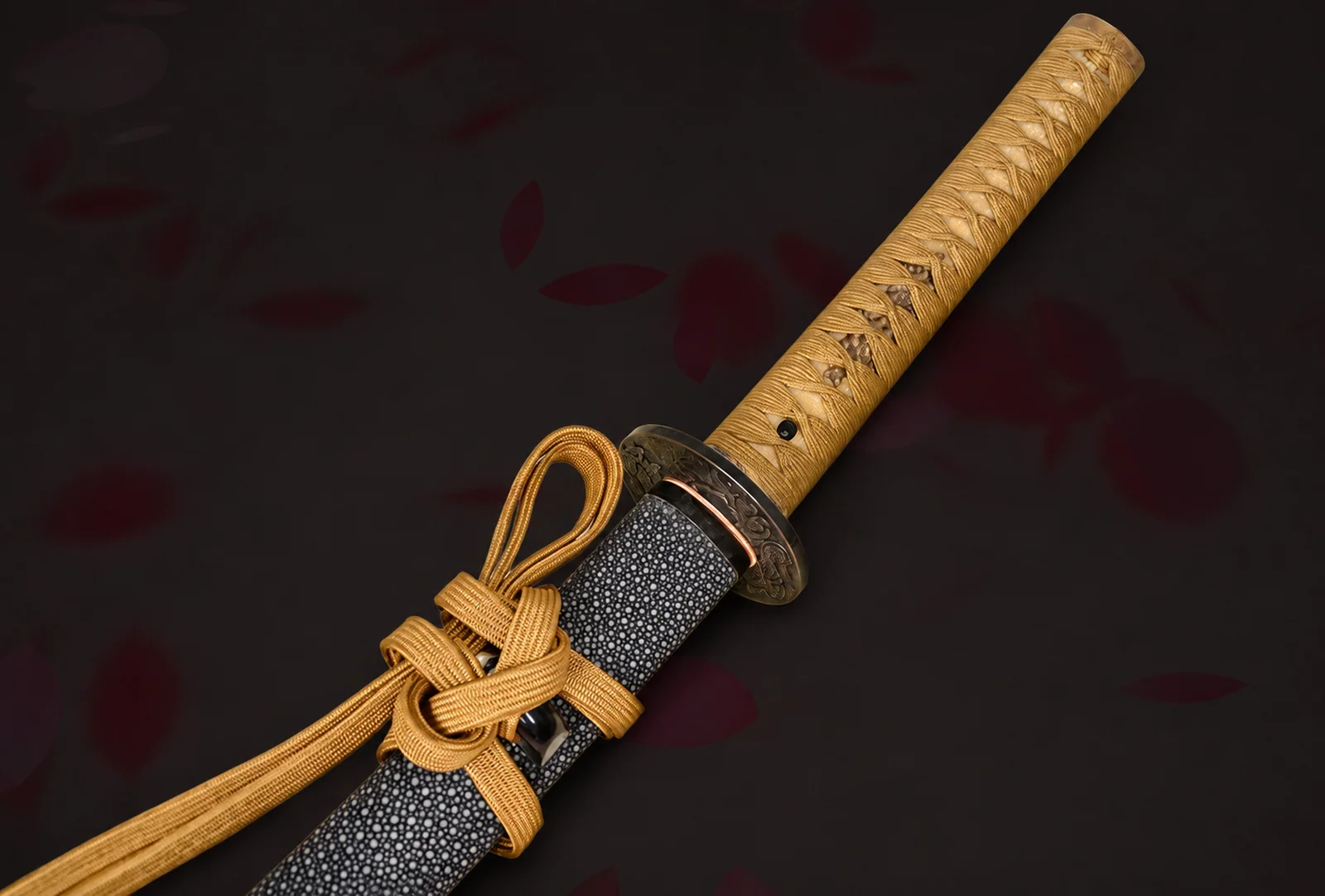
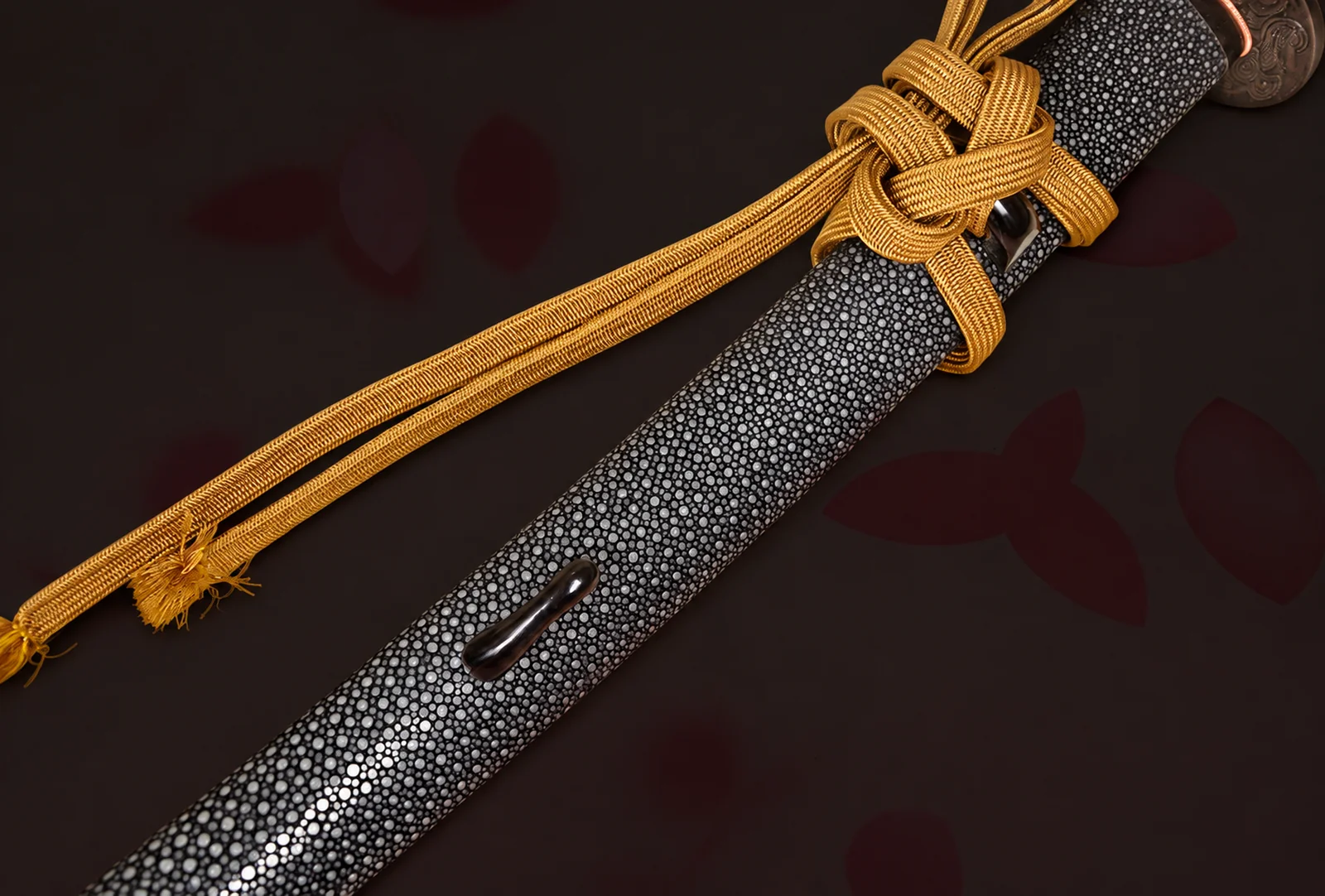
Kōsetsu Samonji katana with a gold-brown handle and black samegawa saya, showing the tied sageo and textured scabbard surface.
Black samegawa with gold-brown sageo.
Detail of the Kōsetsu Samonji black rayskin saya and gold-brown sageo knot near the scabbard opening.
Sageo knot at the saya opening.

THE SAGEO

The Tied Detail

The cord is arranged at the saya with a compact knot and long trailing ends. The close-up shows how the gold-brown sageo sits against the black rayskin texture.

MATERIAL STUDY

Texture at Close Range

The natural rayskin nodules vary in size across the surface. These photographs bring the material itself into focus, beyond the silhouette of the finished scabbard.
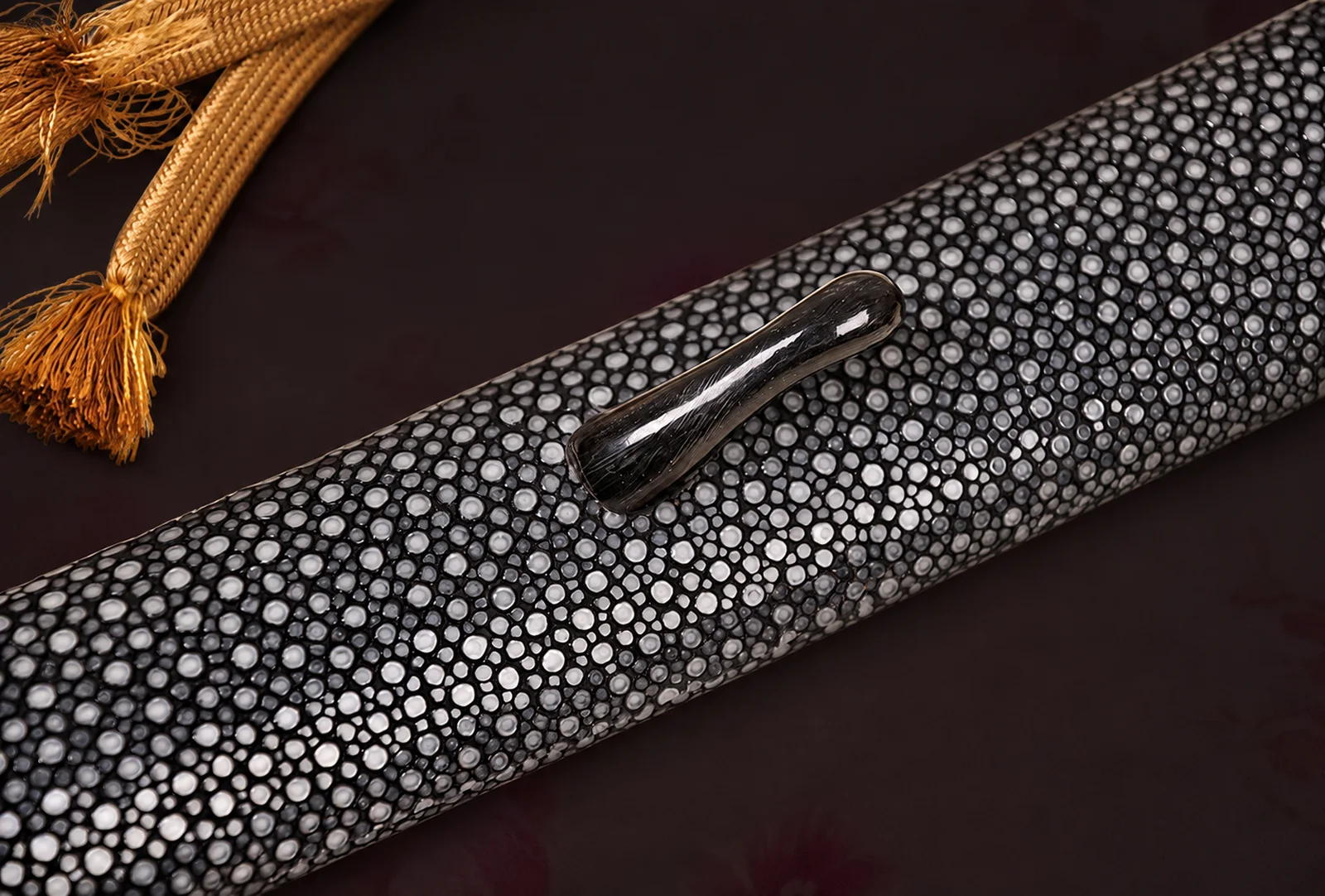
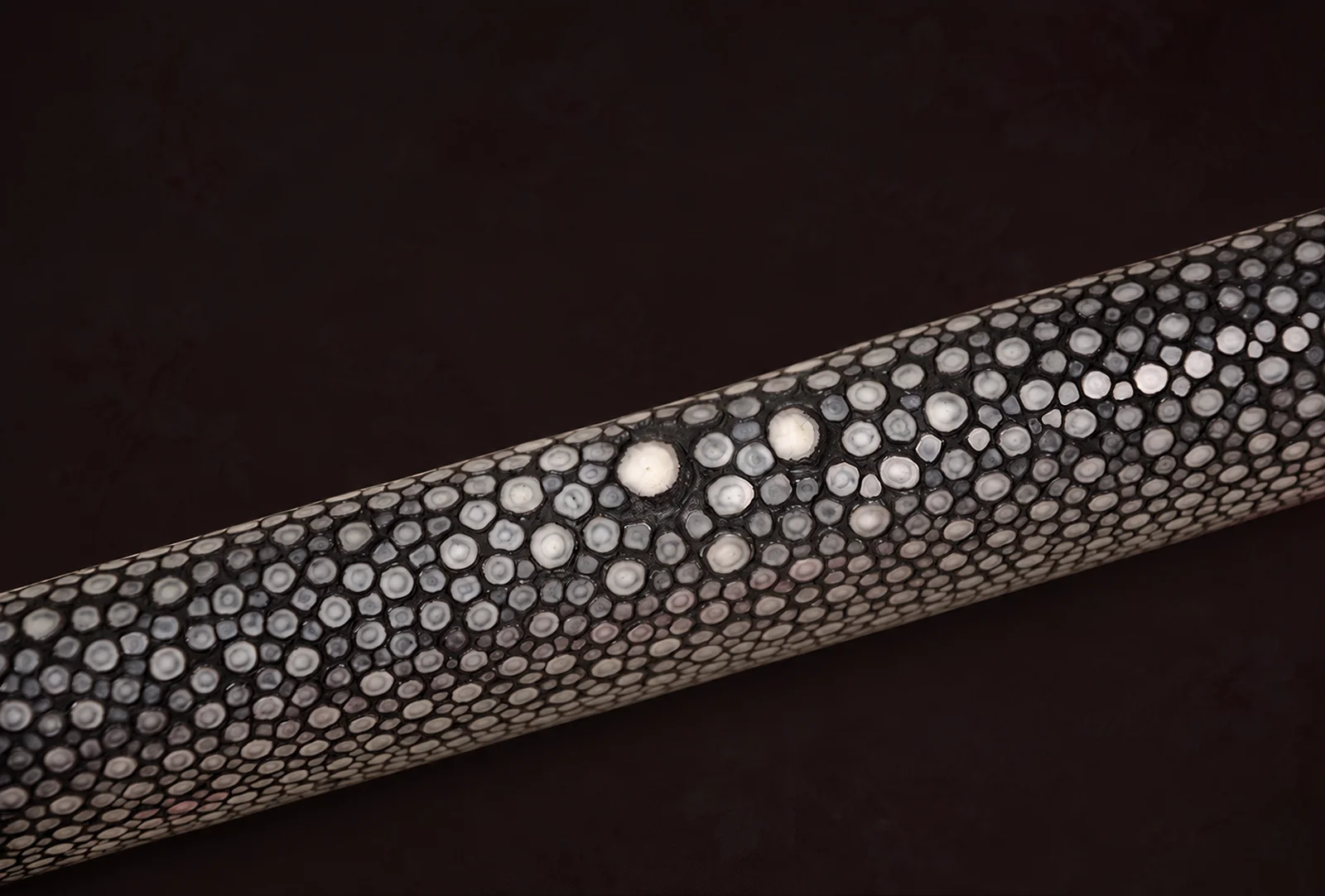
Large close-up of the Kōsetsu Samonji black samegawa saya showing its dense natural rayskin nodules and a scabbard fitting.
Natural rayskin nodules across the saya.
Macro photograph of the Kōsetsu Samonji saya covering with densely packed pale natural rayskin nodes against a dark finish.
A closer view of the samegawa node pattern.

SAYA & CORD

Material & Color

The cord, knot, and black rayskin are shown together here. Their contrast is strongest in the close views: a warm, woven line against the small, irregular nodes of the scabbard covering.
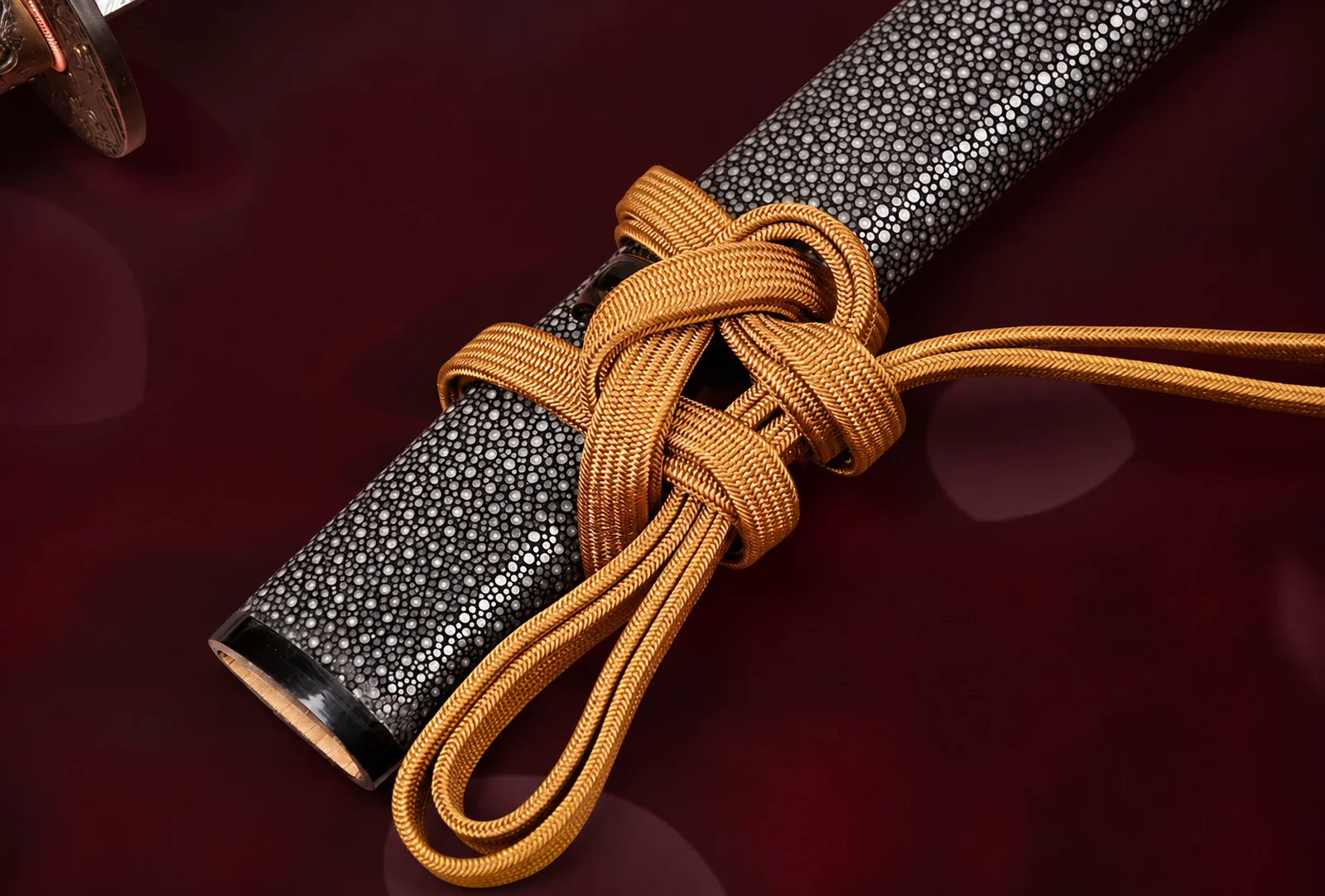
Close-up of a gold-brown sageo knot and cord on the black samegawa saya of the Kōsetsu Samonji katana.
Gold-brown cord against black samegawa.

THE COMPLETE WORK

A Final Full-Length View

The closing view brings the polished blade and its mounting together once more: gold-brown wrapping, dark fittings, and the textured black saya seen as a complete set.
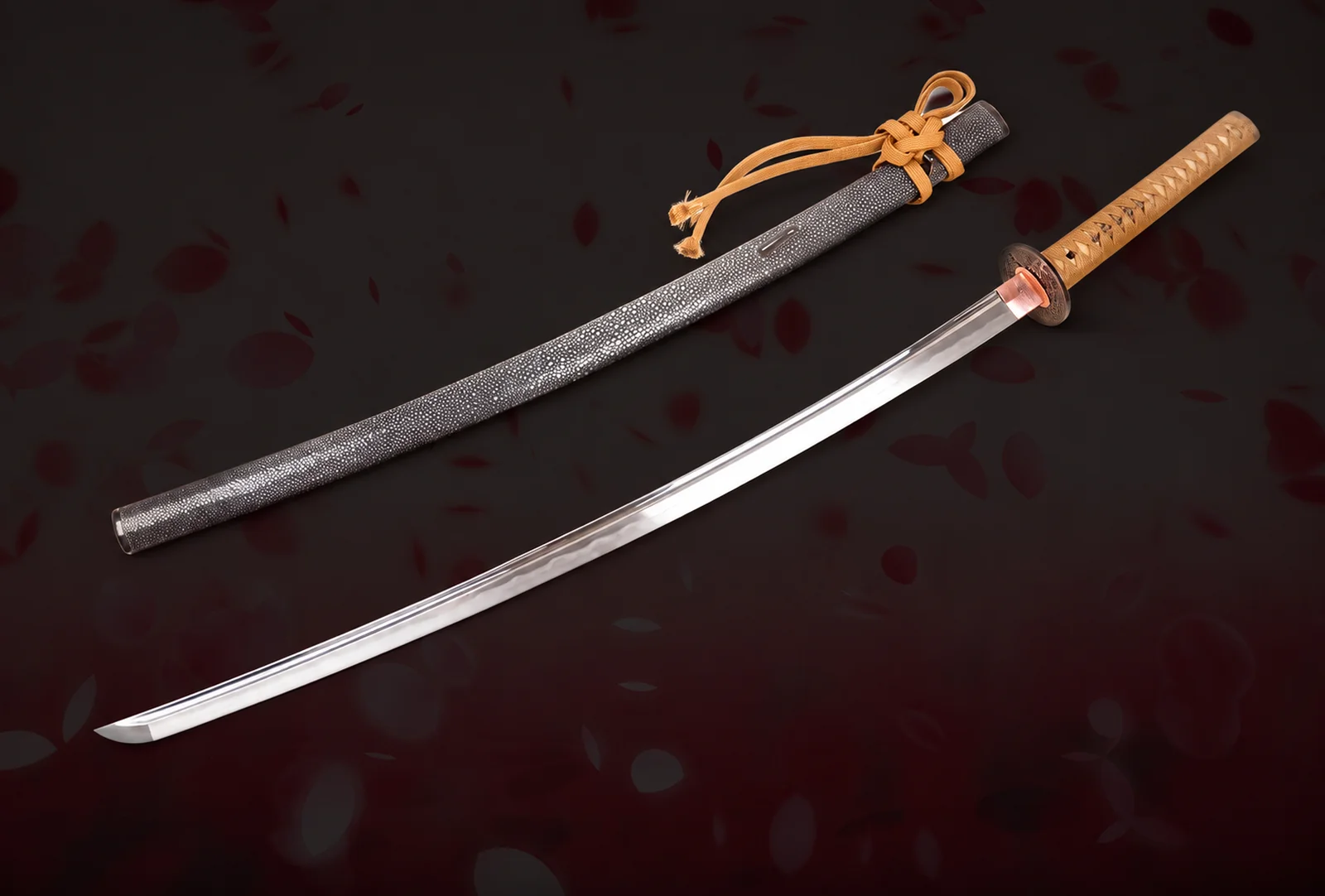
Full composition of the Kōsetsu Samonji katana unsheathed beside its black samegawa saya, with gold-brown handle wrap and sageo on a burgundy background.
The complete katana and saya, shown together.

Rezensionen

Es gibt noch keine Rezensionen.

Schreibe die erste Rezension für „Kōsetsu Samonji Utsushi Katana“

Deine E-Mail-Adresse wird nicht veröffentlicht. Erforderliche Felder sind mit * markiert