Beschreibung
STORY 01 / THE NAME & THE FORM
The Blade Called Onimaru
Onimaru Kunitsuna is one of Japan’s Tenka Goken, the Five Great Swords. Forged by the Kamakura-period swordsmith Awataguchi Kunitsuna, this historic tachi carries a name shaped as much by legend as by the generations who treasured it.
AWATAGUCHI KUNITSUNA / KAMAKURA PERIOD / TENKA GOKEN
THE STORY BEHIND THE NAME
The Dream and the Sword
In the medieval tale Taiheiki, a Hōjō regent is troubled by dreams of a small demon. An old man appears in another dream, speaking as the spirit of Kunitsuna’s sword and asking that its rust be removed.
After the sword is cleaned, it falls and cuts a demon-shaped ornament from a nearby brazier. The nightmares end. From this episode comes the name Onimaru—a story that has followed the blade for centuries.
ONE OF THE FIVE GREAT SWORDS
A Sword Carried Through History
Onimaru Kunitsuna has long been associated with powerful warrior houses, from the Hōjō to the Ashikaga shoguns. Its history reaches beyond any one owner or period.
Today the historic tachi belongs to the Imperial Household collection. Its reputation rests in both the work of Awataguchi Kunitsuna and the stories preserved around the sword.
THE CONTEMPORARY TACHI
A Historic Line, Revisited
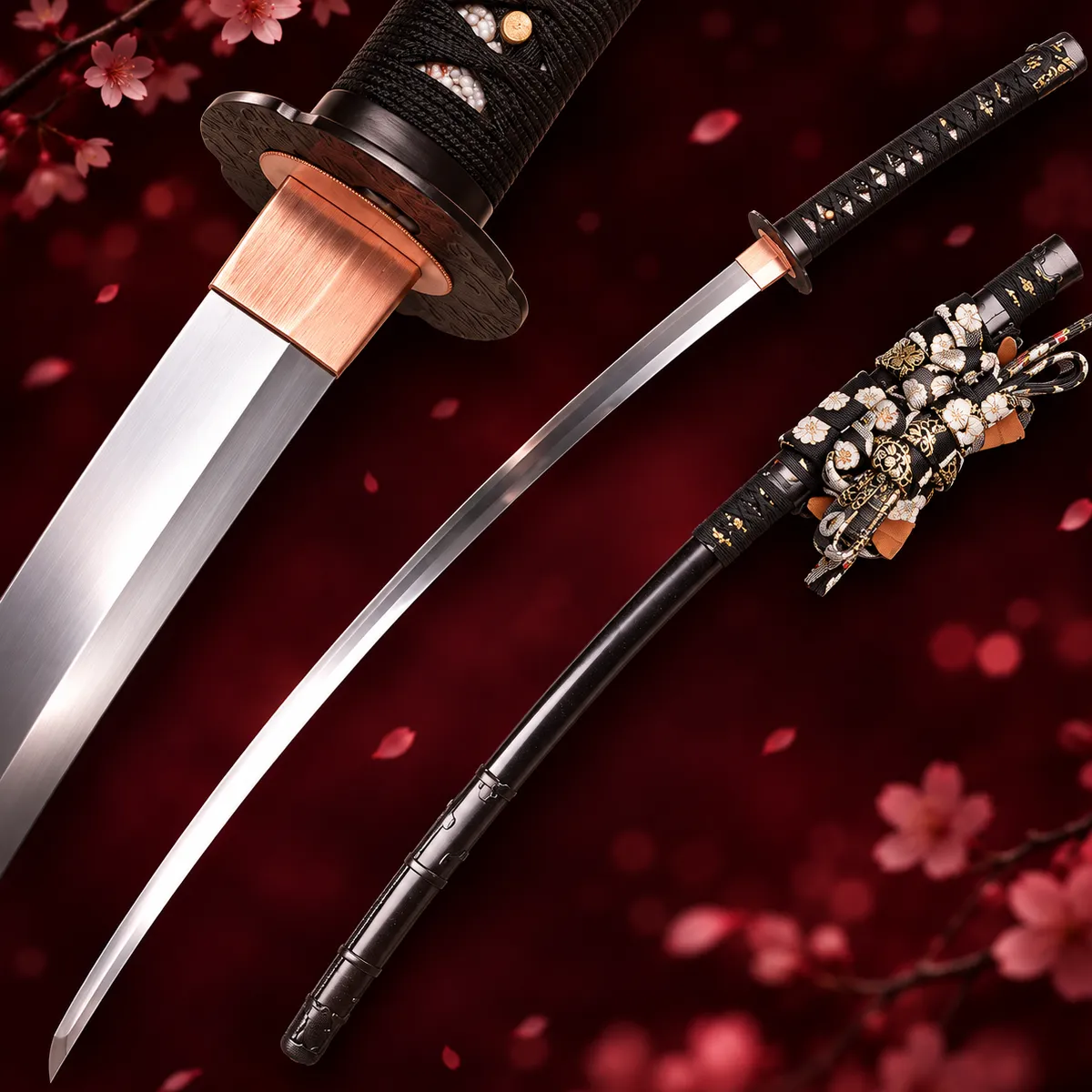
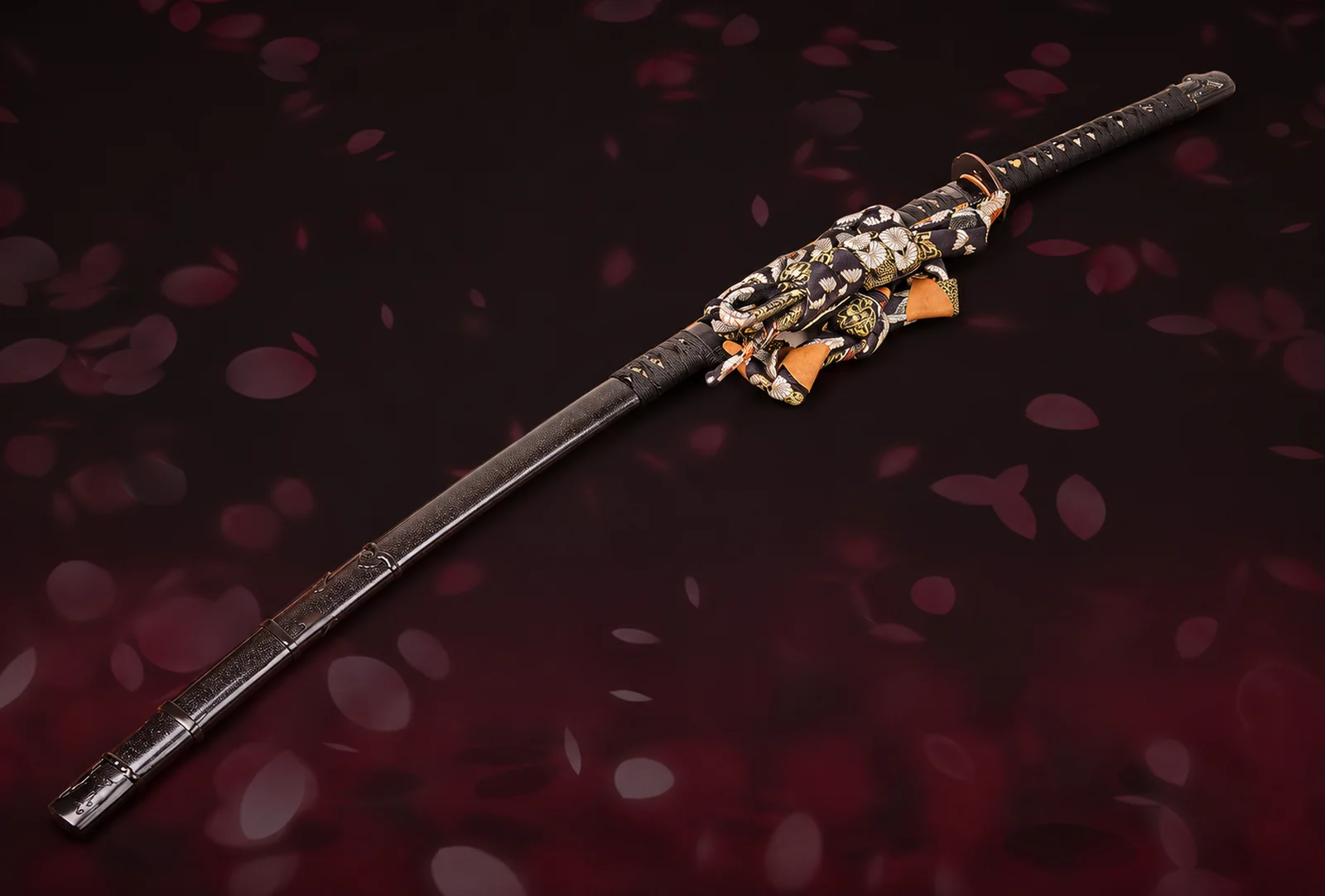
This Onimaru Kunitsuna-inspired work takes the historic sugata as its point of departure. A pronounced curve carries the eye from the hilt toward the tip, while its dark koshirae and black saya create a restrained silhouette. The ornamented tachi cordwork adds a close-up richness to that form.
The next chapter follows the blade itself—its steel, heat treatment, and Japanese-style polish.
NEXT / BLADE CRAFTSMANSHIP — T10 STEEL, CLAY TEMPERING & POLISH
STORY 02 / BLADE CRAFTSMANSHIP
Steel, Curve, and Finish.
The Onimaru Kunitsuna replica tachi is built around a long, pronounced curve. Its 780 mm blade uses T10 carbon steel in Maru construction, with a clay-tempered edge and a Japanese-style polished surface.
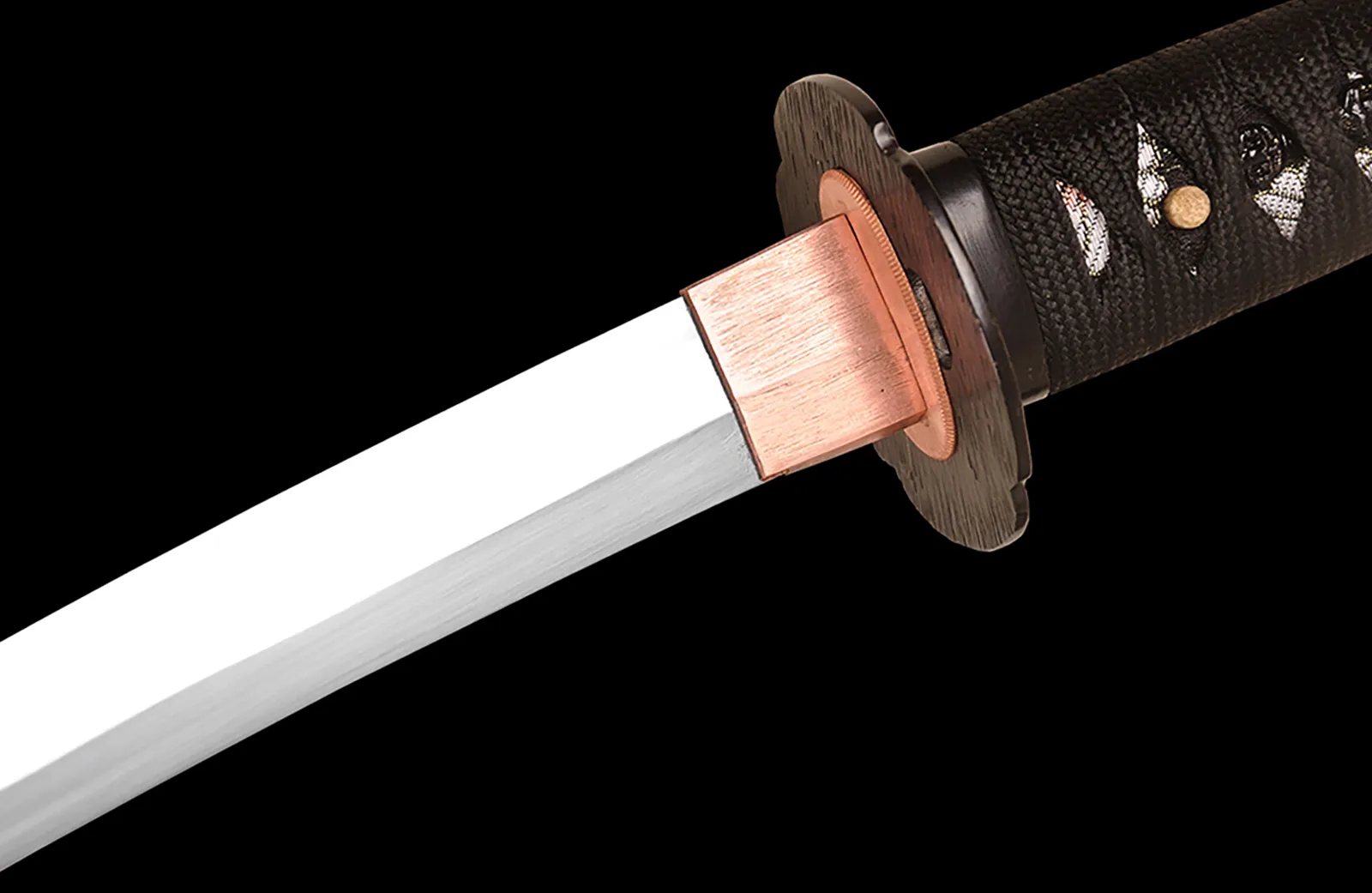
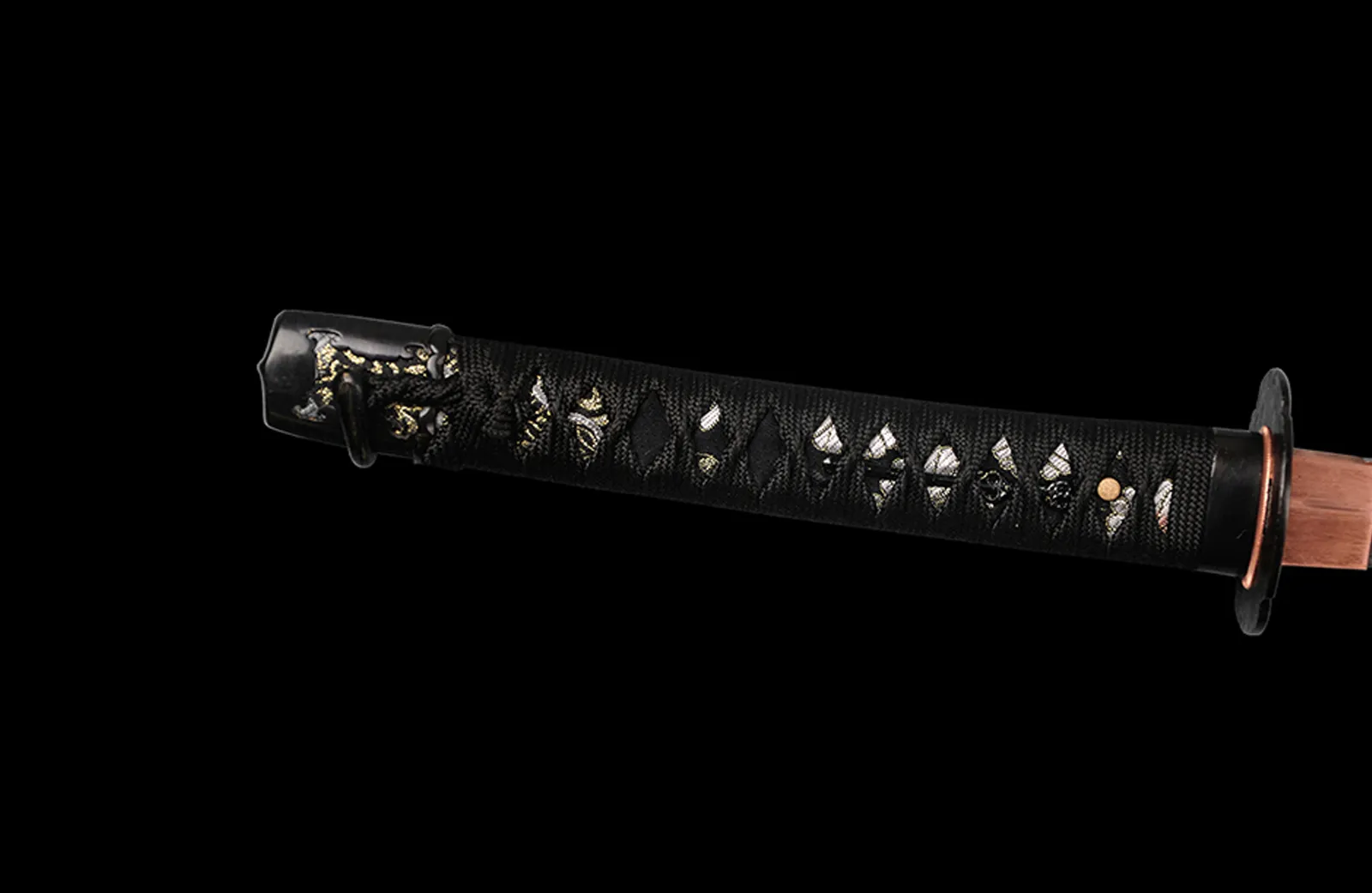
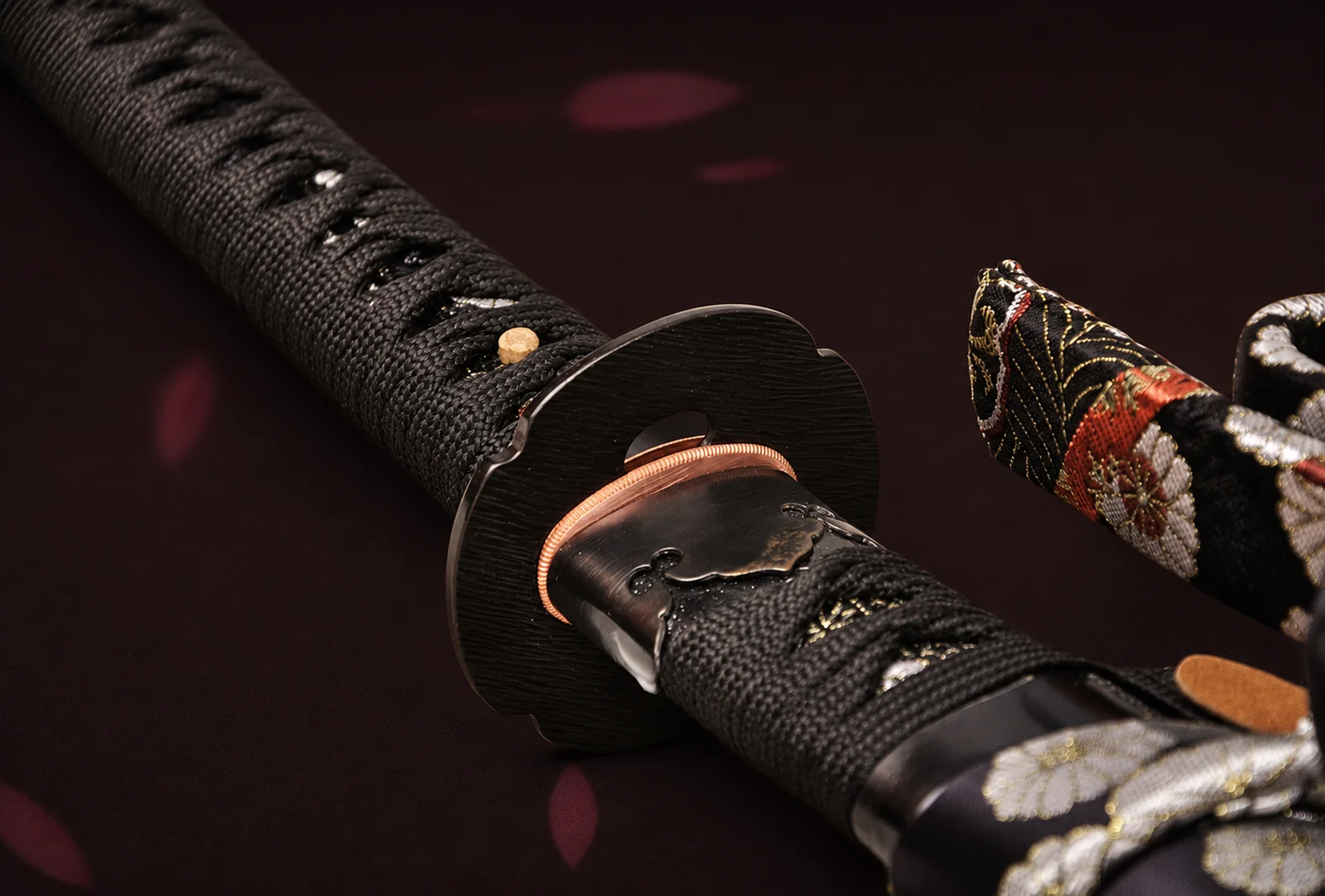
At the base of the blade, the warm copper habaki meets the dark tsuba and black-wrapped handle. These close details frame the blade without distracting from its line.
T10 CARBON STEEL / MARU CONSTRUCTION / 780 MM NAGASA
01 / THE SWORD'S PROFILE
A Curve That Carries the Blade.
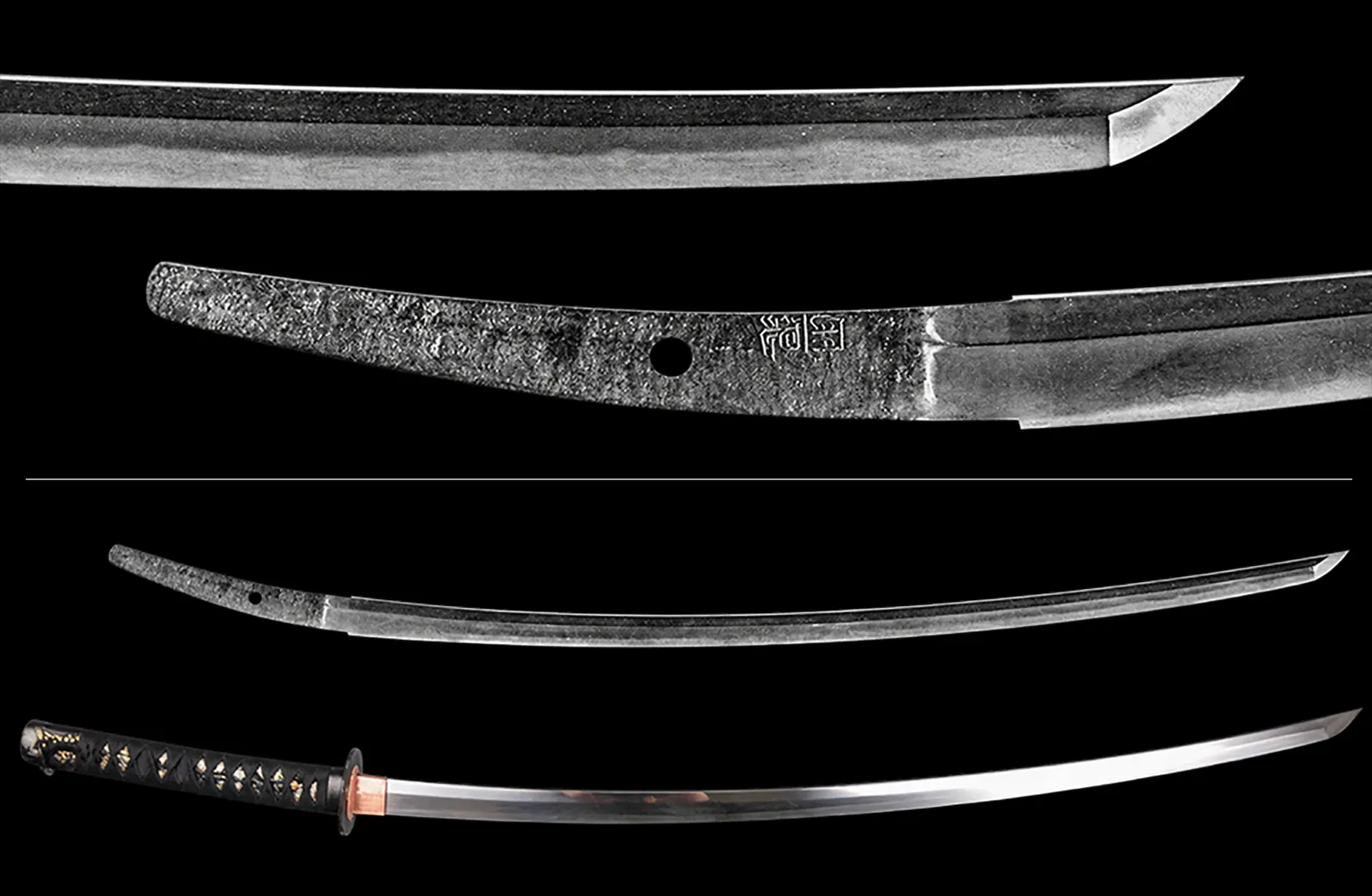
The blade measures 780 mm in length, with 29 mm of width and 7 mm of thickness at its base. A 31 mm sori gives the tachi its distinctive sweep. The curve is evident from the hilt and becomes especially expressive as the blade narrows toward the point.
In the comparison below, views of the historic Onimaru Kunitsuna sit above the contemporary work. The profile study makes the relationship between the long curved blade and its modern interpretation immediately visible.
02 / HARDENING & POLISH
The Finished Steel.
The T10 blade is clay tempered, producing a hamon described as Suguha. The comparatively straight hardened line suits the blade's long, flowing geometry.
Its Japanese-style polish gives the blade a particular balance of light and shadow: a brighter hardened edge, a quieter gray tone across the blade face, and a lively reflection along the ridge.
The workshop video emphasizes the importance of sound foundation work. Flat blade surfaces and crisp geometry allow even a restrained polish to show the form clearly.

03 / THE HANDLE
Texture in the Grip.
The handle introduces a different kind of craftsmanship. Black Nishijin-woven material follows the slight curve of the tsuka, with hishigami paper supports beneath the diamond-patterned wrap.
Seen close up, the woven surface, patterned openings, and dark metal fittings bring a tactile character to the mounting. The copper habaki provides a subtle warm contrast where the handle meets the blade.
04 / THE MOUNTED TACHI
Dark Wood, Woven Ornament.
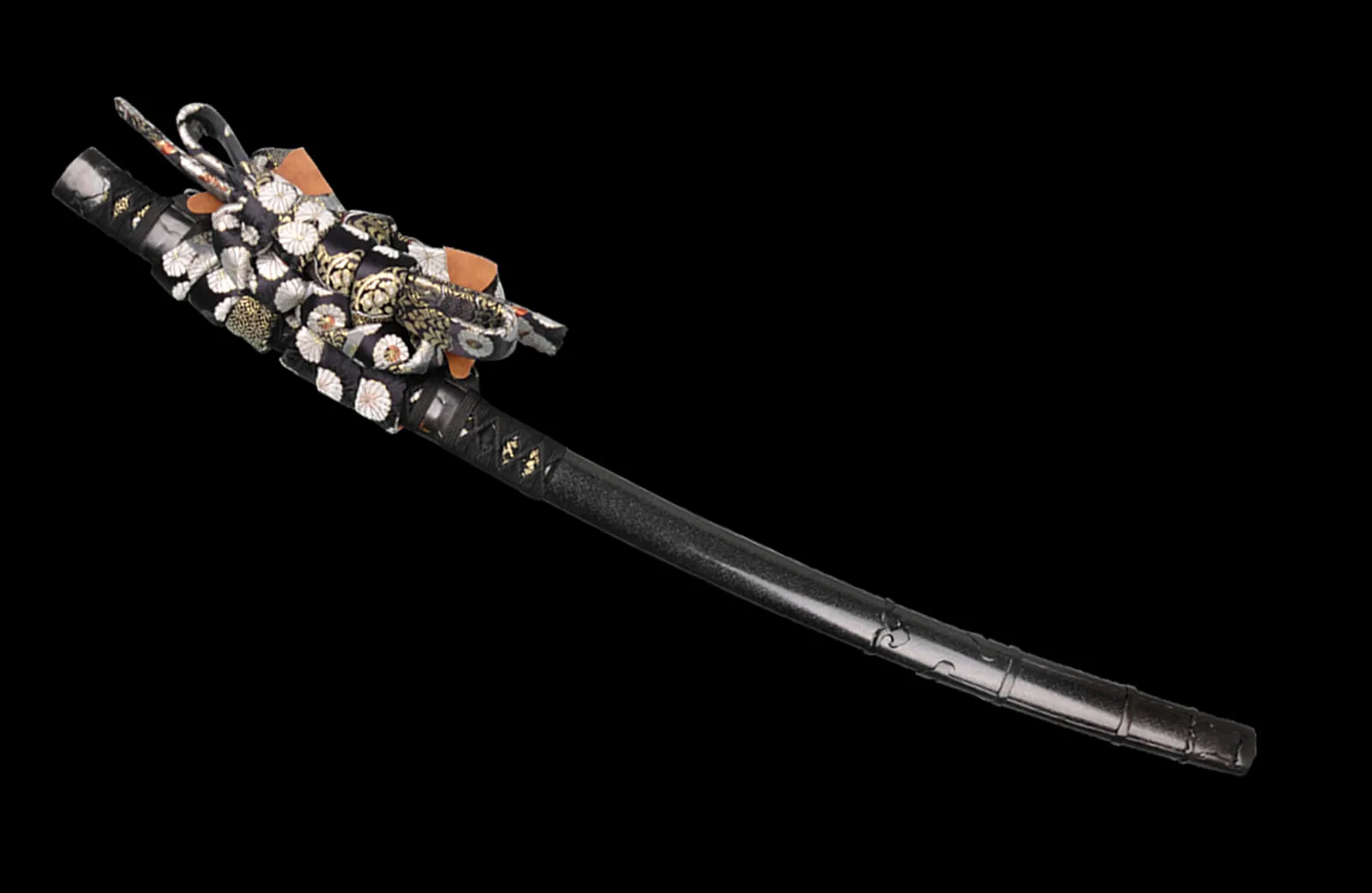
The black lacquered wooden saya follows the curve of the blade. Blackened brass fittings continue the subdued palette, while the decorative tachi cords bring patterned fabric, tight knots, and small accents of color into the finished koshirae.
A CLOSER LOOK AT THE MOUNTING
The Cordwork Up Close.
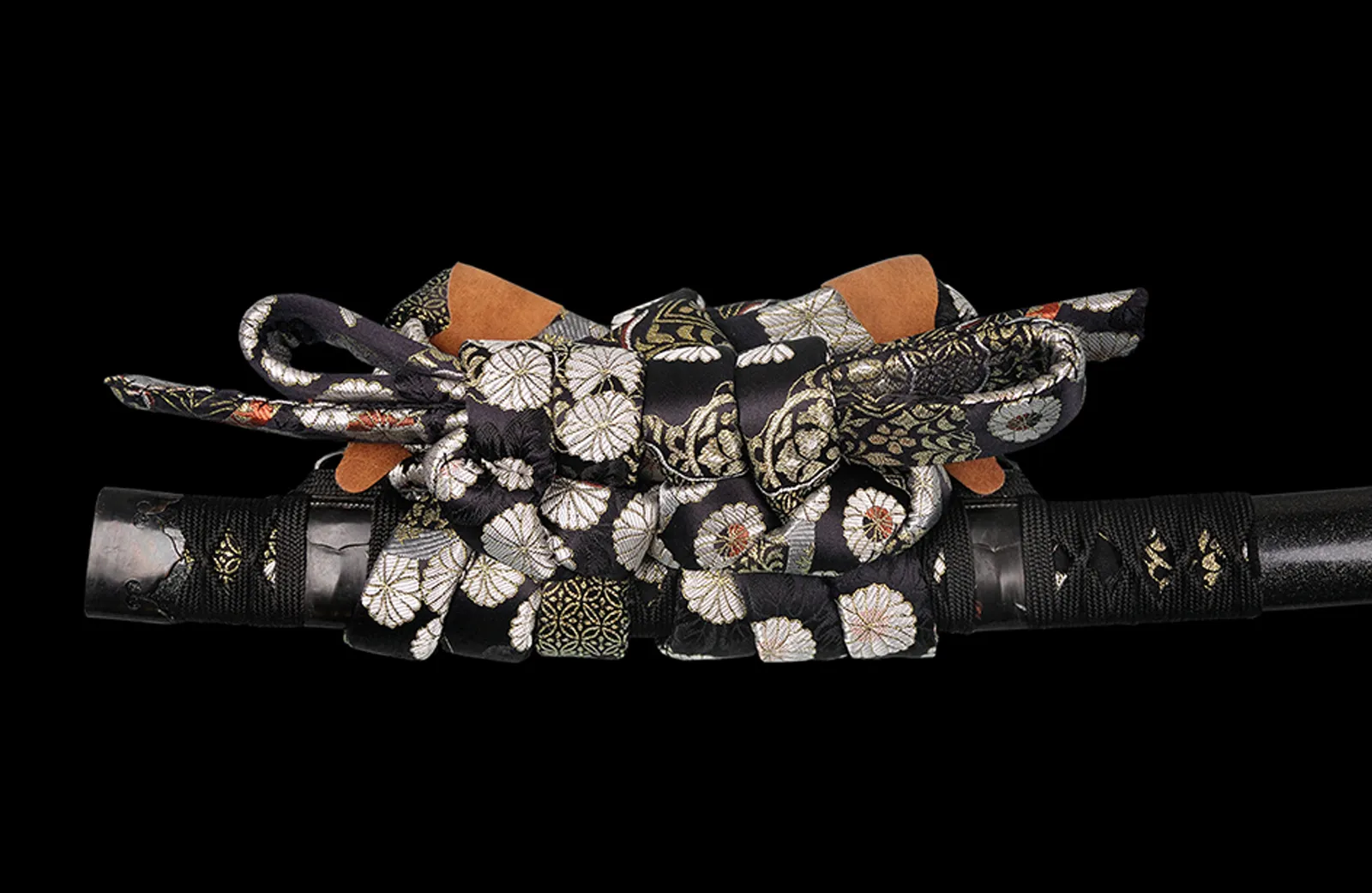
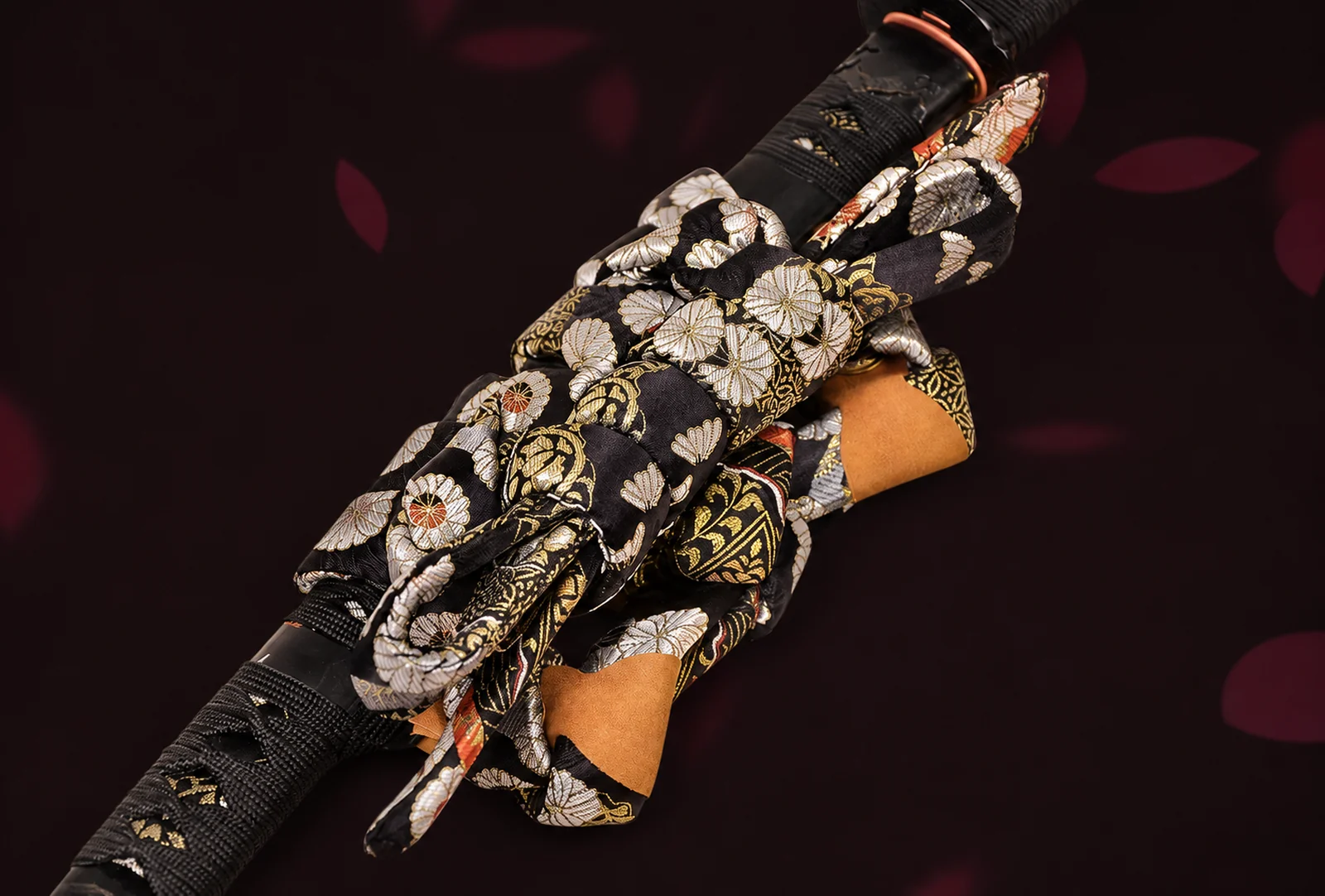
The tachi cord assembly combines floral woven motifs with carefully arranged loops and layered knots. Against the black saya, its cream, gold, and muted orange details become the main decorative focus.
The next Story turns fully to these fittings, the cordwork, and the finished sword as a complete piece.
NEXT / THE KOSHIRAE — BLACKENED BRASS, NISHIJIN WEAVING & TACHI CORDS
STORY 03 / THE TACHI KOSHIRAE
The Blackened Tachi Koshirae.
A deep black scabbard, finely patterned cordwork, and metal fittings finished in dark tones give this tachi a distinct character even before the blade is drawn.
The visual rhythm is in the details: the sweep of the saya, the restrained blackened brass, and small flashes of cream and gold woven through the suspension cords.
01 / THE SHEATHED FORM
A Line Defined by the Saya.
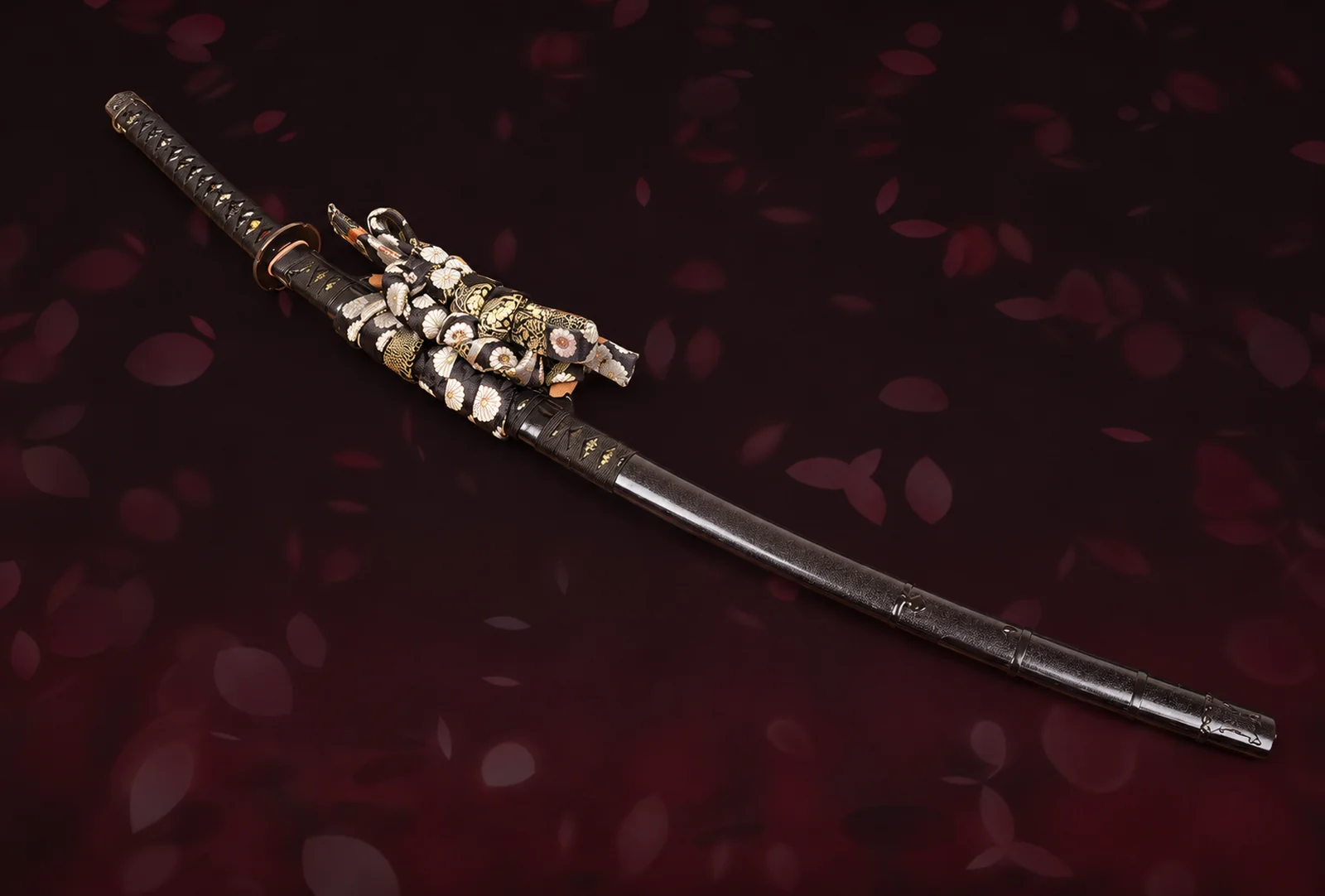
With the sword sheathed, the curve of the black wooden saya becomes the dominant line. The lacquered surface reads almost as a silhouette, allowing the fittings and cordwork to emerge as accents rather than competing ornaments.
The reverse view reveals how the end fitting, cord arrangement, and wrapped handle sit along that continuous curve.
THE HILT
Woven Texture at the Handle.
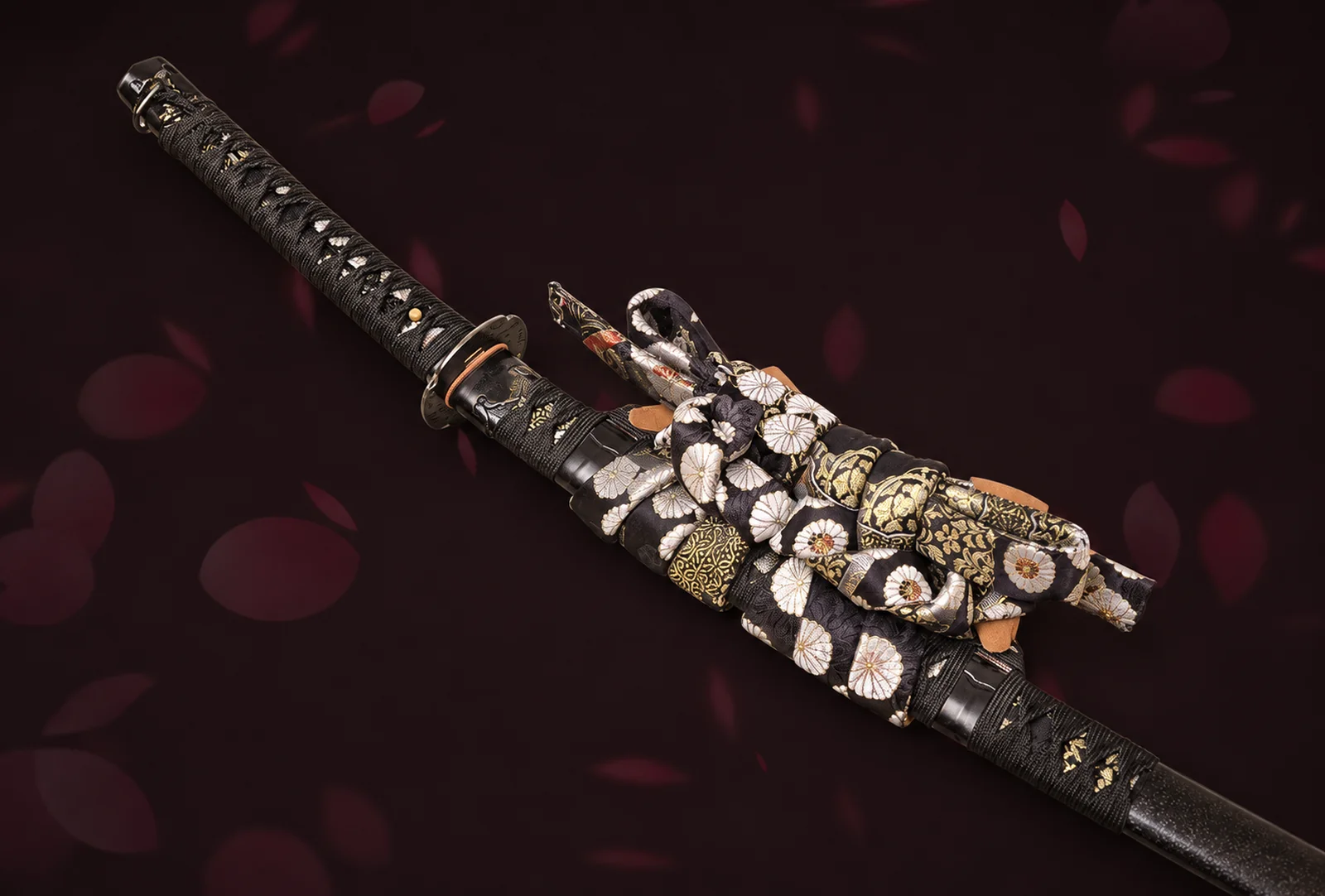
The grip is wrapped with black Nishijin-woven fabric. Its tightly worked diamond openings reveal the texture beneath, while small hishigami paper supports help maintain the regular pattern.
The woven wrap and curved handle give the hand a clear sense of orientation without overwhelming the slender form of the sword.
02 / DARK METALWORK
Blackened Brass in Close View.
The fittings are brass with a blackened finish. Their dark surface is not visually flat: relief, polished edges, and areas of reflected light reveal the different shapes in the metalwork.
The workshop refined its brass selection and blackening process to achieve the deeper, more consistent appearance seen on this mounting.
KASHIRA & FINISH
The Detail at the End of the Grip.
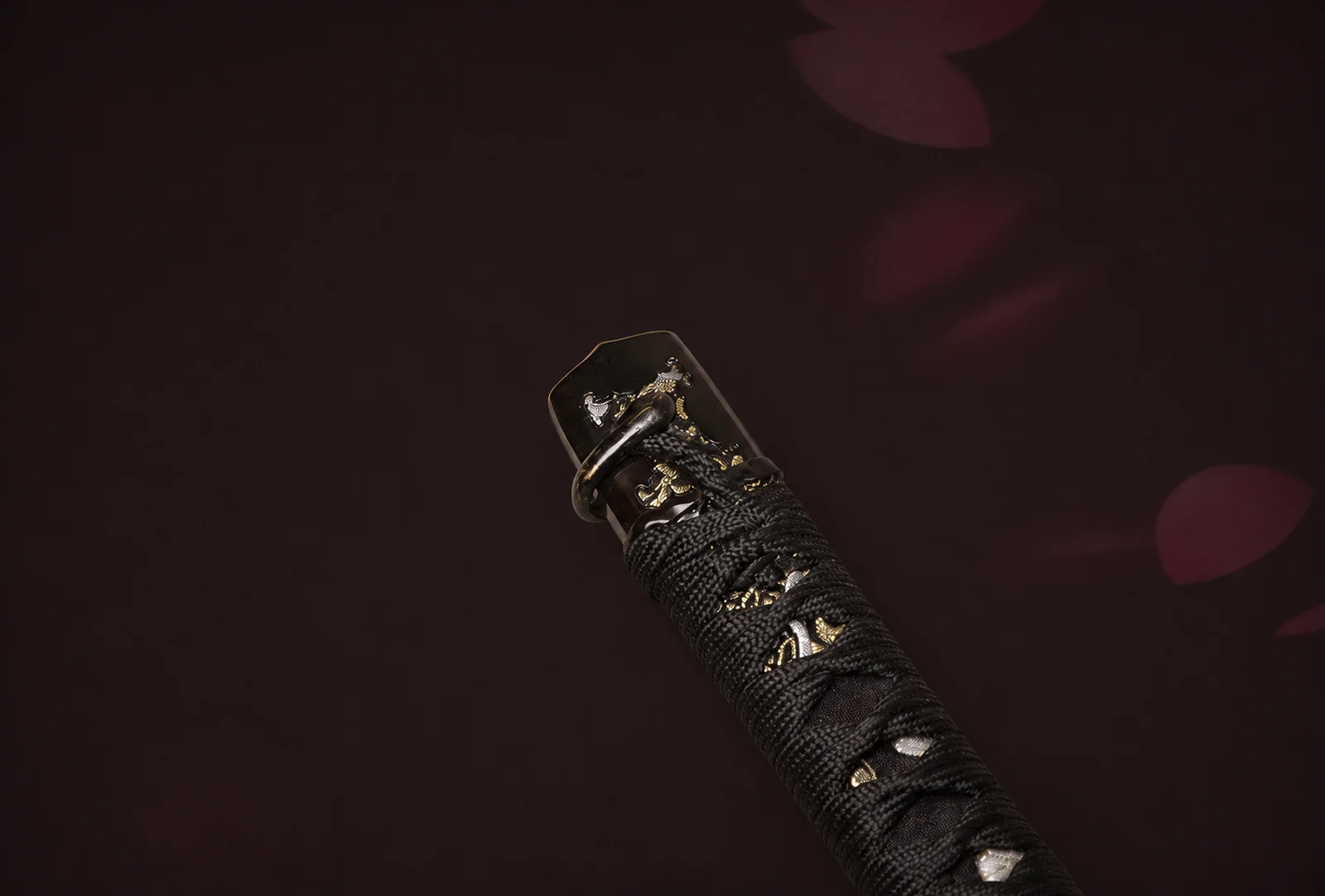
The end fitting continues the same dark-metal palette. In close view, small raised motifs and the black fabric around them give the handle a concentrated, finely worked finish.
The contrast comes from texture as much as from color.
WRAP & FITTINGS
Materials That Meet at the Hilt.
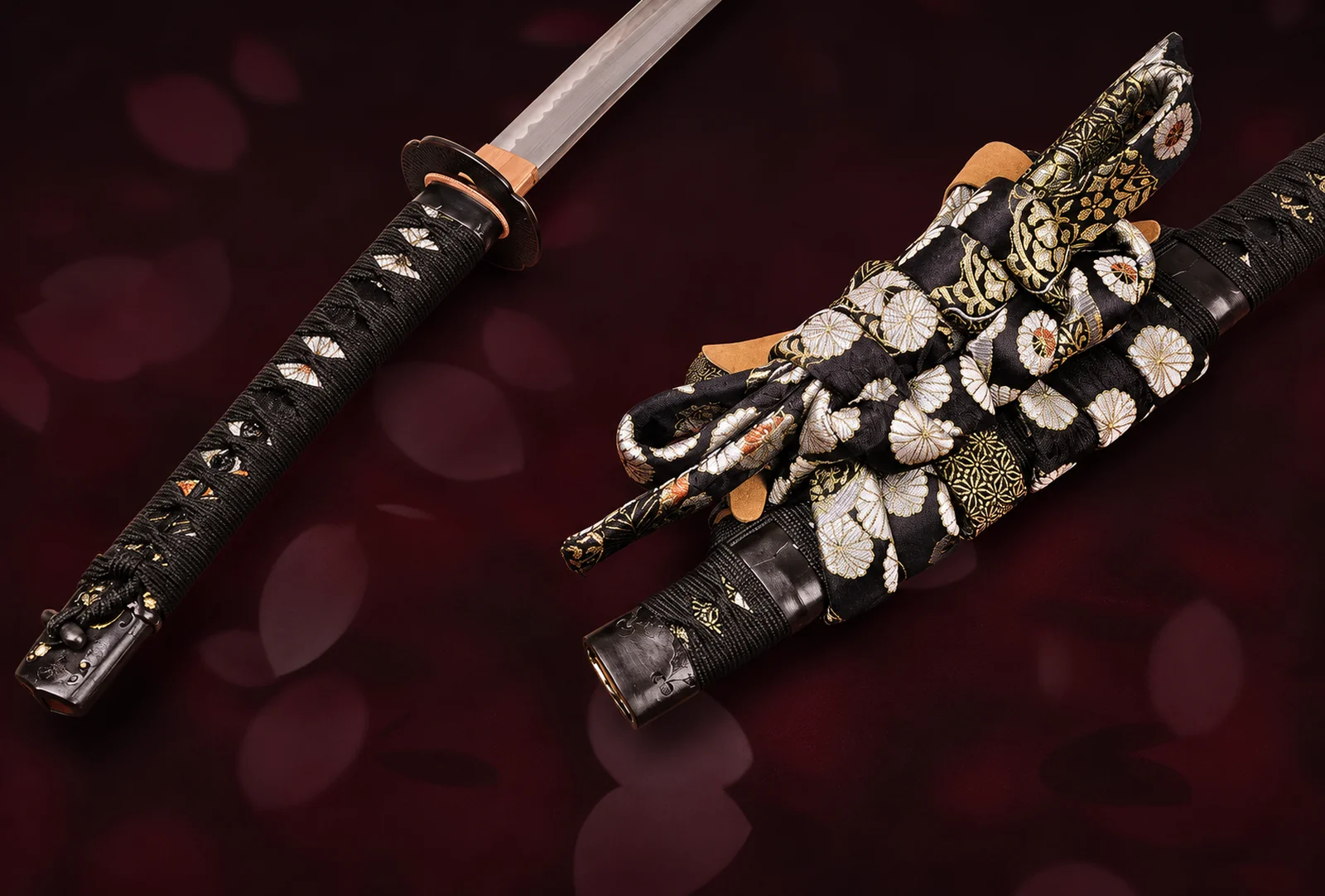
The tsukamaki, metal fittings, and suspension arrangement are tightly grouped around the hilt, yet each element remains legible. Cream-colored floral motifs soften the dark mounting, while the metallic accents add definition.
This balance between woven ornament and restrained metalwork gives the sword its signature black-and-gold character.
03 / THE TEXTILES & THE SAYA
The Cordwork Has Its Own Pattern.
The floral-patterned suspension cords bring movement to the otherwise quiet sheath. Layered loops, firm knots, and alternating light and dark sections make the textile work a visible part of the koshirae.
Against the matte black and lacquered surfaces, the woven flowers stand out without losing the overall subdued palette.
SCABBARD DETAIL
The Dark Finish Continues.
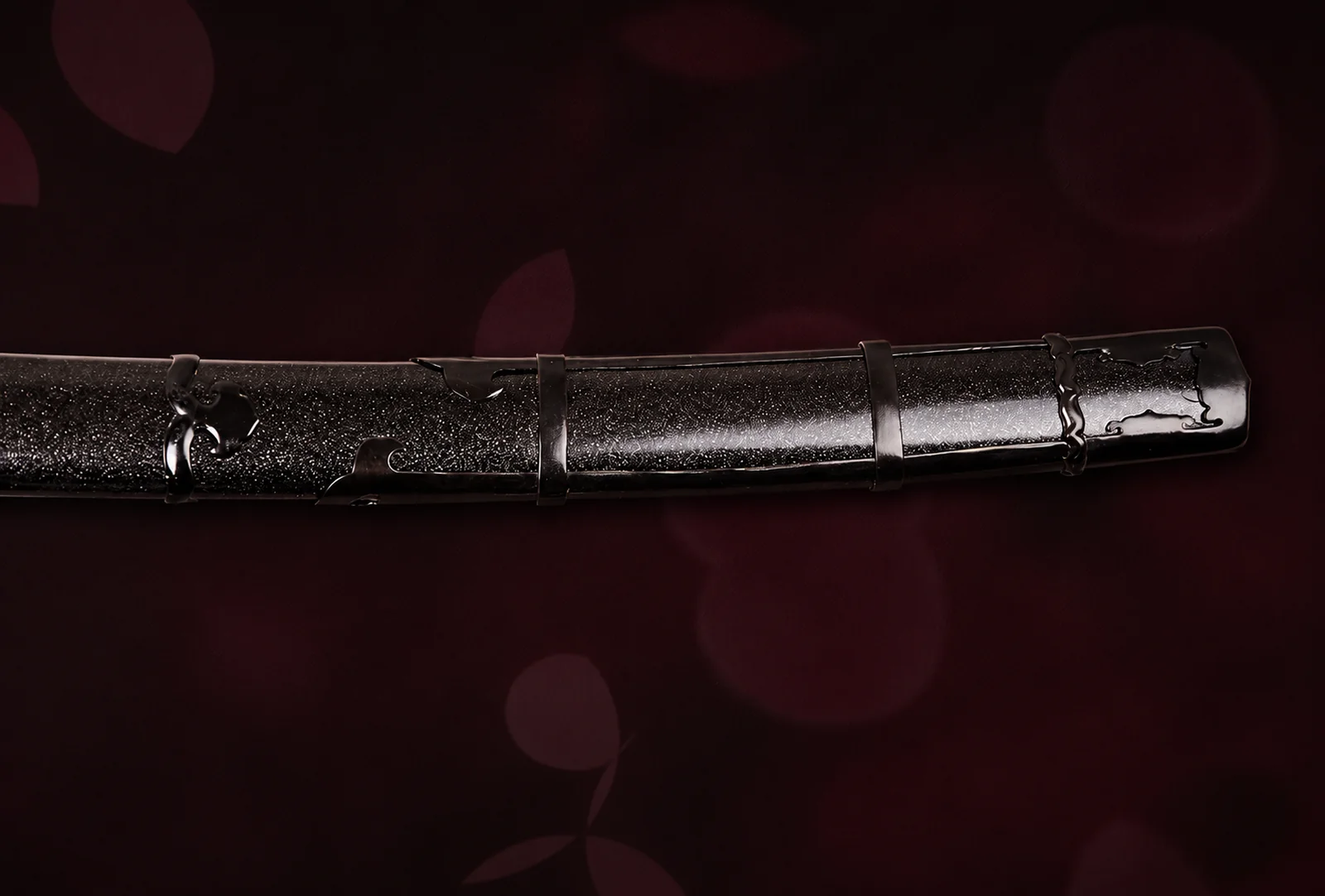
The wooden scabbard is finished in black lacquer, with dark metal accents continuing toward the tip. The narrow end fitting is shaped to complete the line rather than draw attention away from it.
Viewed close up, the changes between lacquer, metal, and light are subtle but deliberate.
04 / DRAWN & SHEATHED
Two Views of One Finished Tachi.
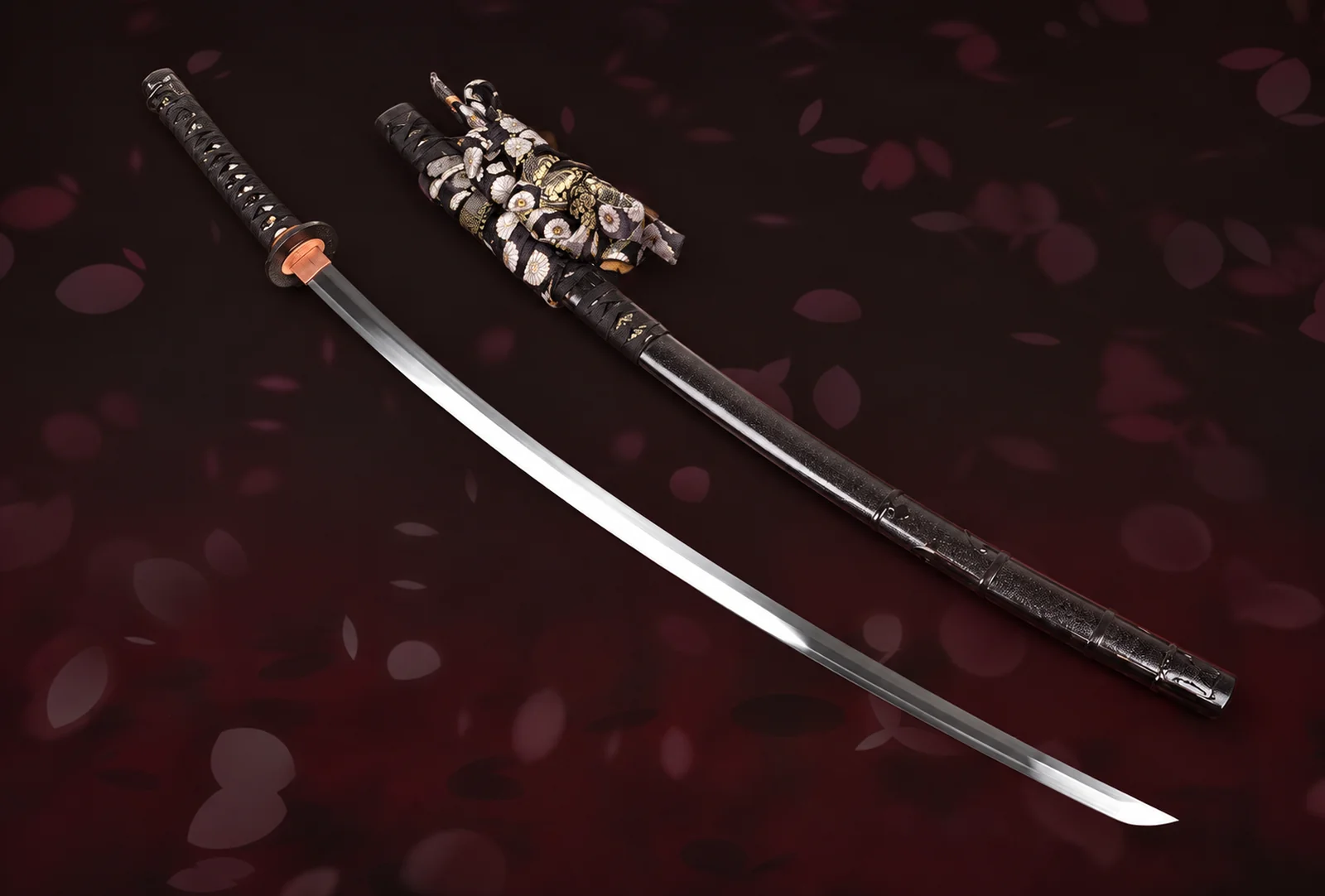
The sword changes character when drawn. The blade is clean and bright; the sheathed mounting is dark and densely detailed. Side by side, they reveal how the steel and the mounting complement each other.
The last views move between the complete sword and the small transitions where blade, handle, and scabbard meet.
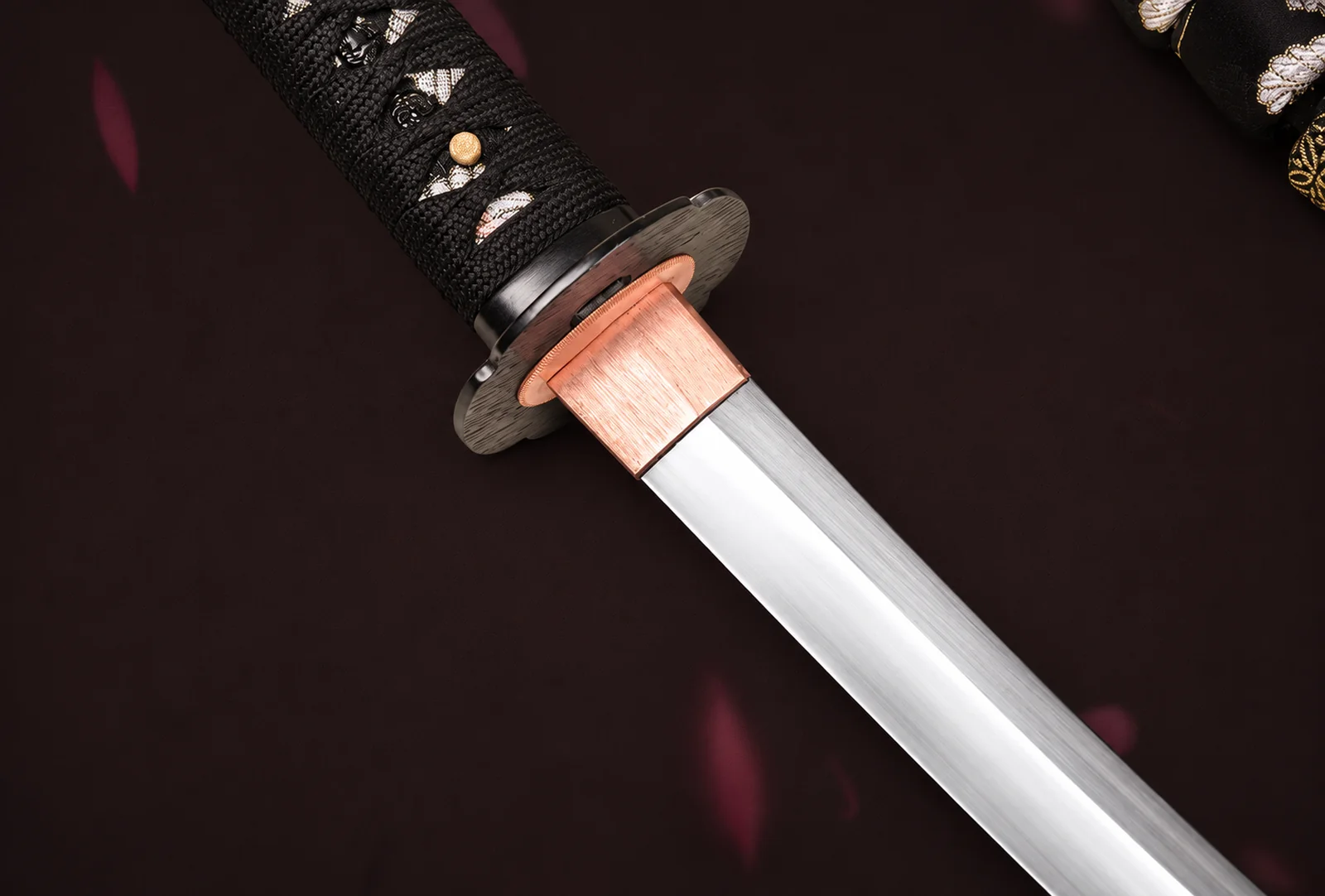
AT THE BLADE BASE
Copper Against Blackened Metal.
The copper habaki provides a warm, distinct edge between polished steel and dark guard. It is a small but visually important junction where the materials of blade and mounting come together.
The black handle and dark guard make that copper tone particularly clear.
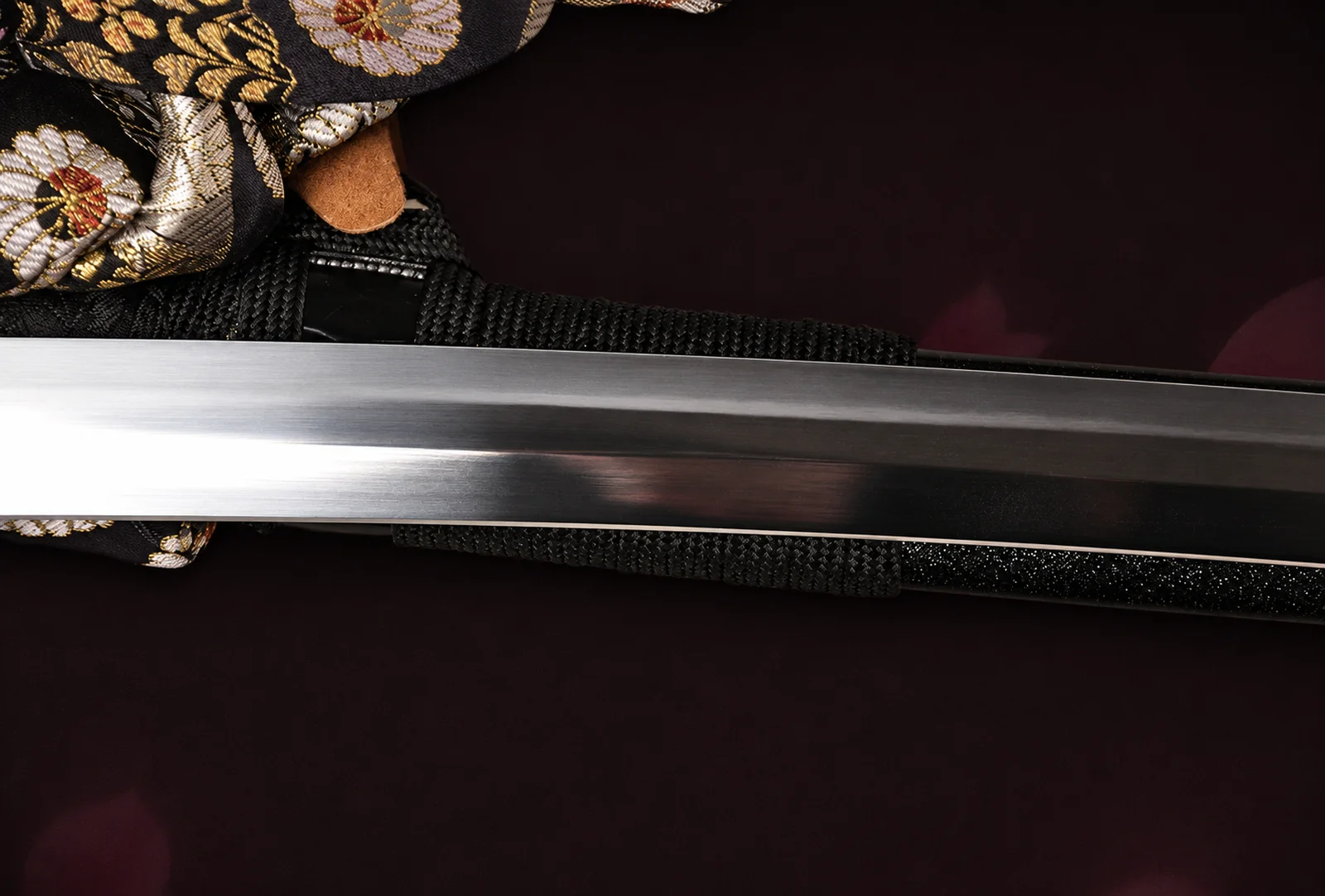
STEEL & ORNAMENT
A Different Balance in Close View.
Across the decorated mounting, the blade becomes a long band of reflected light. The polished steel and patterned textile sit close together, but their surfaces retain their own clarity.
These details are best appreciated at different distances, from the single metal joint to the whole curved silhouette.
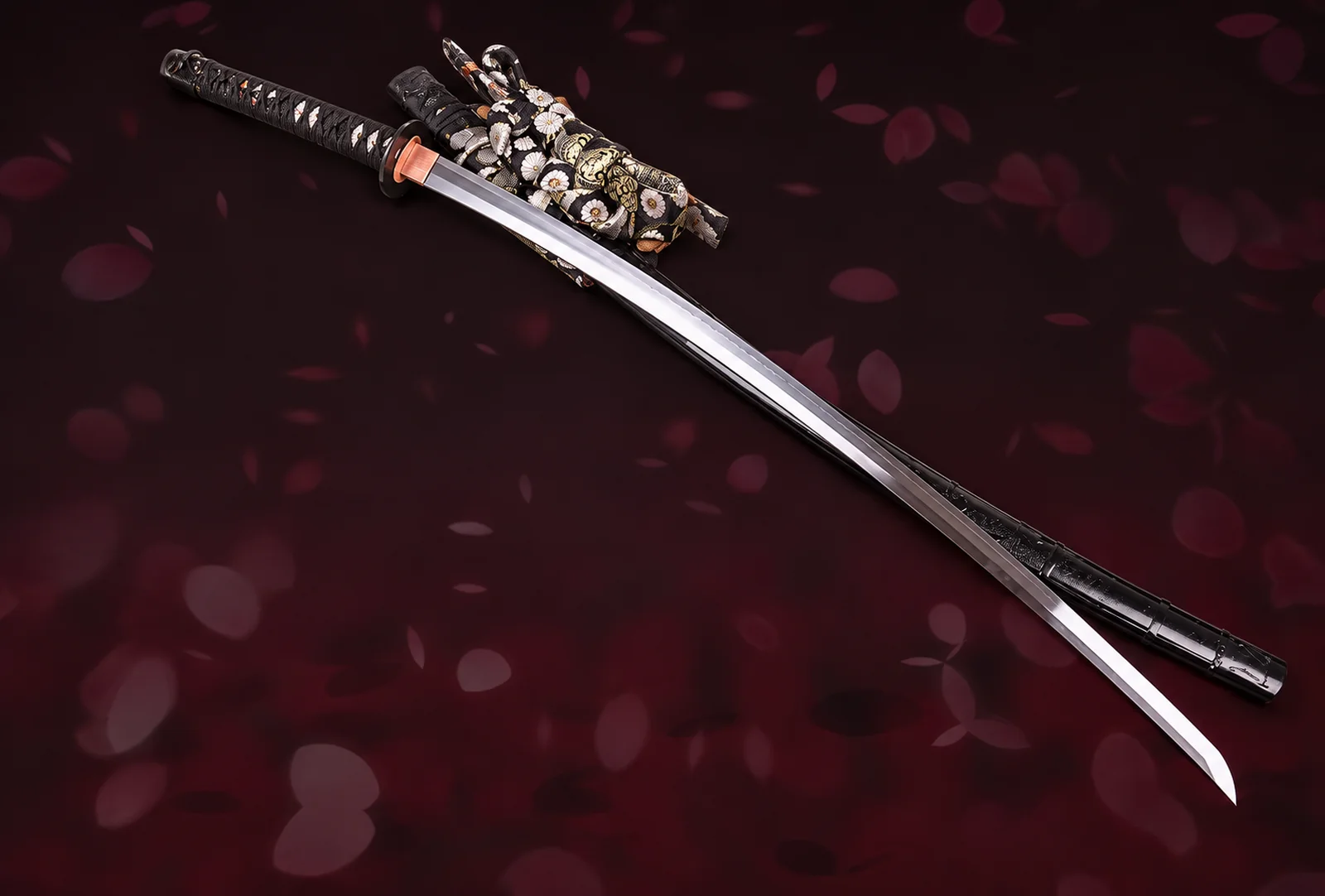
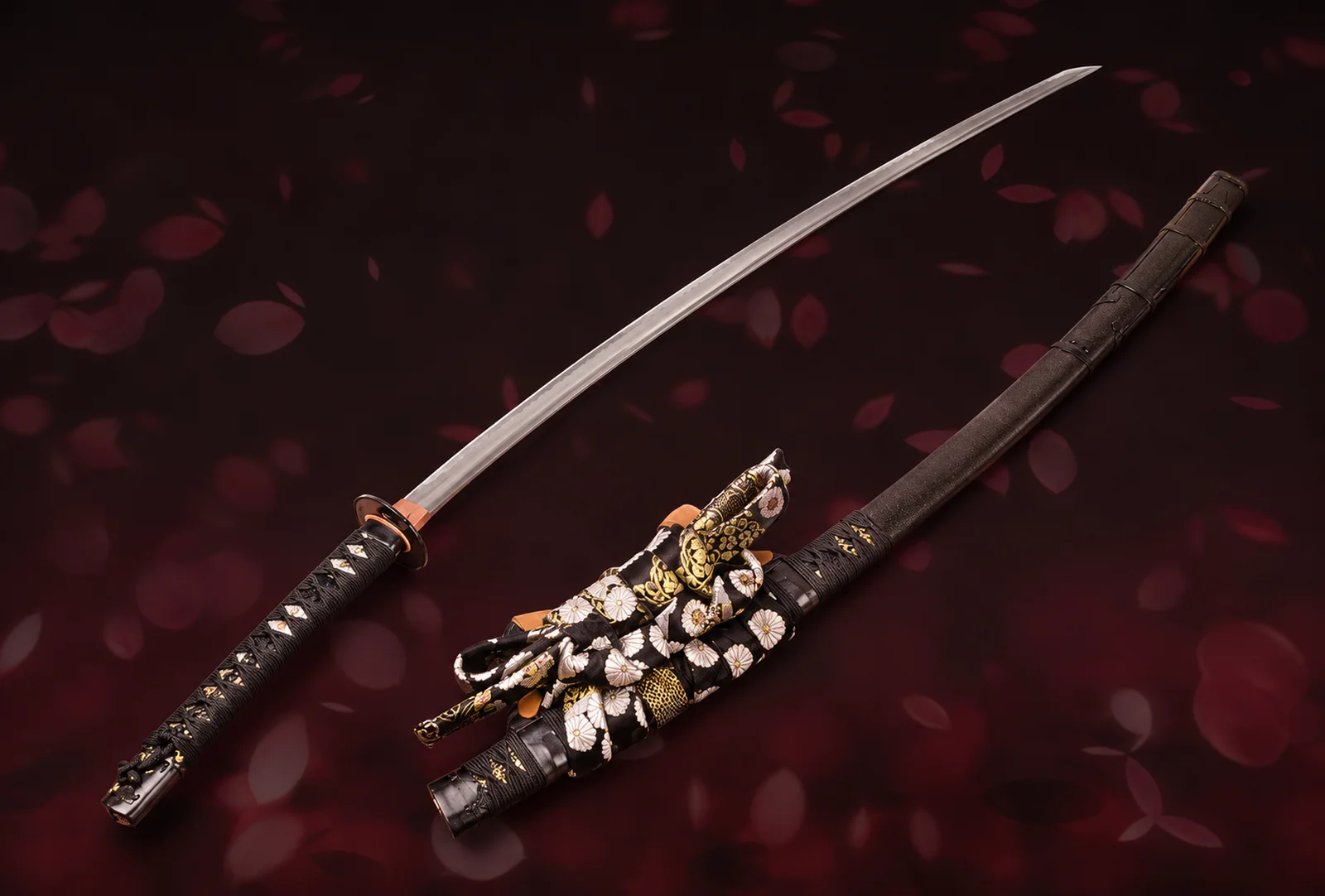
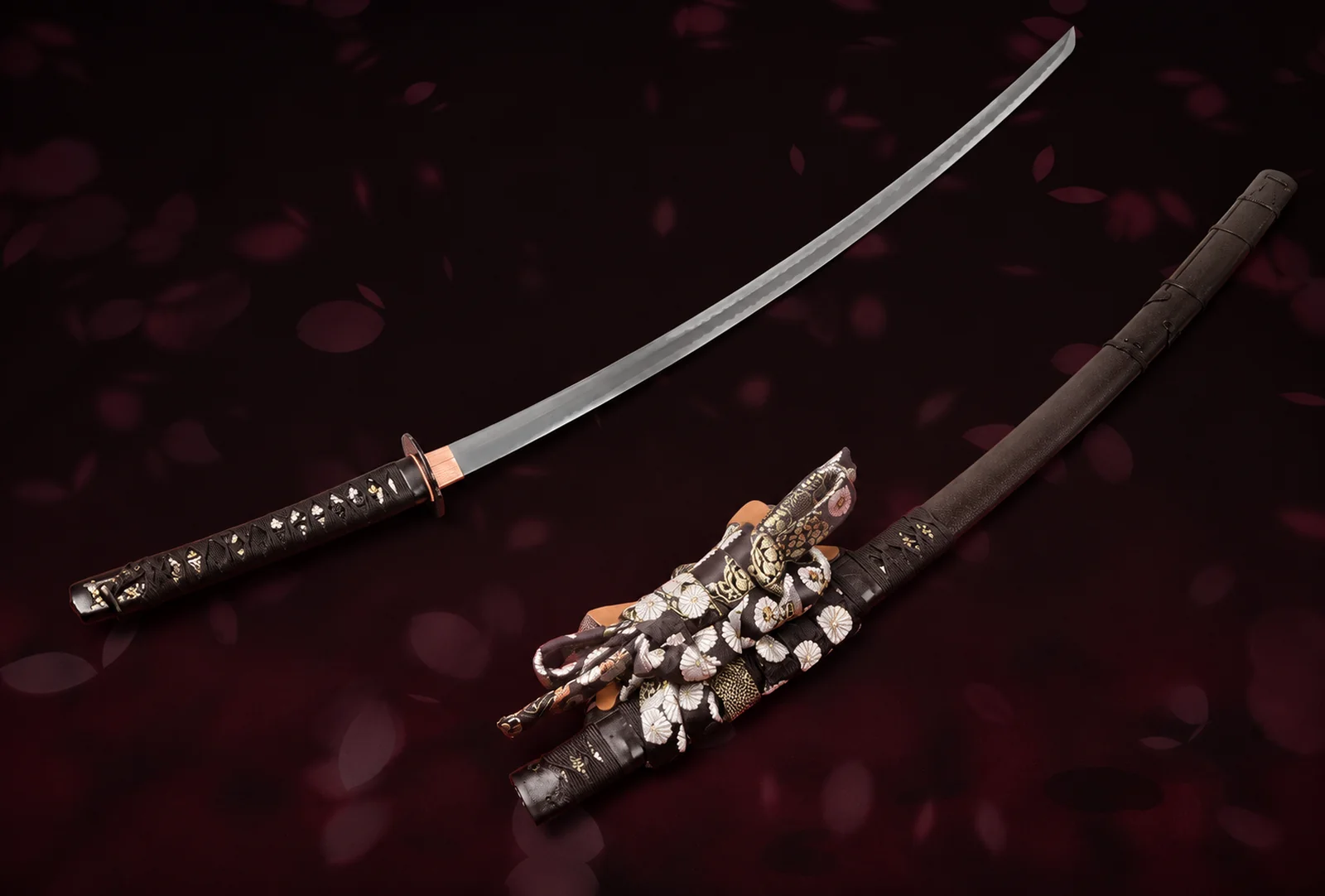
FINAL VIEW
The Complete Presence.
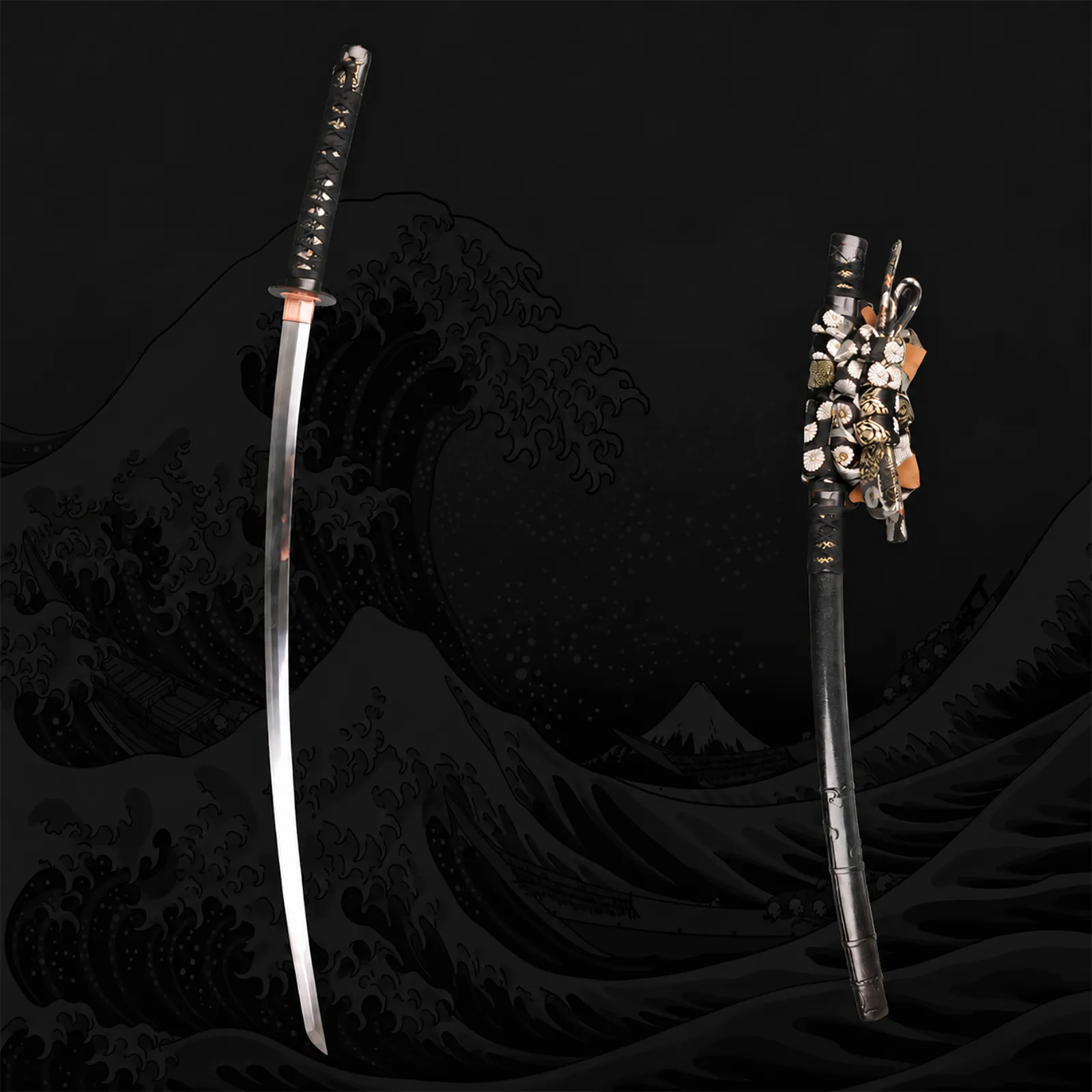
In the final composition, the full curve of the blade appears alongside the dark sheath, woven cords, and blackened fittings.
It is a design with a quiet silhouette and a wealth of detail at closer range—one finished tachi, appreciated in two complementary forms.
ONIMARU KUNITSUNA / THE FINISHED MOUNTING
Blackened brass, woven floral cordwork, a lacquered saya, and the long sweep of a drawn blade: the character of the tachi rests in the way these details are brought together.
Rezensionen
Es gibt noch keine Rezensionen.