QUIET CRAFTSMANSHIP · LONGQUAN

Ukiyo — Mikazuki Munechika Replica Tachi

¥2,398.00

WORKSHOP NOTES

The blade itself is difficult to make, and fitting the mountings is even more demanding.

One reason is that the blade was made to closely follow the proportions of Mikazuki Munechika.

That makes the blade more challenging to produce.

The mounting assembly is particularly demanding.

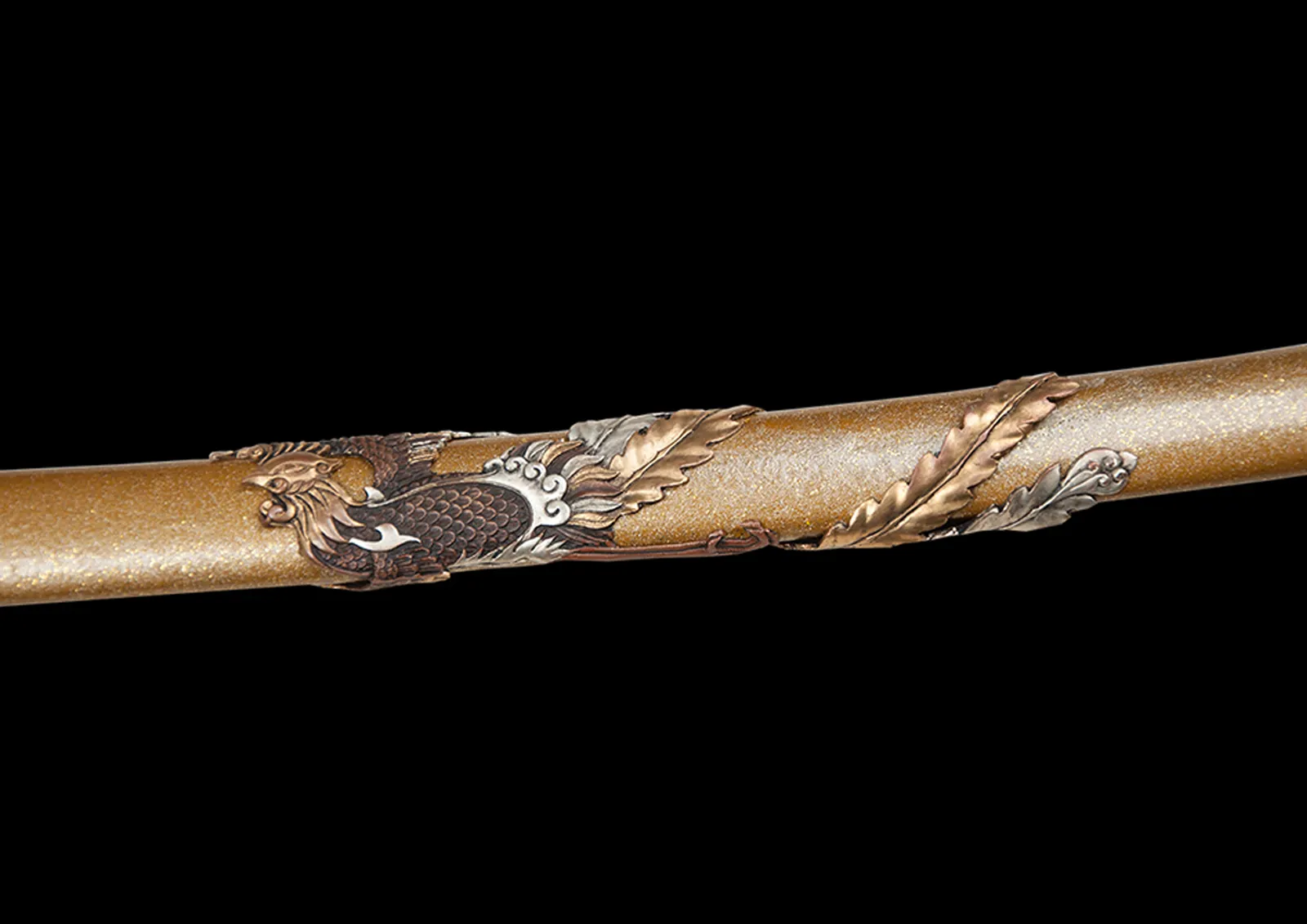
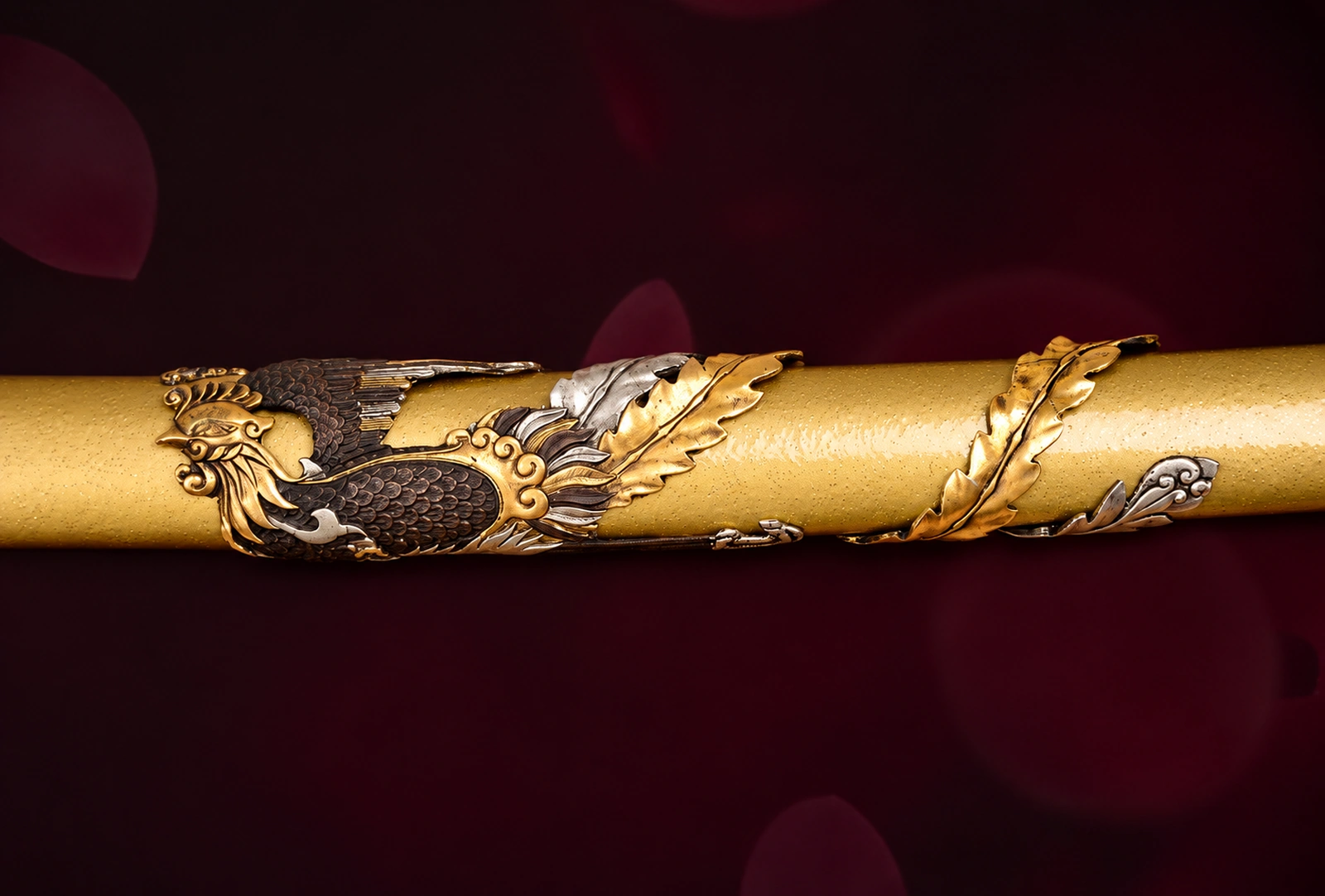
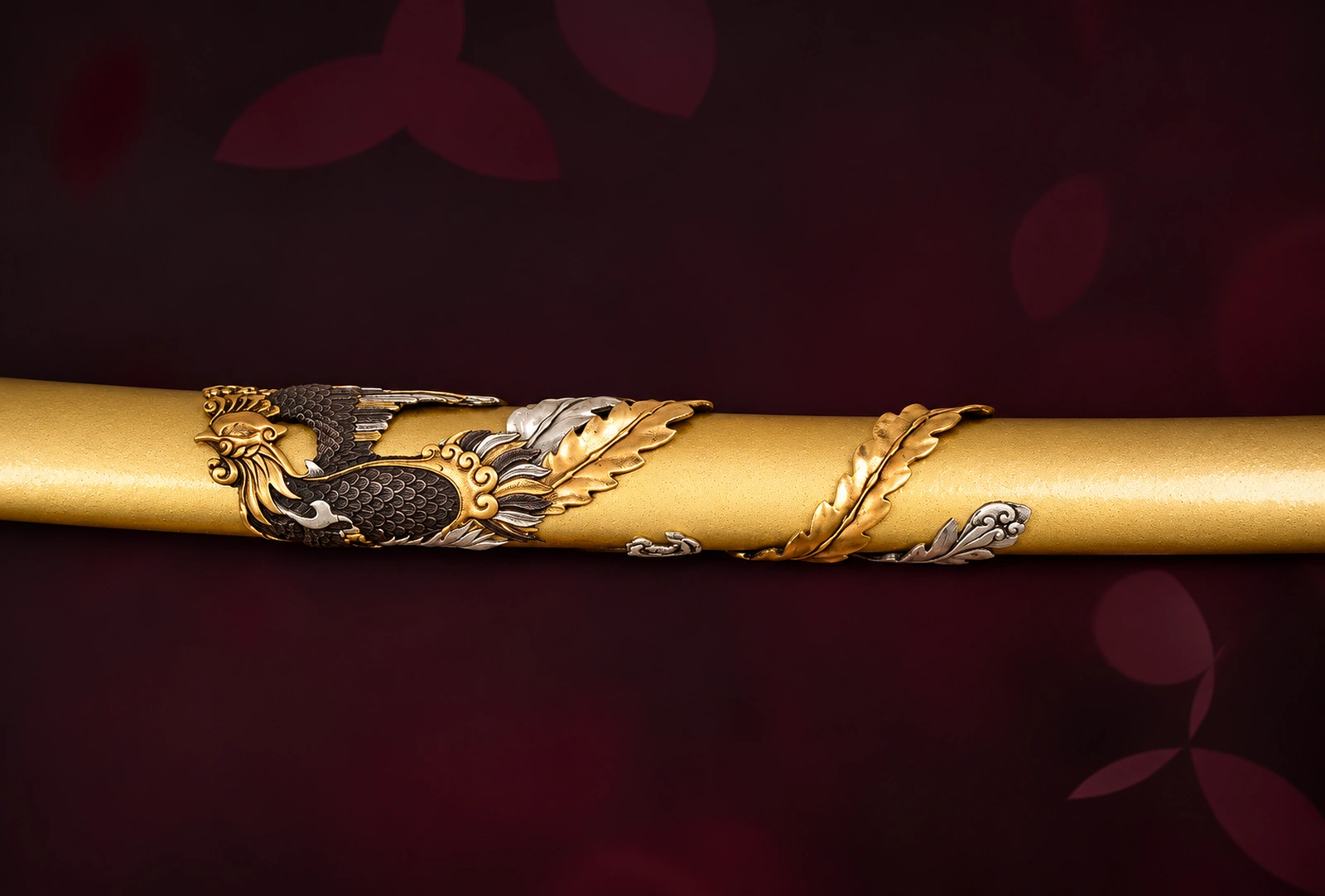
Look at the phoenix ornament on the saya. It sits neatly now, but it arrived badly distorted.

I had to reshape it, smooth the inner surface, and gradually fit it on a dedicated assembly saya before installing it on the finished scabbard.

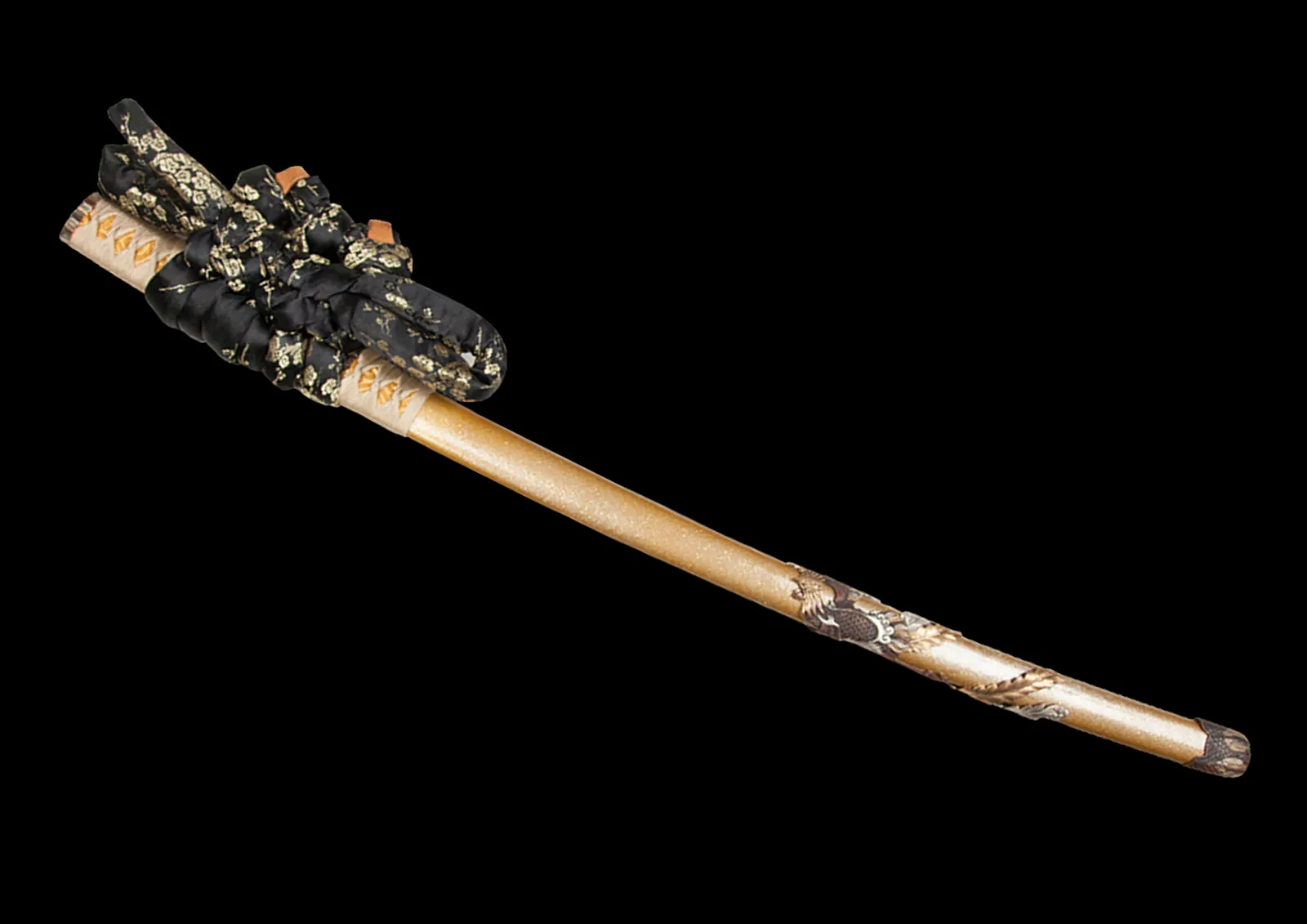
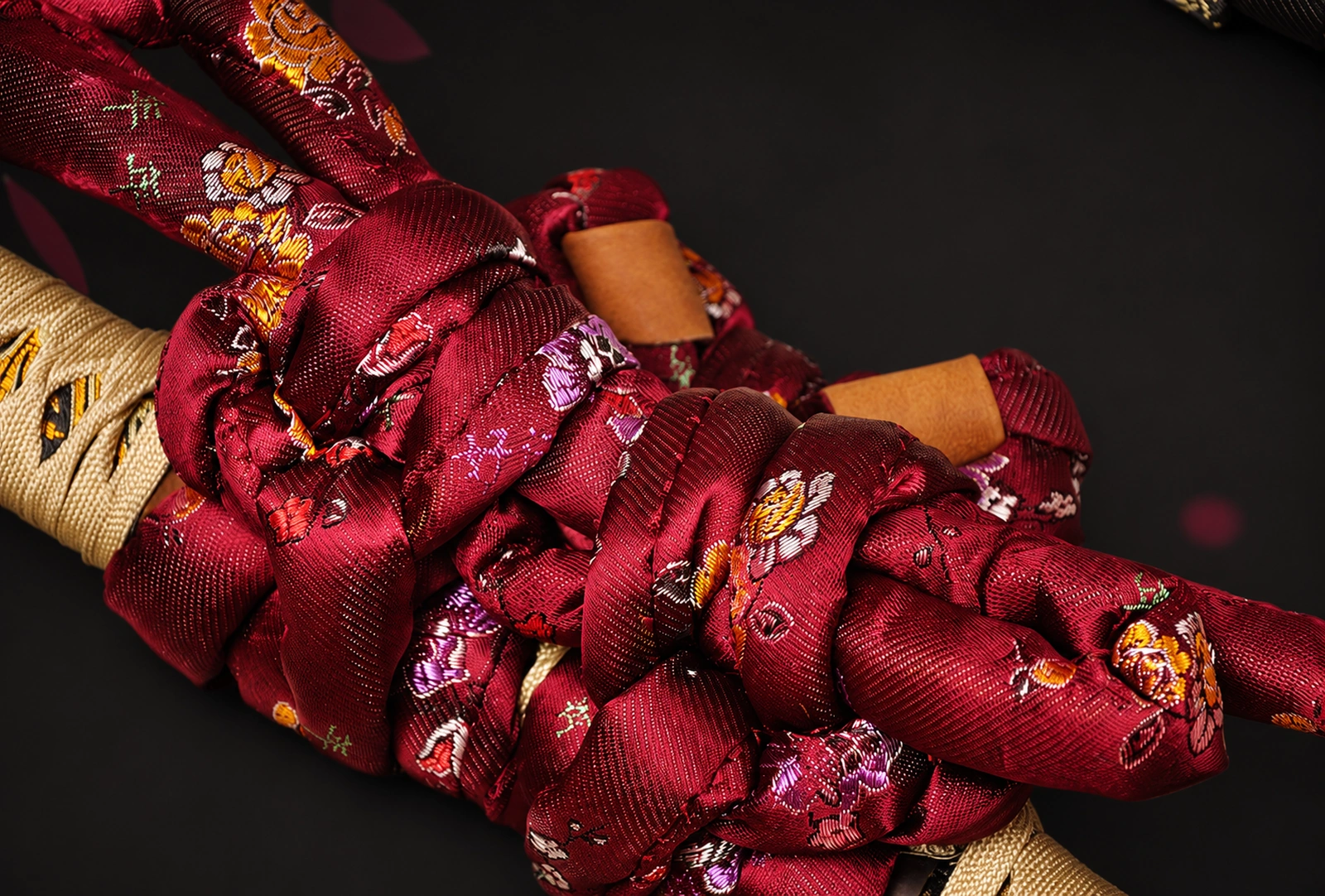
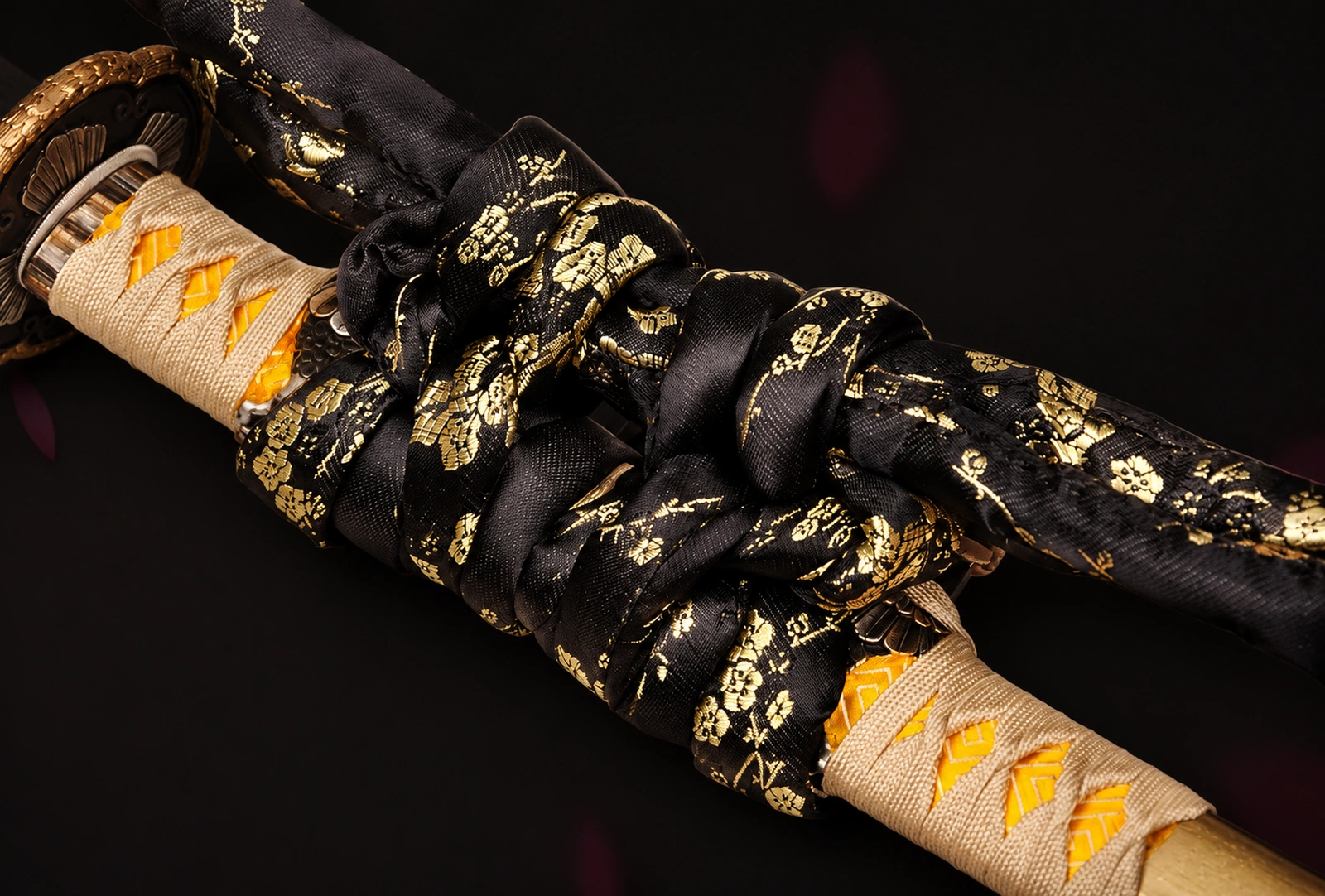
The tachi suspension cord is custom-made, with Nishijin-style woven fabric and a fully rayskin-wrapped grip.

Many people love this sword for the elegance of its blade and overall silhouette.

Its motohaba is only 2.8 centimeters, yet the pronounced curvature gives it a strong visual presence.

Let me talk about the polishing.

This is actually a fairly basic polishing treatment.

Starting from a mirror finish, I mainly brightened the cutting-edge area with a simple hadori-style treatment.

The brightened edge is easier to see in the video.

The kissaki is about the length of the first joint of my little finger, as shown earlier.

Another distinctive point is that there are two mounting styles: Dragon and Phoenix.

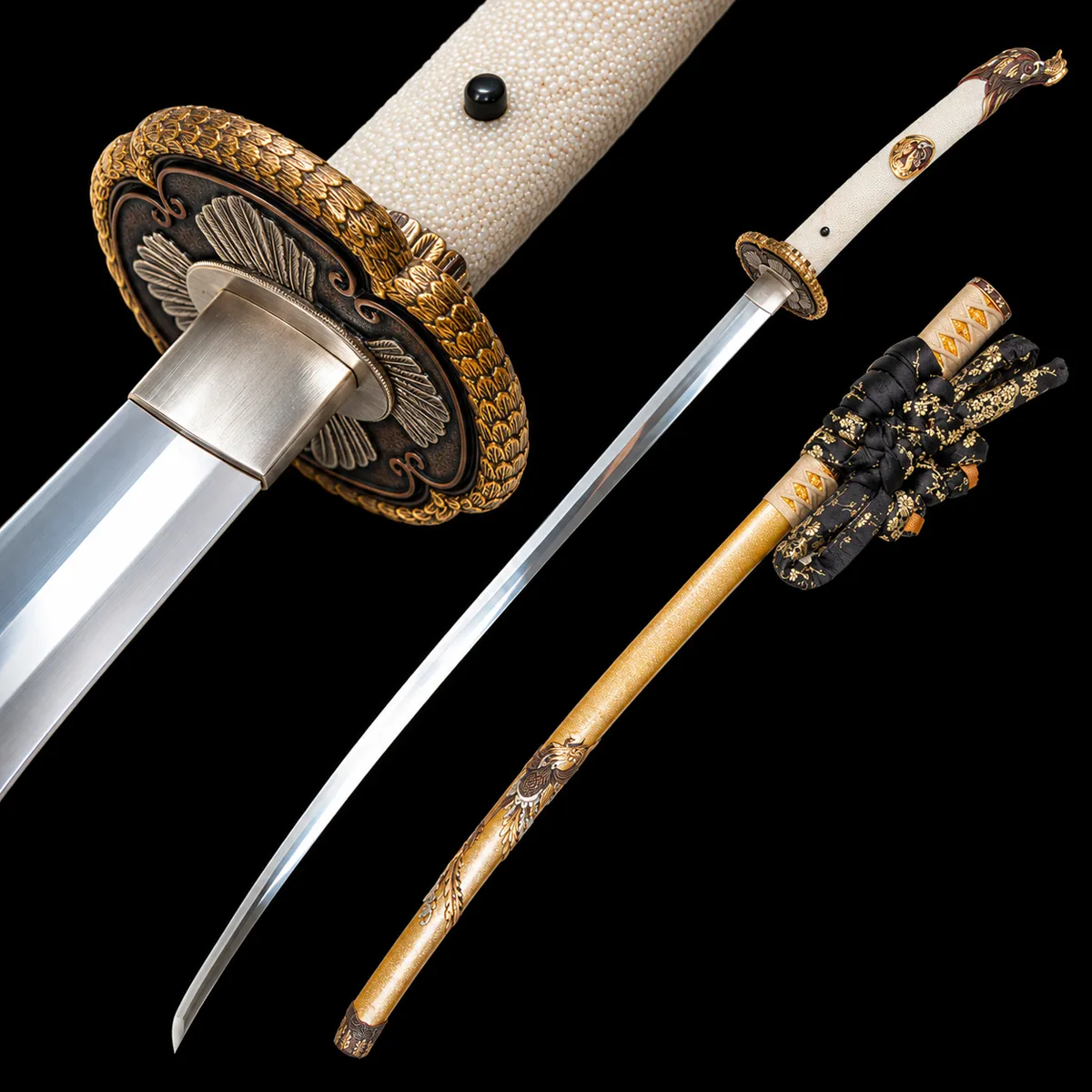
It is a modern tachi replica designed around the proportions and silhouette of Mikazuki Munechika.

The grip and saya are both notably slender. You can see how narrow the scabbard is.

This angle makes it easier to see.

Now, let me slide the blade into the saya.

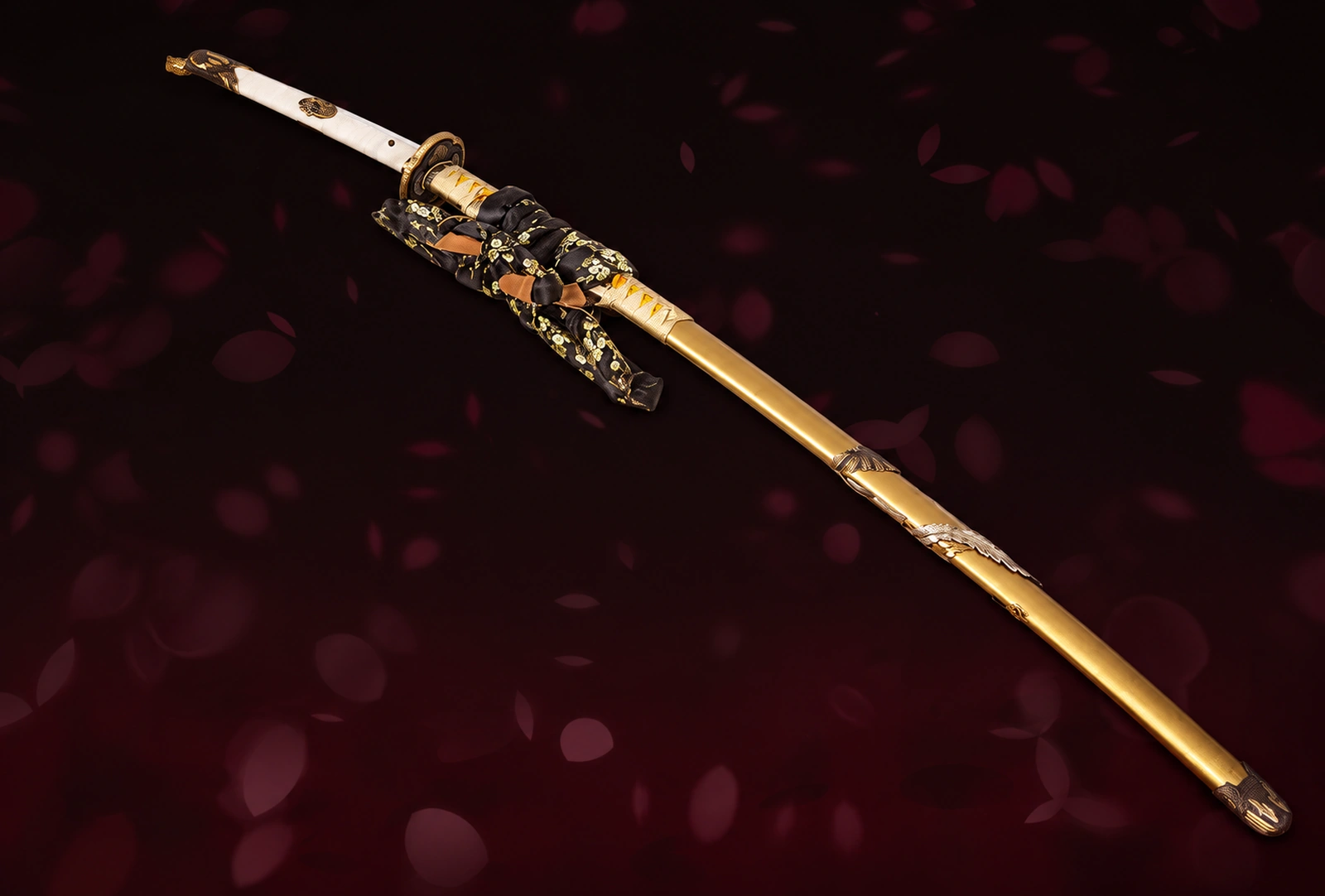
The complete sword's silhouette becomes even more striking.

The grip has a slight curve of its own.

This view shows the slender saya and the elegant overall curvature clearly.

Technical Overview

Core specifications.

Nagasa
800 mm
Motohaba
28 mm
Motokasane
7 mm
Tsuka Length
250 mm
Overall Length
1090 mm
Weight without Saya
1015 g
Weight with Saya
1310 g
Handmade product dimensions may vary slightly.
Blade & Craft

Blade craftsmanship.

Blade Material
T10 Carbon Steel
Construction
Maru Construction
Heat Treatment
Clay Tempering
Hamon
Clay-Tempered Hamon
Hamon Pattern
Suguha
Polish
Japanese-Style Polish

Description

01 / UKIYO — THE PASSING WORLD

The World Passes.
The Moon Remains.

There is a particular beauty in things that do not stay: the turning seasons, falling blossoms, and moonlight passing over a quiet landscape. Ukiyo begins with that feeling.
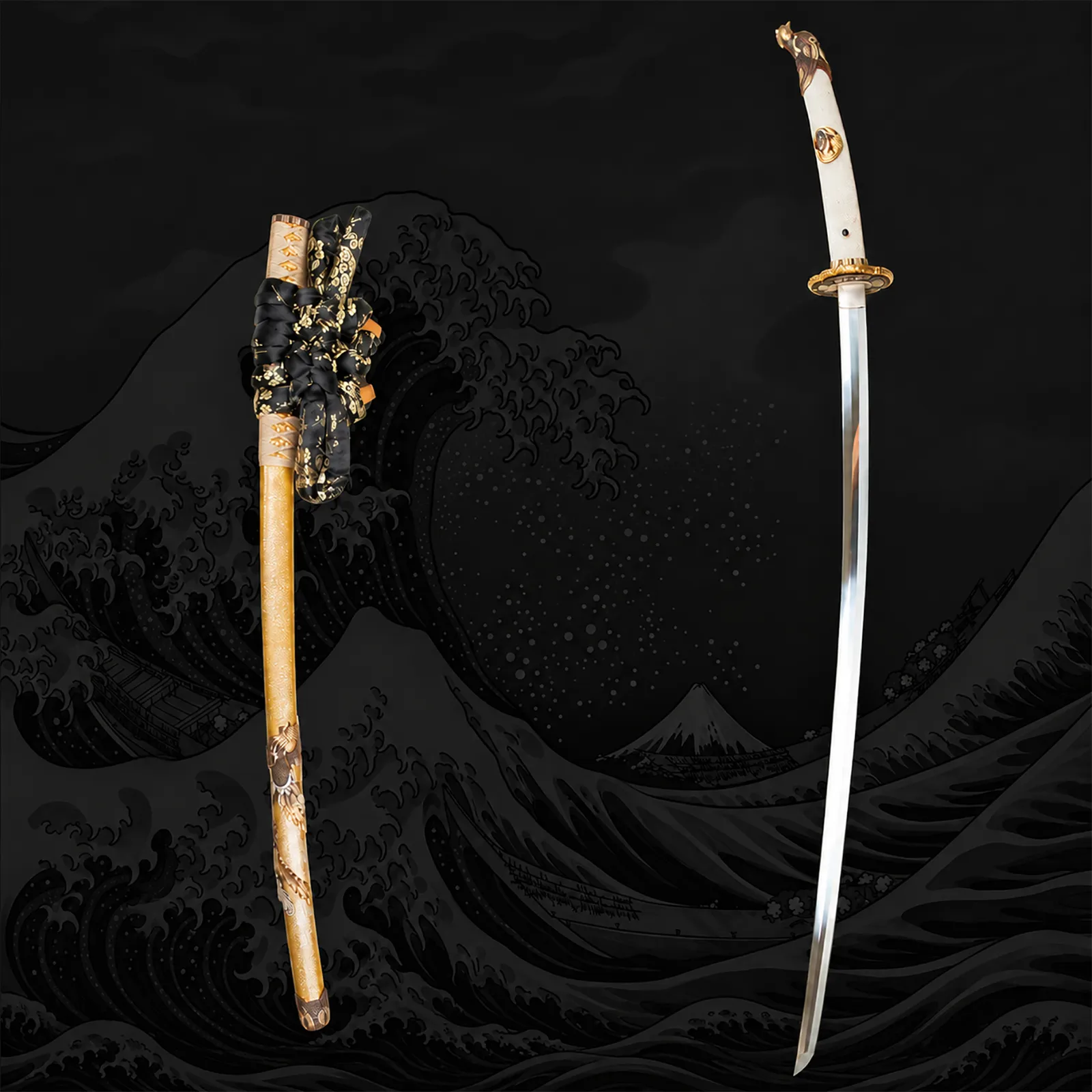
WK-300 Ukiyo Mikazuki Munechika replica tachi in Phoenix koshirae, with white rayskin handle and gold-toned saya against a dark wave illustration
Ukiyo — the Phoenix-mounted tachi, photographed against a dark, wave-inspired backdrop.

A NAME CARRIED THROUGH TIME

A Crescent in the History of the Sword.

The historic Mikazuki Munechika dates to Japan’s Heian period. Traditionally attributed to the swordsmith Sanjō Munechika, this celebrated tachi is counted among the Tenka Goken — the Five Great Swords of Japan.

Its name, Mikazuki — “crescent moon” — comes from the delicate crescent-shaped activity visible along the original blade’s tempered edge. The historical sword is now preserved in the Tokyo National Museum.

That legacy becomes the starting point for a modern interpretation. The curved silhouette, luminous white samegawa, and elaborate Phoenix koshirae bring together the presence of a tachi and the visual richness of its mountings.

THE SPIRIT OF UKIYO

A moment may pass. Its beauty can remain.

The moon, the passing world, and the enduring outline of a sword — a quiet prelude to the craftsmanship that follows.

02 / THE SHAPE OF STEEL

A Line Kept
Through Time.

The presence of a tachi begins with its silhouette. In Ukiyo, the long sweep of the blade, its quiet edge and its carefully finished point carry the inspiration of Mikazuki Munechika into a contemporary work.
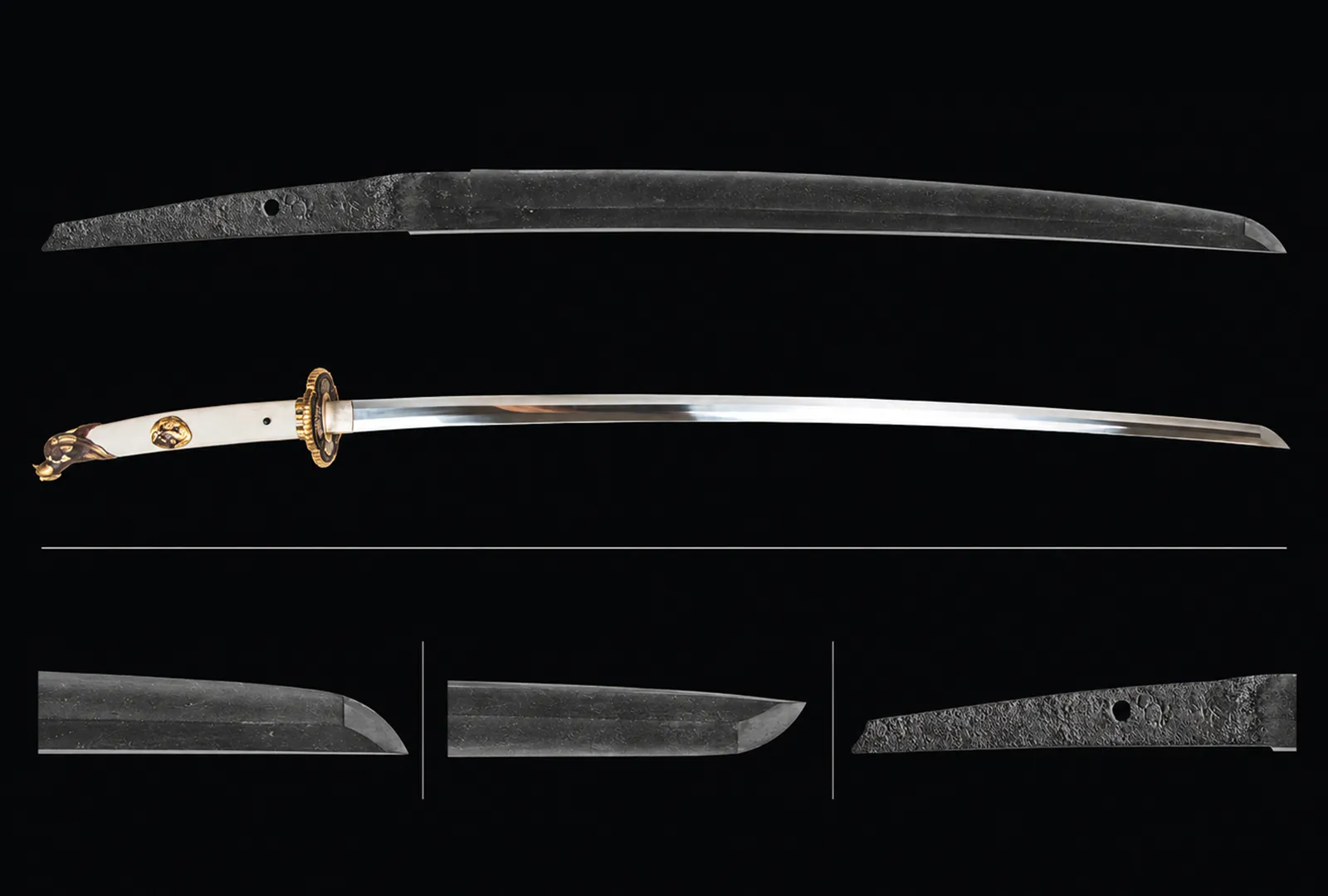
Historical Mikazuki Munechika blade above the WK-300 Ukiyo reproduction tachi, with close-up studies of original blade tips and tang
Historical blade and Ukiyo reproduction — a study in curvature, point geometry and the form of the tang.

THE GEOMETRY OF MIKAZUKI

The Original Line. The Living Form.

Placed beside the historical blade, the Ukiyo reproduction reveals the defining rhythm of the form: a long, restrained curve flowing toward a compact kissaki. The exposed nakago and original blade-tip studies invite a closer reading of that geometry.

PROPORTION & CURVATURE

An 800 mm blade length gives the silhouette its reach. The 28 mm sori lends it the characteristic rise and sweep of a tachi, with the point completing the line rather than interrupting it.

STEEL / FIRE / THE HARDENED EDGE

The Quiet Strength of a Straight Line.

The blade is formed from T10 carbon steel in a single-steel construction, then clay tempered. Along the cutting edge, a Suguha hamon follows an almost straight course — measured and understated.
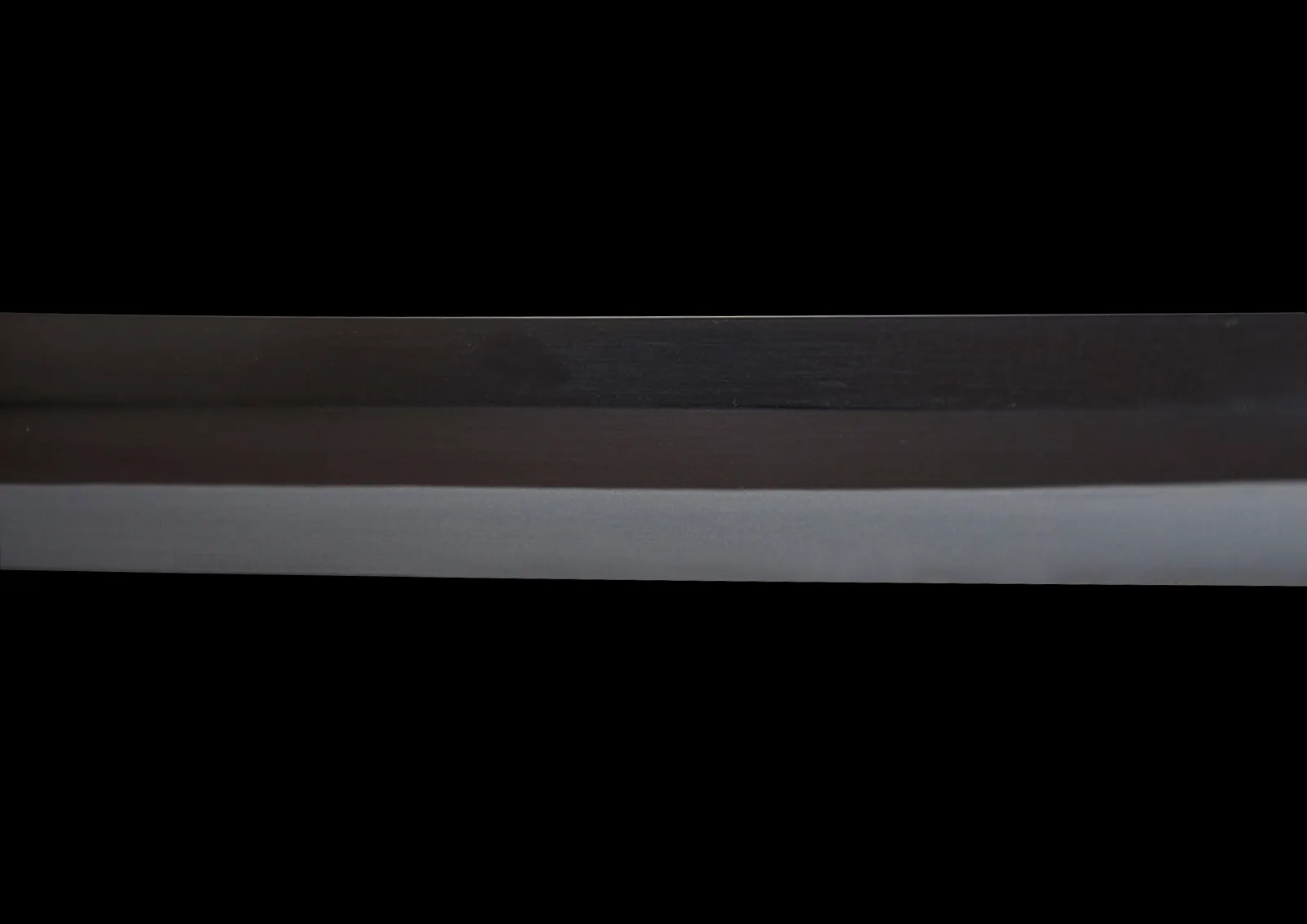
Close-up of WK-300 Ukiyo tachi blade showing the straight Suguha hamon and contrasting polished steel surfaces
The straight Suguha boundary: bright ha, subdued ji and restrained surface reflections.

JAPANESE-STYLE POLISH

Light moves across the blade in different tones. The edge is bright; the body of the steel remains quietly grey.

THE POINT & ITS GEOMETRY

A Clear Change of Plane.

At the yokote, the main blade transitions into the kissaki. Here, a true geometric boundary meets a separately defined polished point — a small detail that gives the finish its precision.
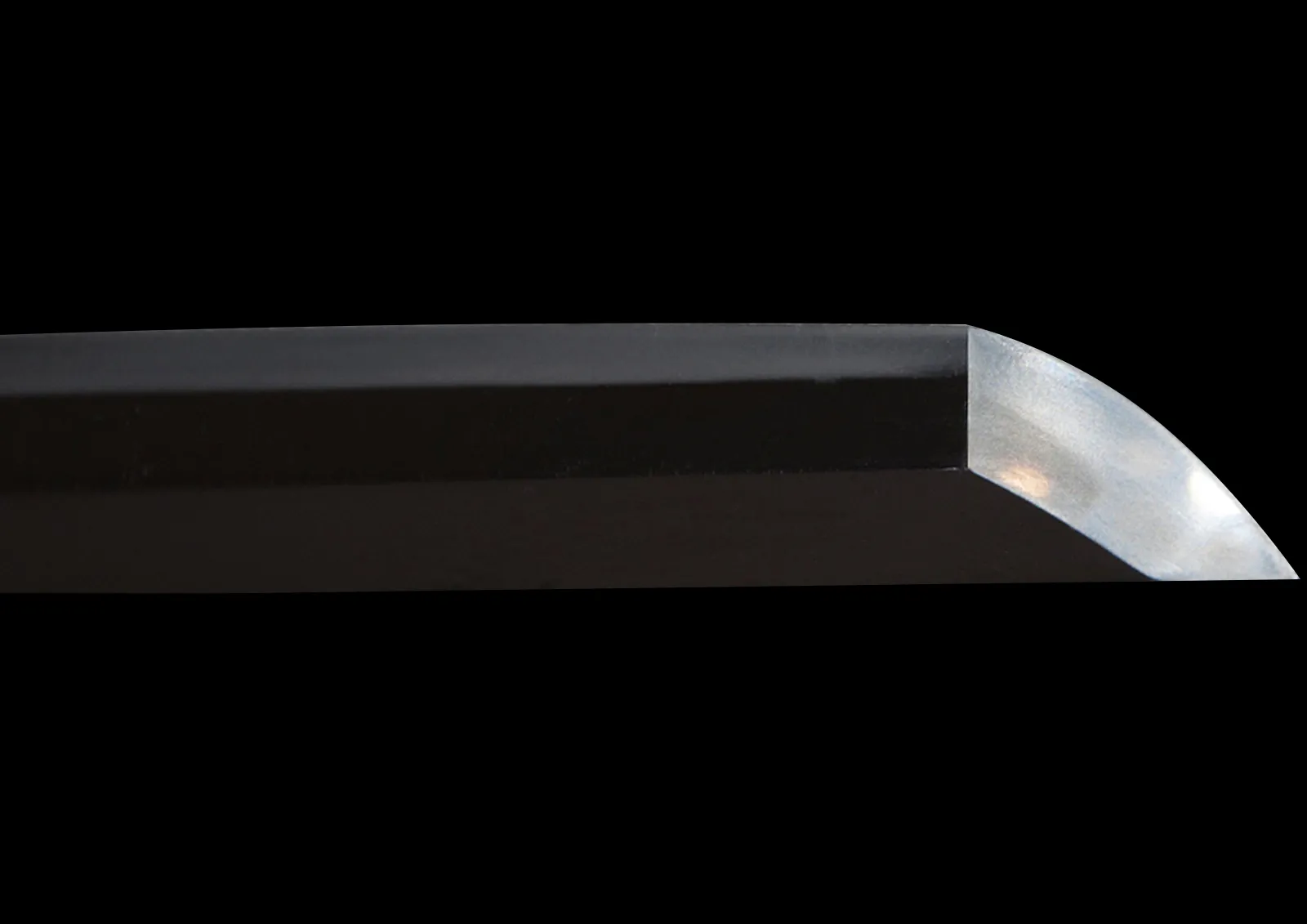
Close-up of WK-300 Ukiyo replica tachi kissaki, showing the true geometric yokote and polished blade tip
True yokote and kissaki — the blade's planes meet in a crisp, visible line.

THE PHOENIX MOUNTINGS

Ornament with a Purpose.

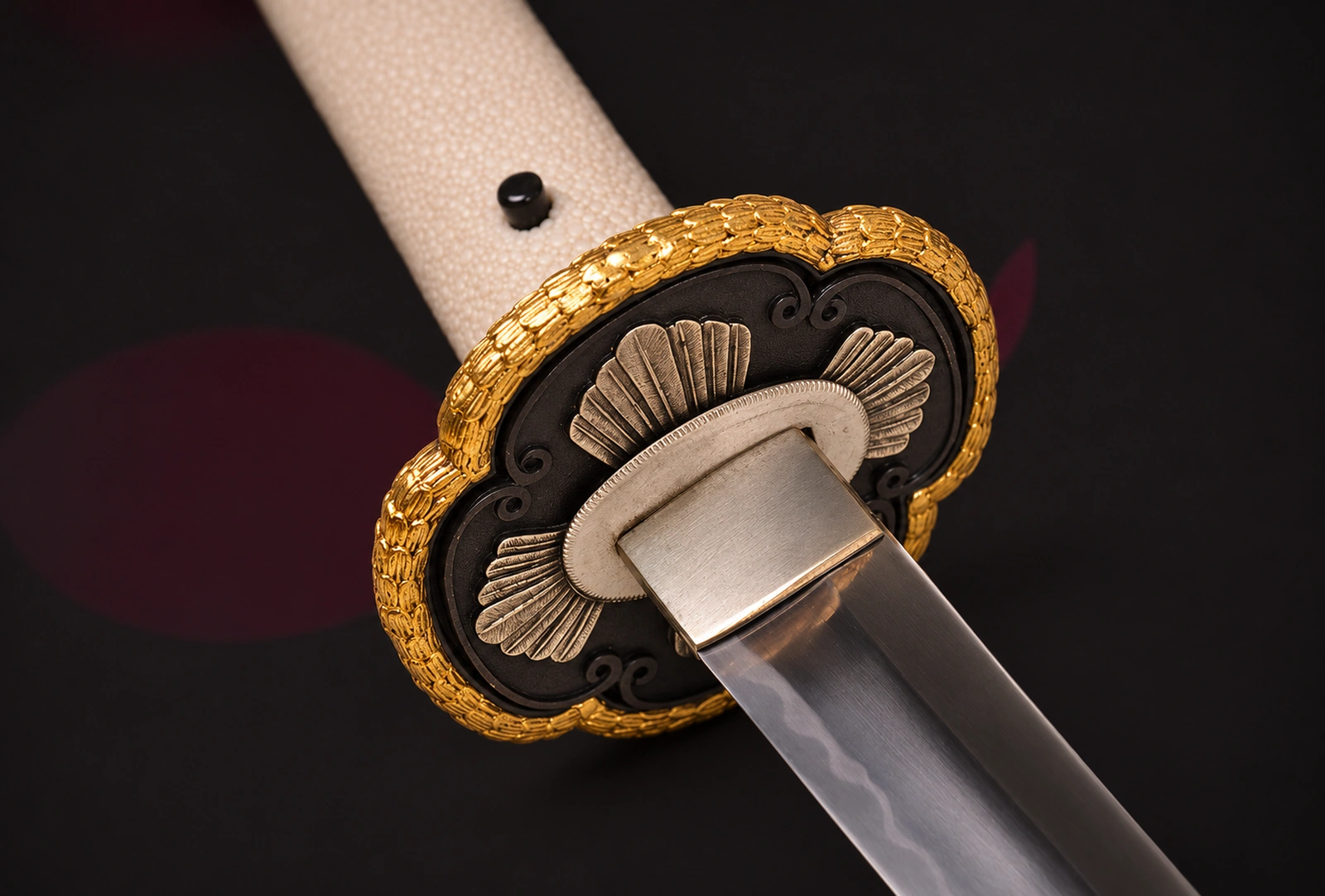
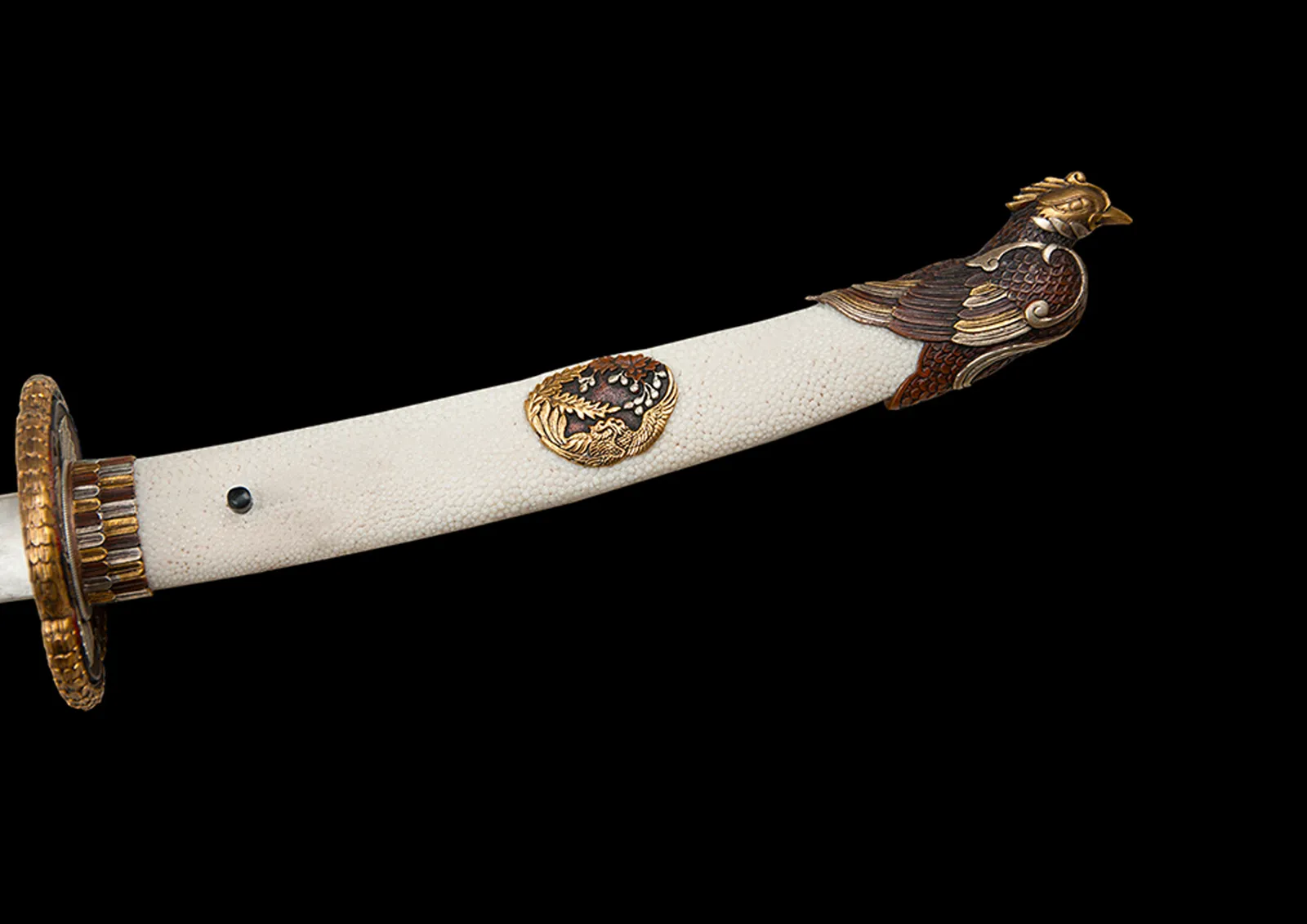
The Phoenix koshirae brings warmth to the blade's cool silver line. Gilded tones, dark metal relief and full-wrap white samegawa make the mounting a deliberate part of the sword's character.
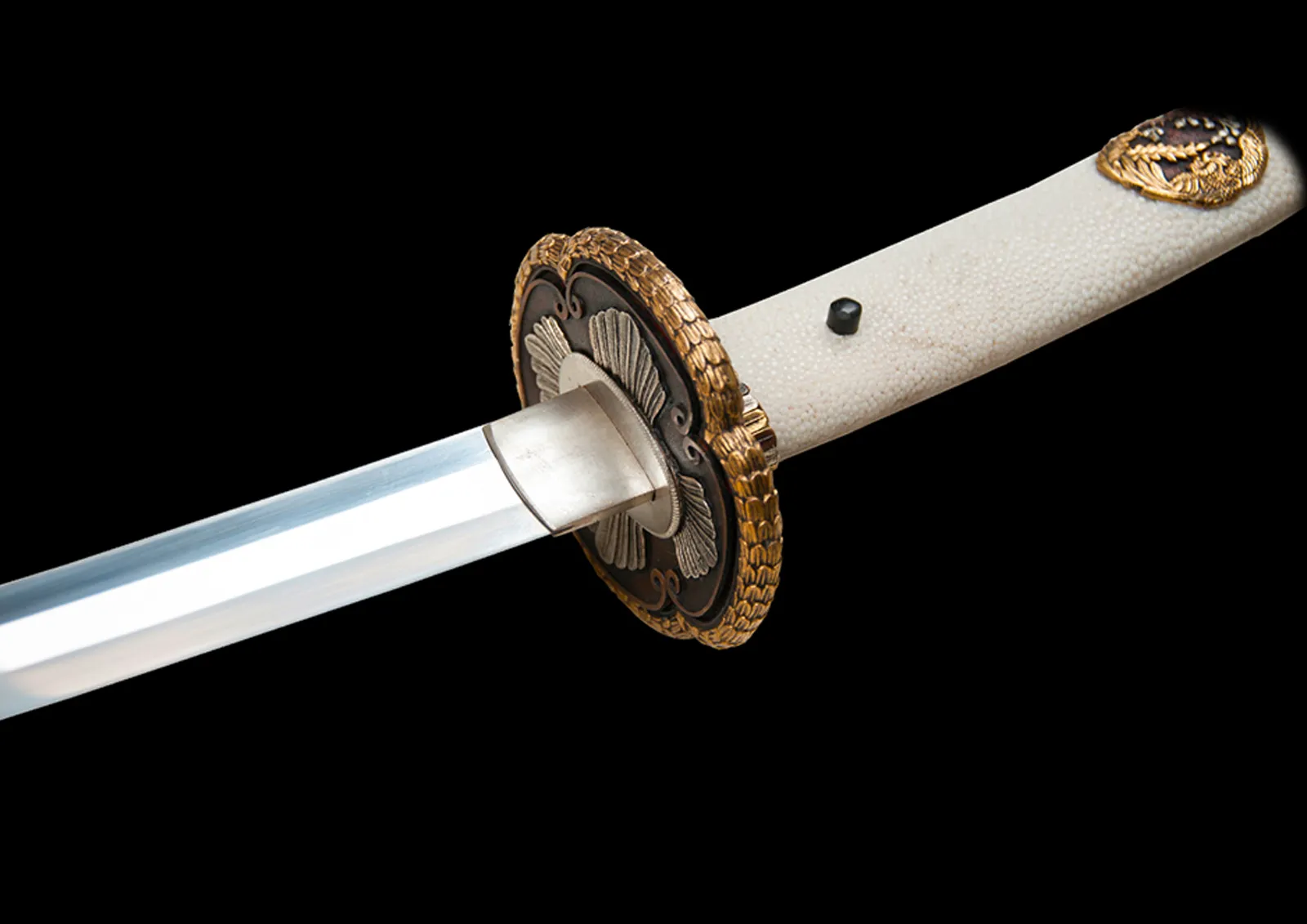
Close-up of the ornate gold-accented tsuba, blade collar and white rayskin handle of the WK-300 Phoenix-mounted tachi
The tsuba — dark relief beneath a richly detailed golden rim.
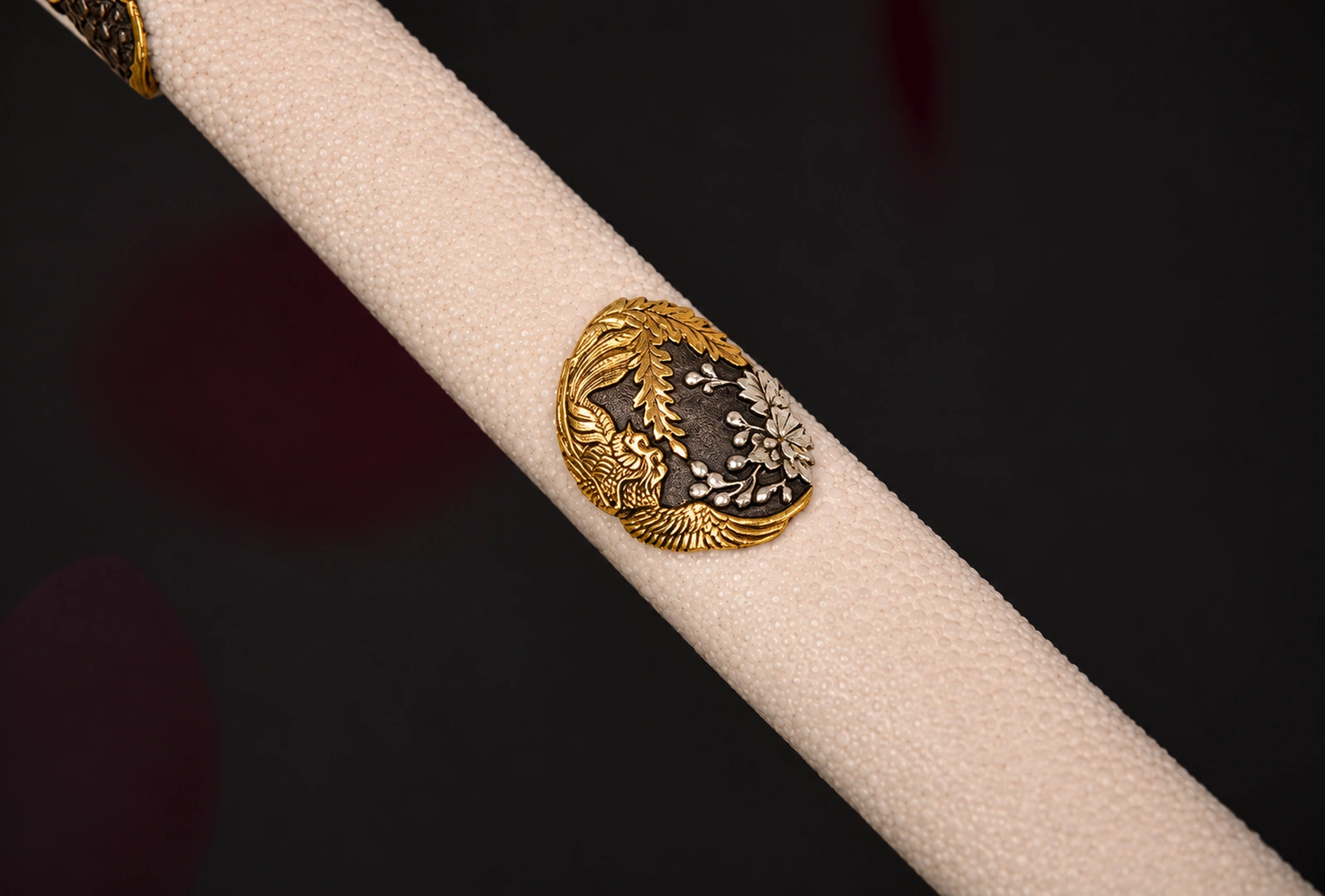
White full-wrap rayskin tsuka of WK-300 Ukiyo tachi with phoenix-themed pommel fitting and ornamental medallion
The tsuka — white full-wrap samegawa and a sculpted Phoenix pommel.
Full gold-toned saya of the WK-300 Phoenix koshirae with black-and-gold patterned sageo and phoenix decoration
The golden saya, finished with an elaborate black-and-gold sageo.
Close-up of the phoenix relief ornament on the gold-toned saya of the WK-300 Ukiyo reproduction tachi
The Phoenix motif — layered feathers and sculpted relief across the saya.

THE WHOLE, IN ITS DETAILS

A blade is drawn in steel.
Its character lives in every line.

03 / THE COLLECTOR'S GALLERY

Two Forms.
The Same Quiet Presence.

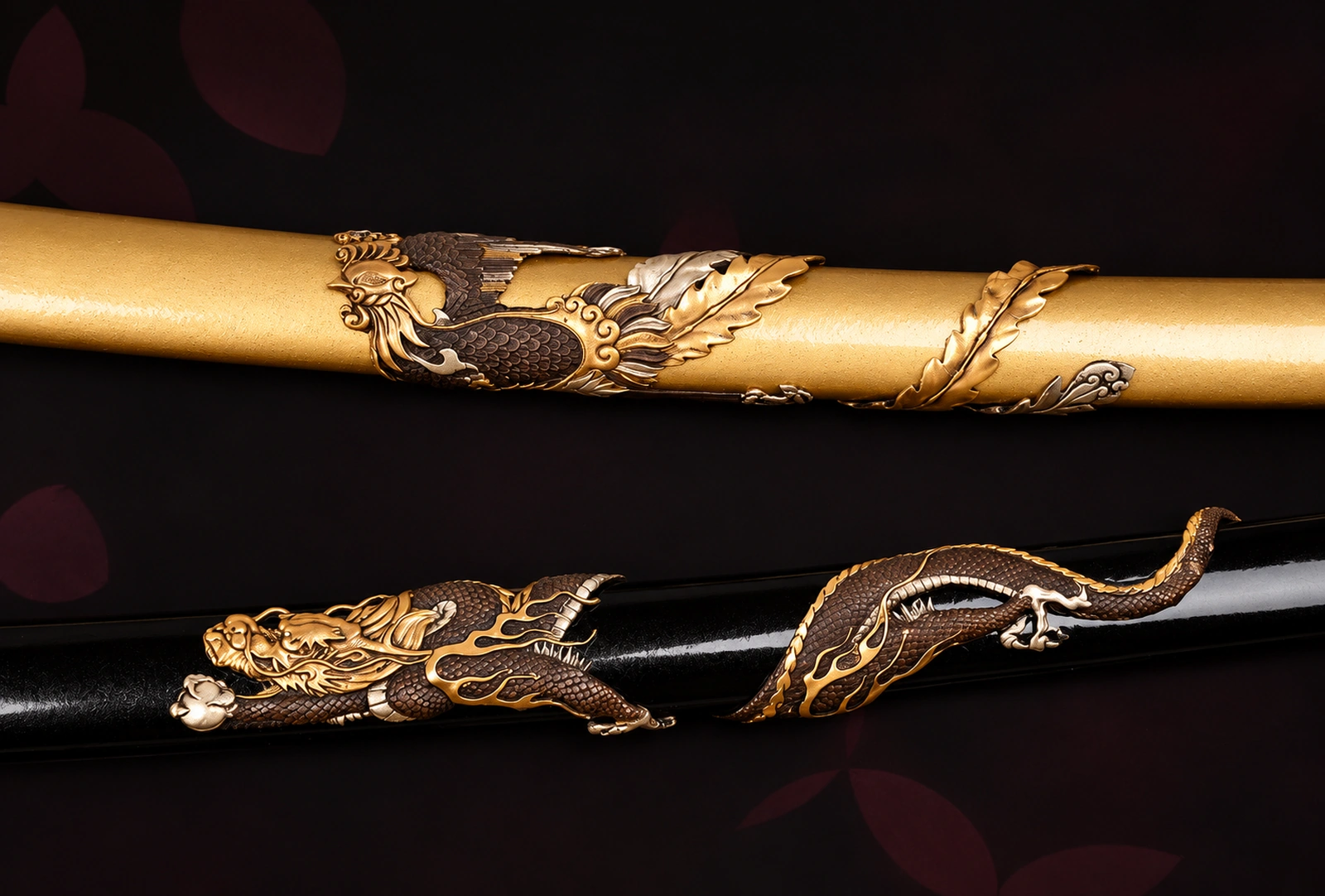
Ukiyo is presented in two distinct koshirae: Phoenix, luminous in gold and black; and Dragon, defined by dark lacquer and crimson accents. Together, they reveal two visual characters around the graceful silhouette of a tachi.
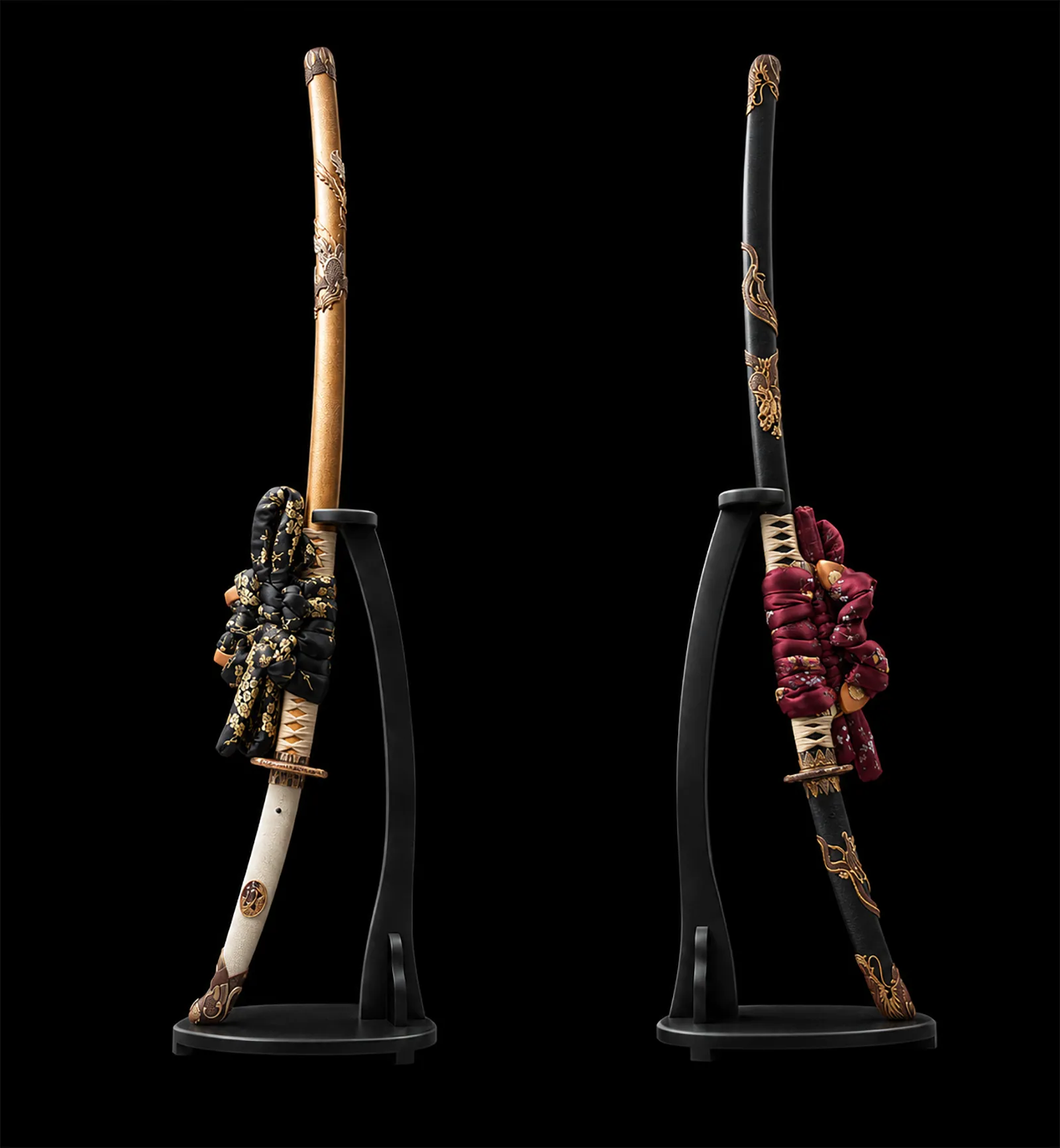
WK-300 Ukiyo replica tachi in Phoenix gold saya and Dragon dark saya, each mounted vertically on a sword stand
The first encounter: Phoenix and Dragon, displayed together.

THE TWO MOUNTINGS

In Contrast. In Conversation.

The warm gold of the Phoenix saya and the darker Dragon mountings carry different rhythms. Red petals fall across both — a restrained backdrop to let the shapes and surface details speak.
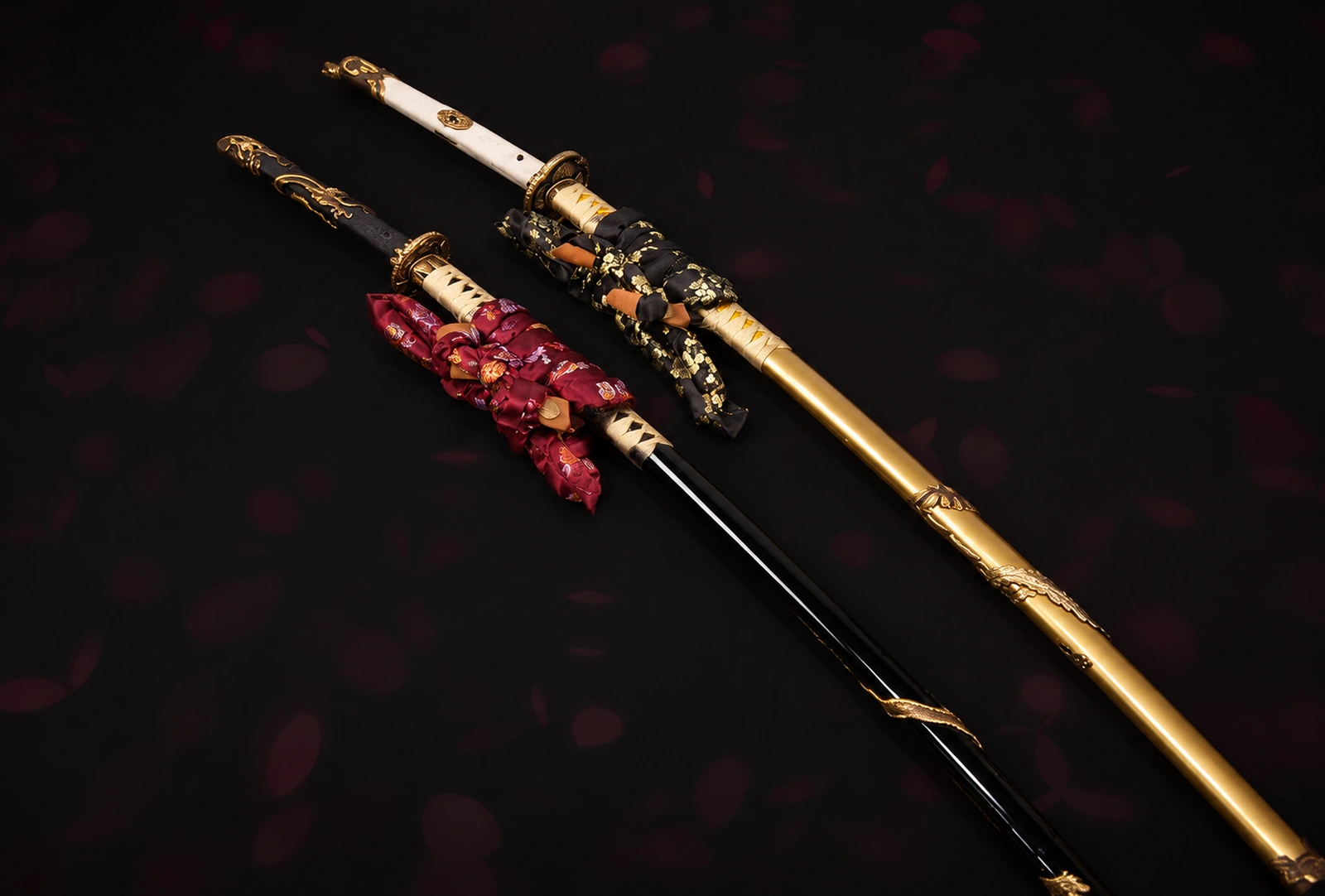
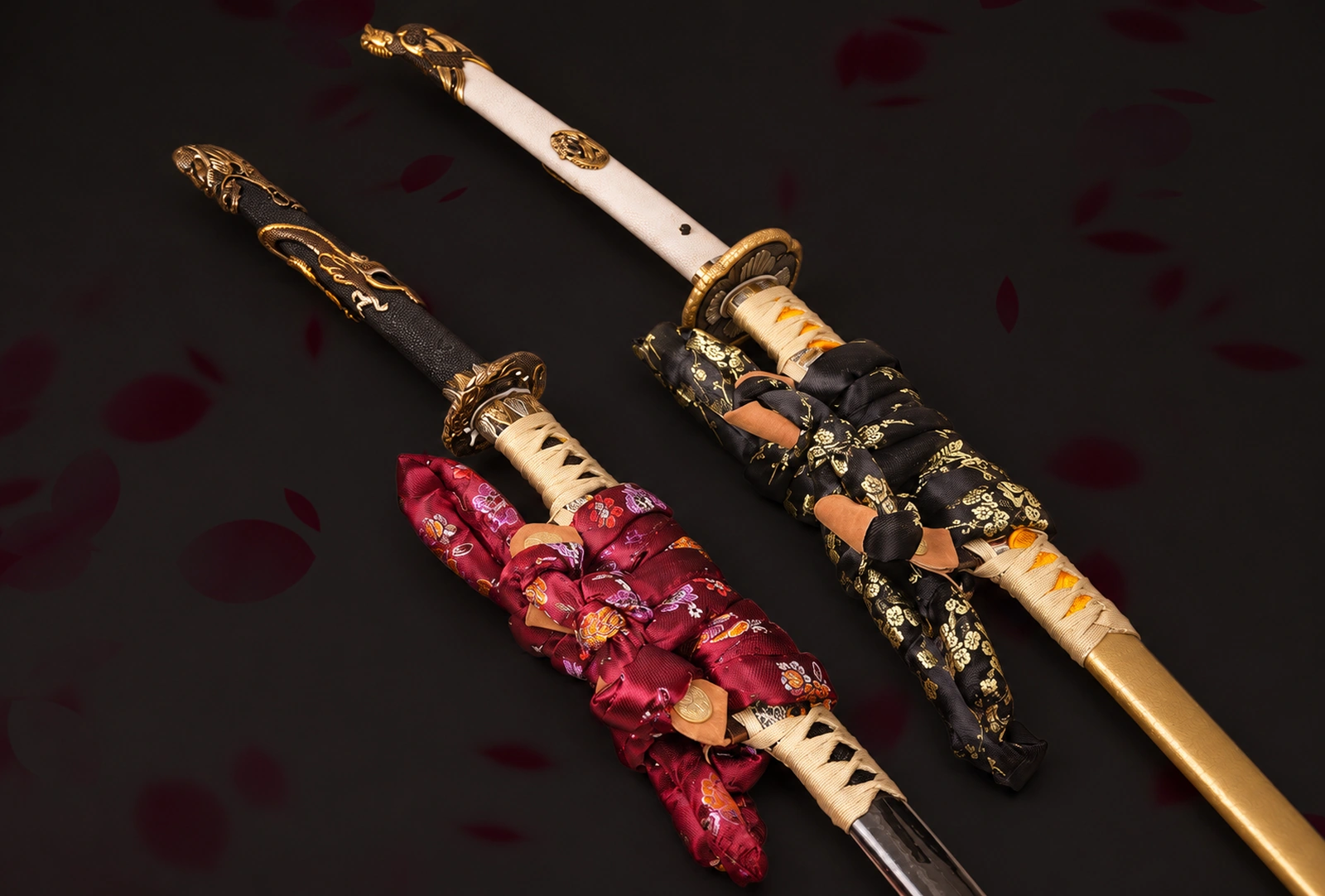
Phoenix and Dragon mounted tachi displayed diagonally with gold and black scabbards over scattered red petals
Two distinct silhouettes, brought into a single frame.
Closer diagonal view of Phoenix and Dragon Ukiyo tachi with contrasting black-gold and crimson cords
Gold and dark lacquer, with two different arrangements of cord and fittings.
Close comparison of gold Phoenix saya and black Dragon saya, both bearing ornamental metal details
Two scabbards; two palettes, closely compared.

BEYOND THE MOUNTINGS

Ornament changes the atmosphere.
The polished edge holds the eye.
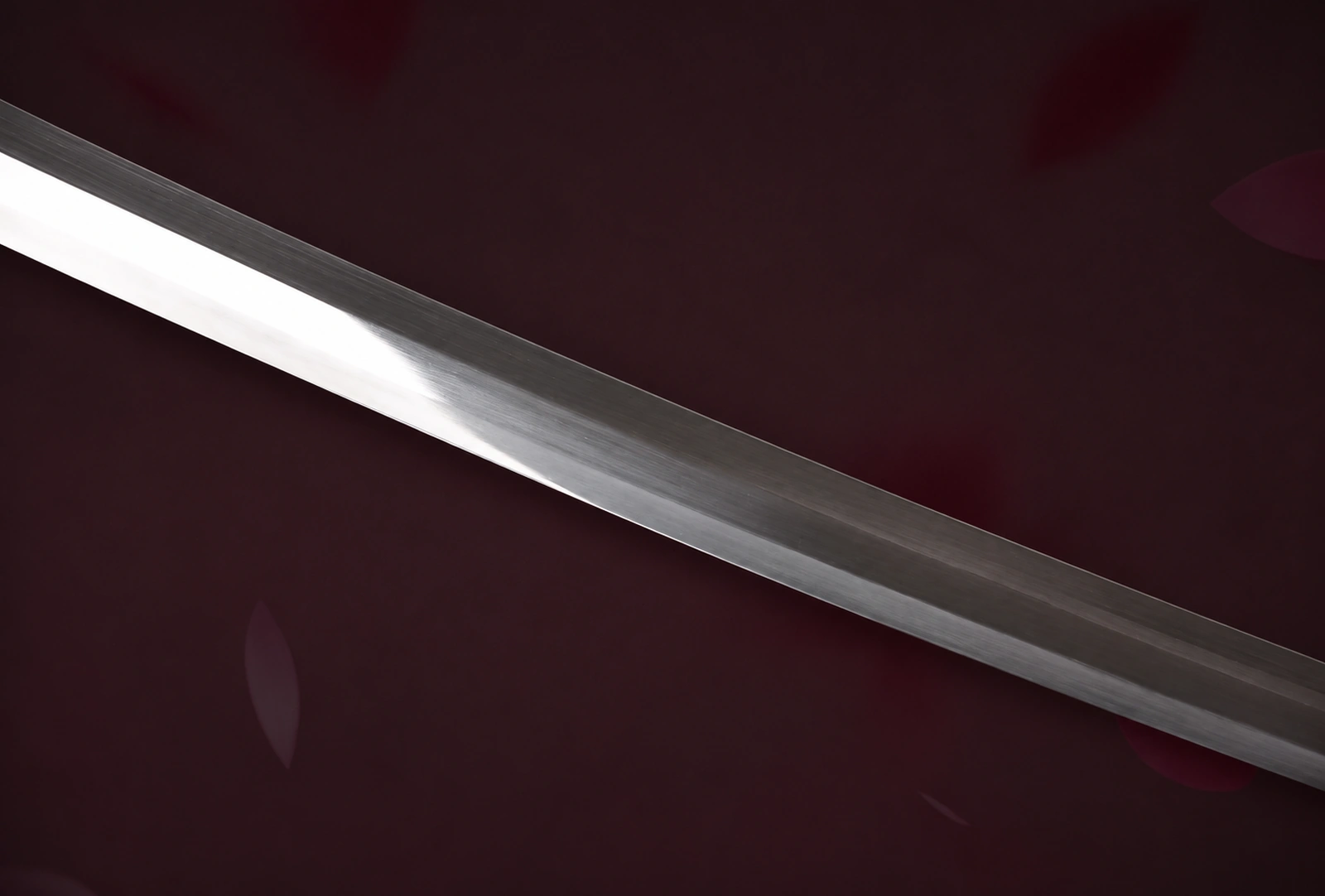
Close-up of the gently curved polished Ukiyo tachi blade against a dark red petal background
Beyond the fittings, a closer look at the polished line of the blade.

THE DRAGON KOSHIRAE

A Darker Expression.

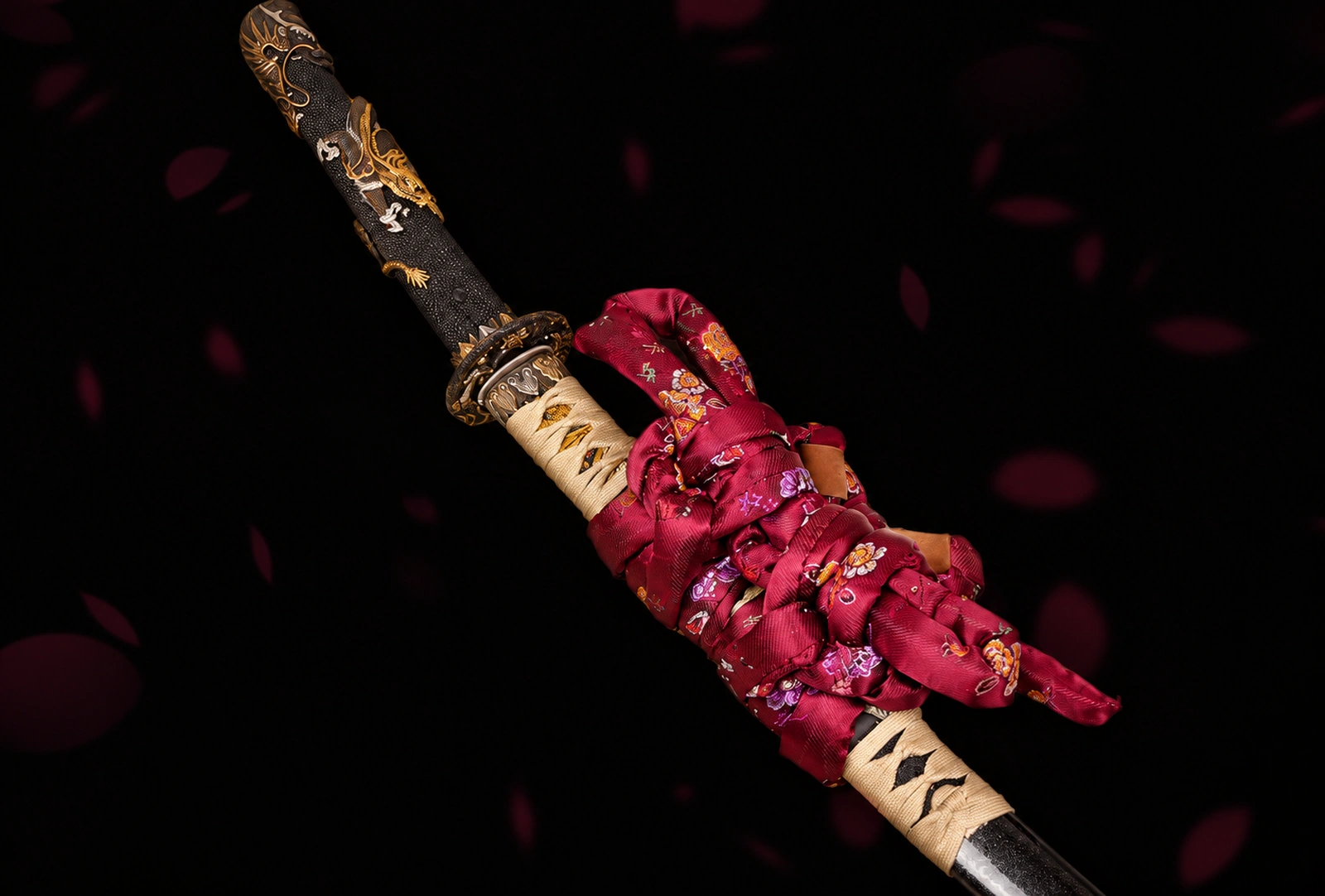
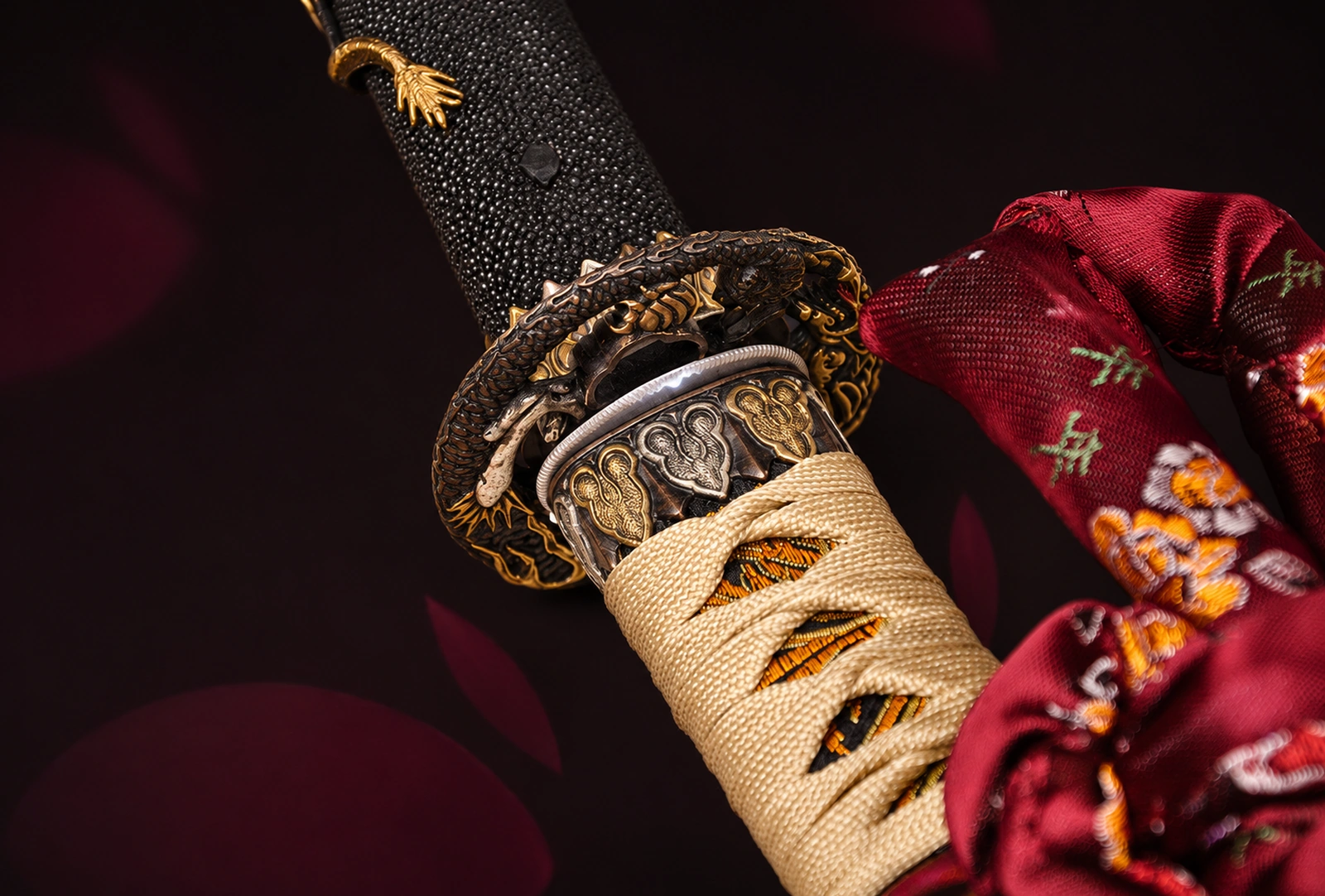
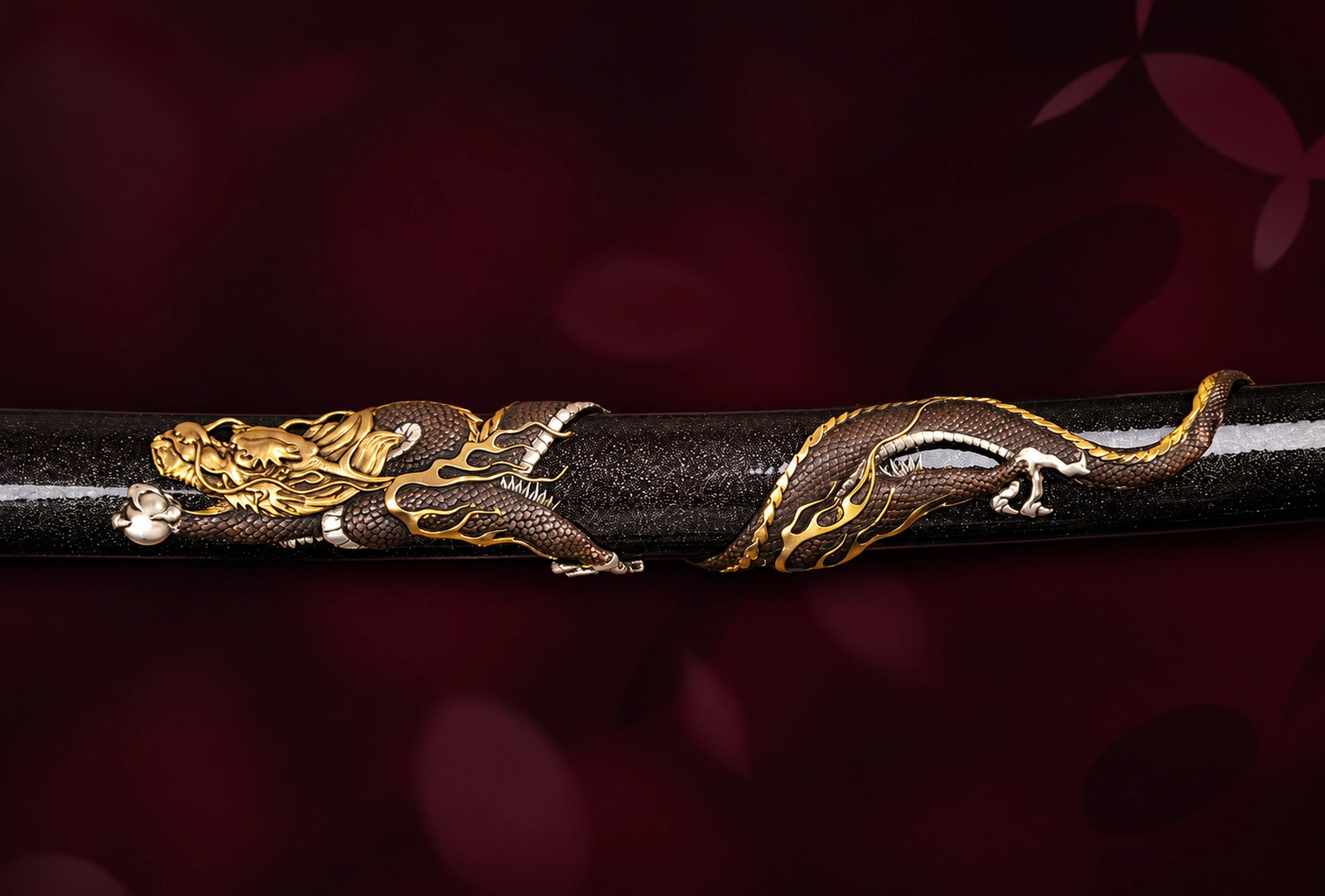
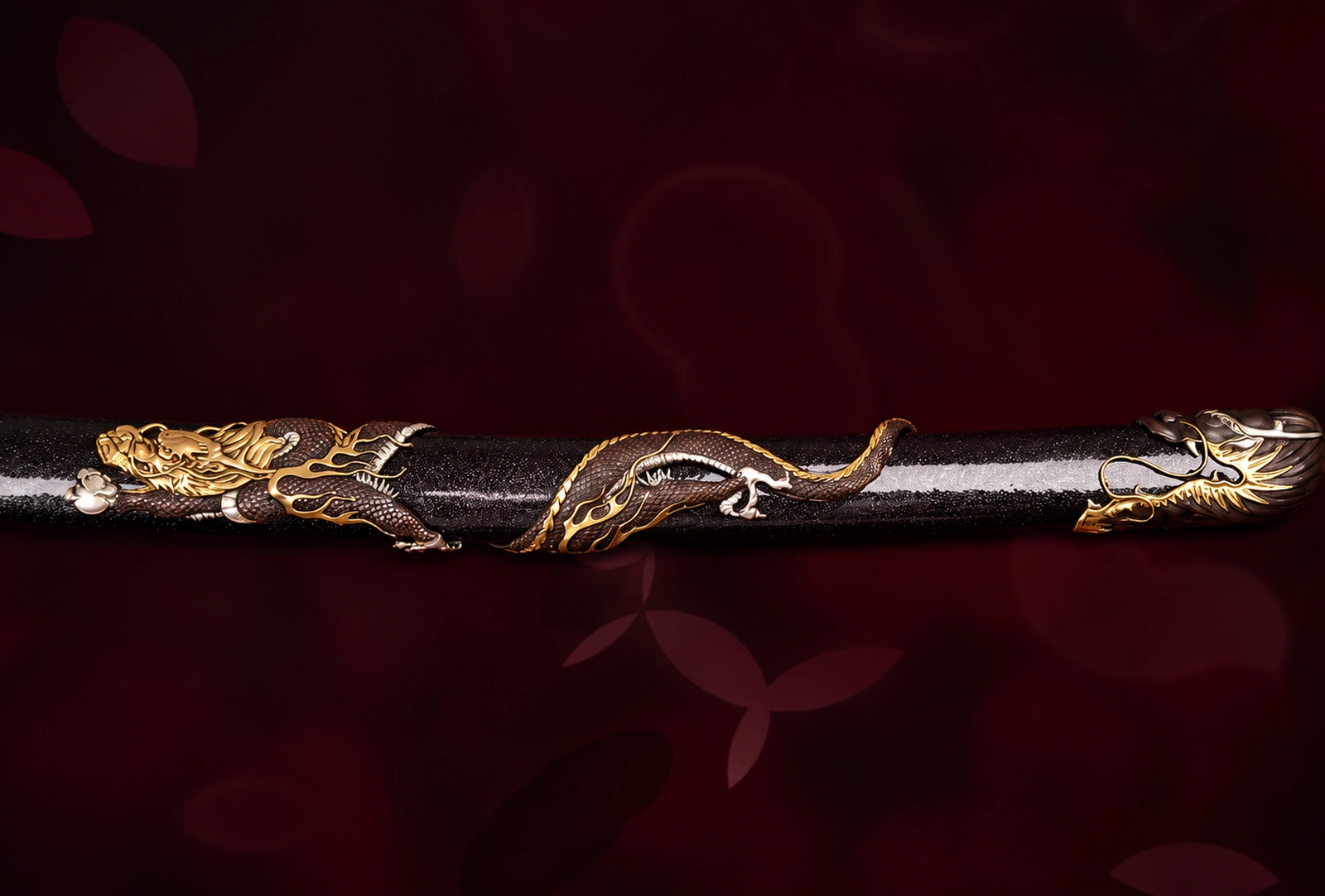
In the Dragon koshirae, dark lacquer draws the eye along the saya. Rich crimson fabric and gold-toned ornament give the composition its contrast — vivid details held within a quiet silhouette.
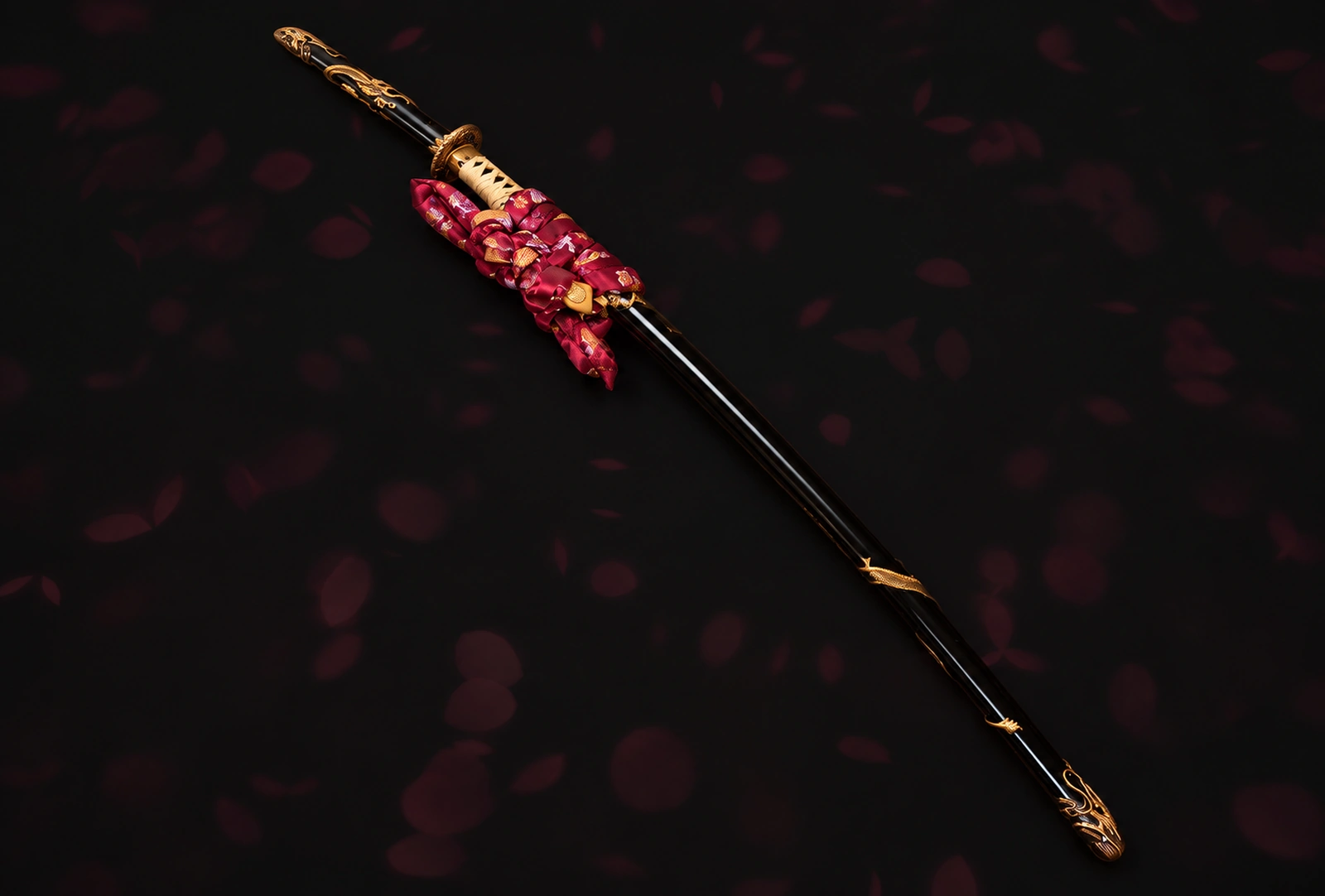
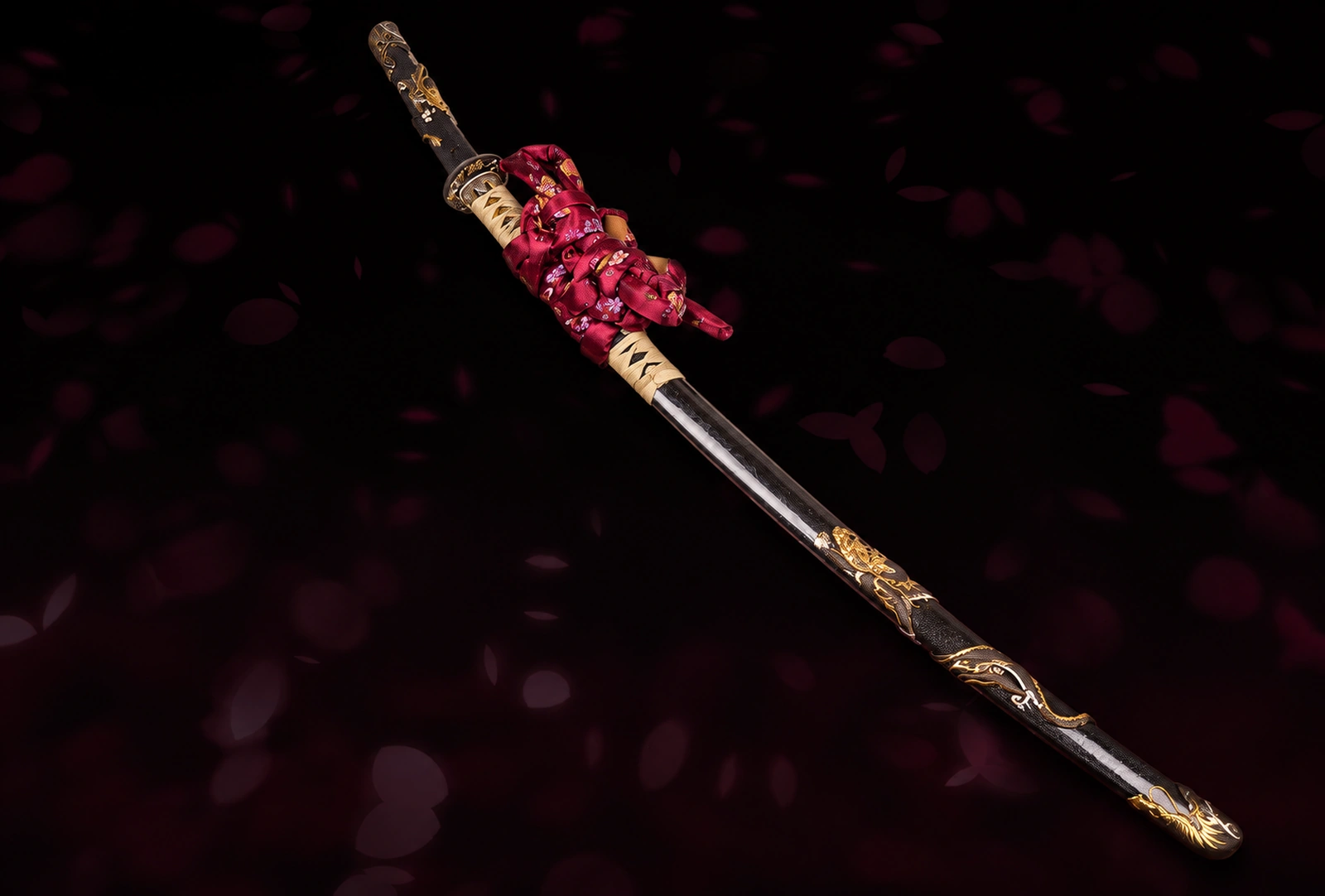
Full diagonally displayed Dragon koshirae tachi with black scabbard and crimson cord
The dark silhouette of the Dragon mountings.
Dragon koshirae tachi arranged diagonally on a dark cherry-blossom background
The Dragon composition, set against a quiet field of fallen petals.
Detail of the Dragon mounted tachi with red patterned cord and a section of polished blade
A close view of the crimson cord against polished steel.
Close-up of the Dragon tachi guard, ivory-colored grip accent and deep red braided cord
At the guard: dark fittings, pale handle detail and crimson cord.
Dense crimson patterned cord knot of the Dragon mounted Ukiyo tachi
Crimson folds and intricate woven details.
Detail of decorative metal fittings along the black saya of the Dragon koshirae
Gold-toned ornament against dark lacquer.
Dark Dragon saya with raised gold-toned decorative motifs in close-up
The surface of the dark scabbard, seen at close range.

Crimson against shadow.
Gold against the dark.

THE PHOENIX KOSHIRAE

The Warmth of Gold.

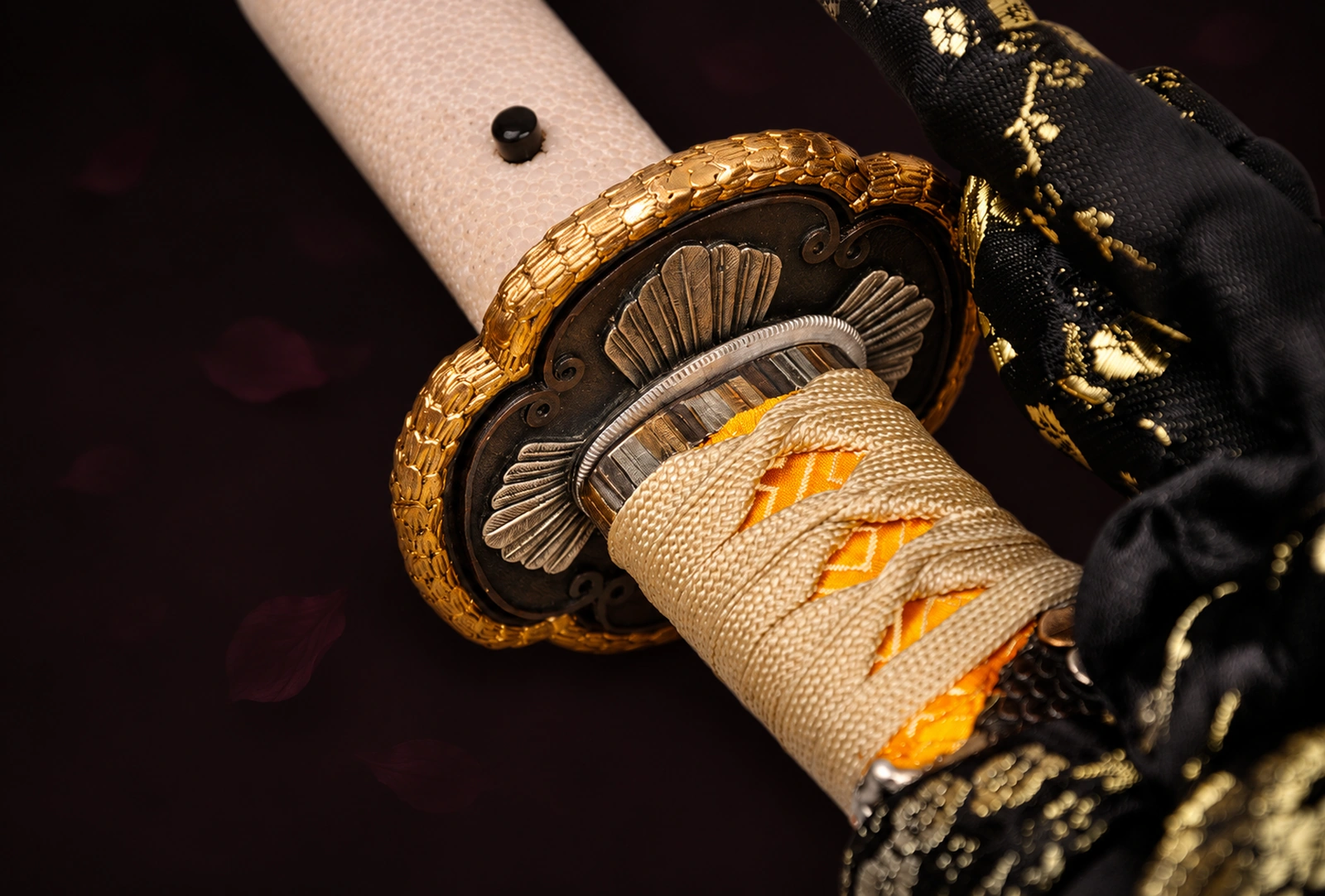
The Phoenix koshirae returns to gold, ivory-white samegawa and an elaborate black-and-gold sageo. Close views of its fittings and surface decoration reveal how much of the design lives in small details.
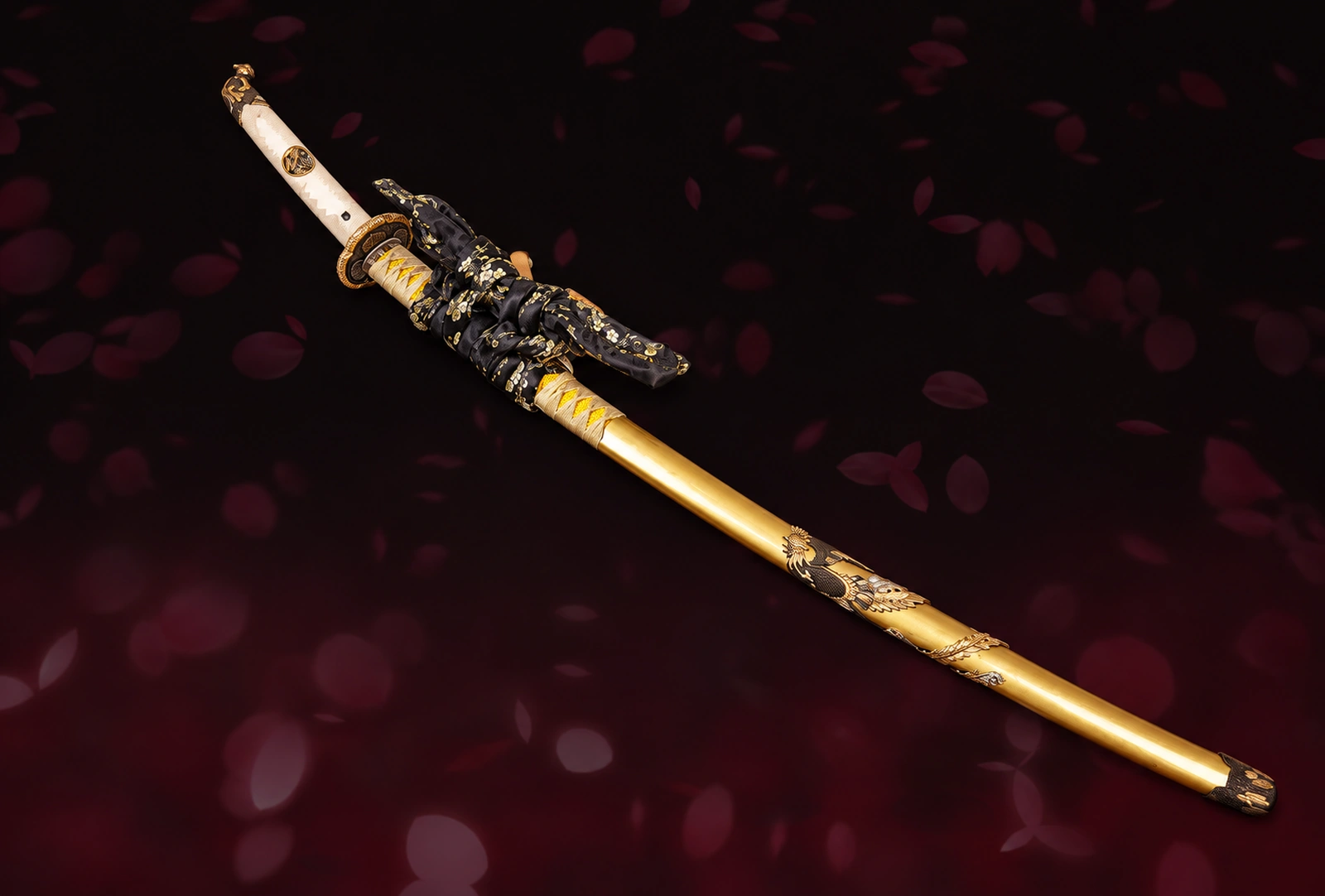
Full Phoenix koshirae tachi with gold scabbard and black-gold cord on dark red petal background
The Phoenix presentation, with its long gold-toned scabbard.
Close-up of Phoenix mounted sword hilt fittings and black-and-gold braided cord
The Phoenix mountings: gilded fittings beside a patterned black-and-gold cord.
Detail of textured black-and-gold patterned cord on the Phoenix koshirae
A study in woven texture and the folds of the dark patterned cord.
Phoenix motif and raised decoration across the gold-toned tachi scabbard
A Phoenix motif set against the warm gold of the scabbard.
Close view of metal Phoenix ornament on a gold tachi saya
The Phoenix figure follows the line of the golden scabbard.
Full-length Phoenix koshirae tachi arranged diagonally over scattered dark red blossom petals
The full Phoenix silhouette, another angle on its curved outline.
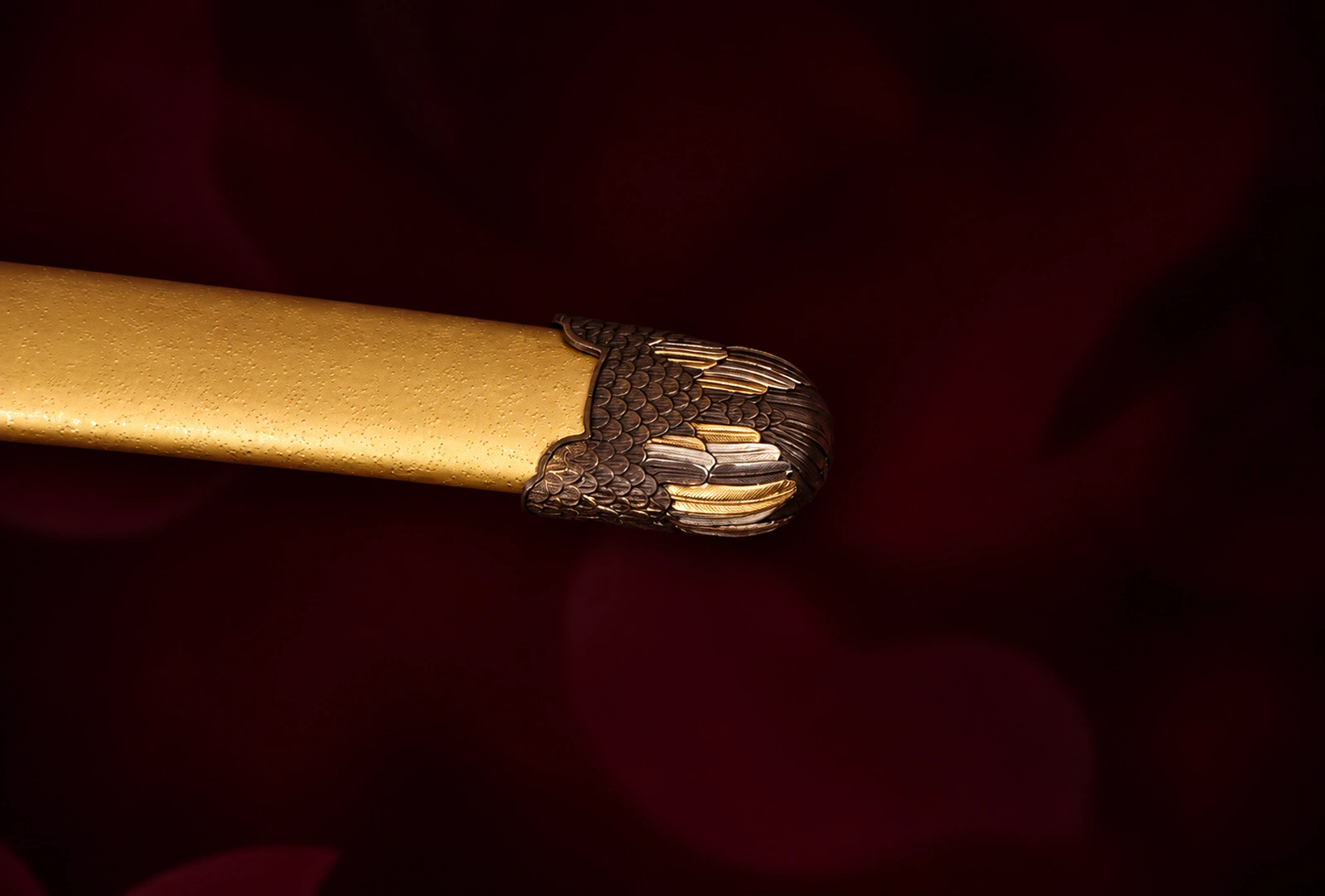
Close-up of decorated end cap on the gold saya of the Phoenix koshirae
Ornament at the very end of the scabbard.
Close-up of a gold ornament inset into the white rayskin-covered Phoenix tachi handle
A small gold-toned detail set into the white samegawa.
Close-up of the gold-edged tsuba and polished blade of the Phoenix mounted tachi
The sculpted tsuba beside the polished steel.

THE FINAL PORTRAIT

One last view draws the blade and the Phoenix mountings into the same frame — the silver curve answering the warmth of gold.
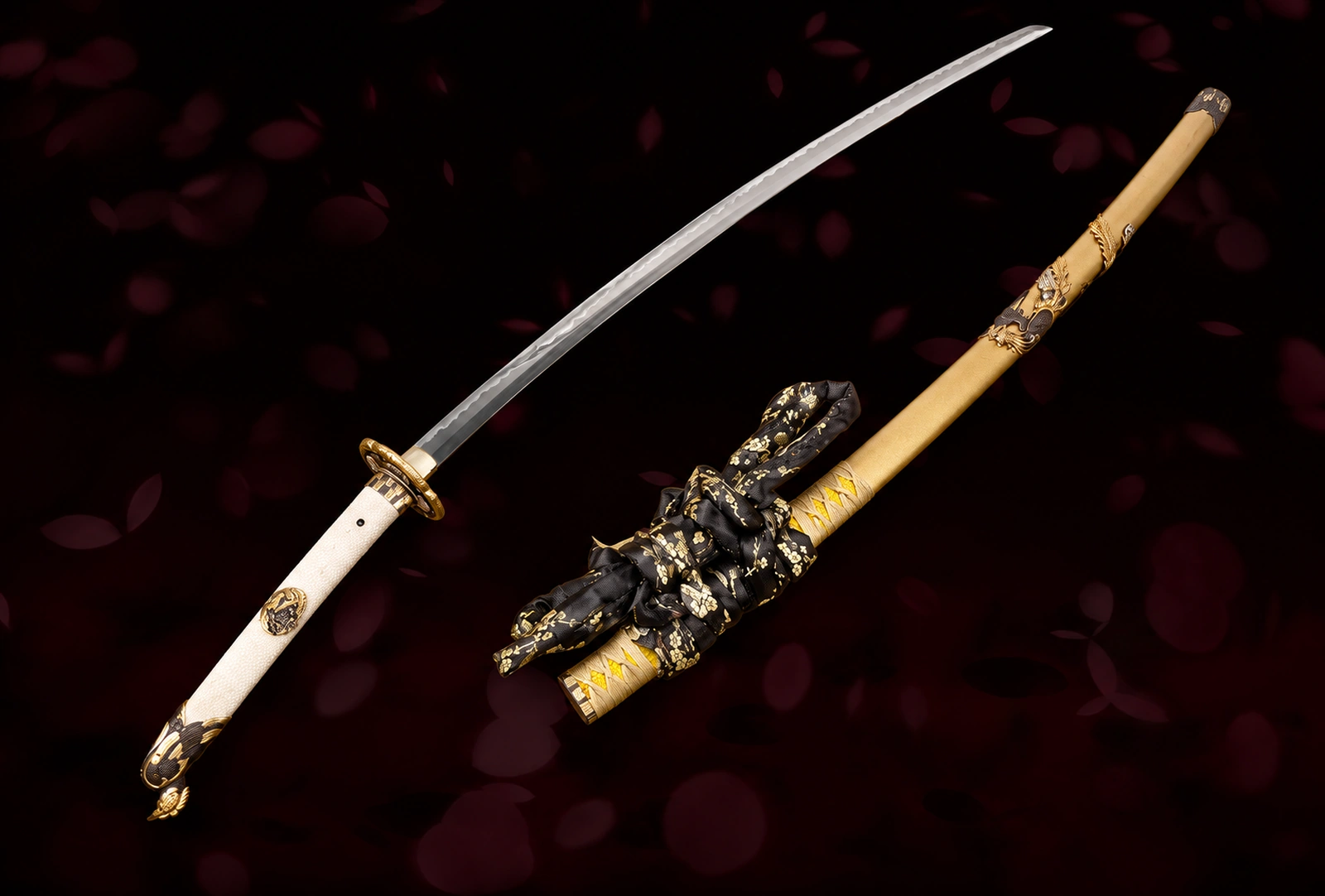
Unsheathed Ukiyo tachi beside its gold Phoenix koshirae saya on scattered dark red petals
The blade and its Phoenix mountings, together in the final portrait.

UKIYO / THE LAST IMAGE

The petals pass.
The form remains.

Reviews

There are no reviews yet.

Be the first to review “Ukiyo — Mikazuki Munechika Replica Tachi”

Your email address will not be published. Required fields are marked *