QUIET CRAFTSMANSHIP · LONGQUAN

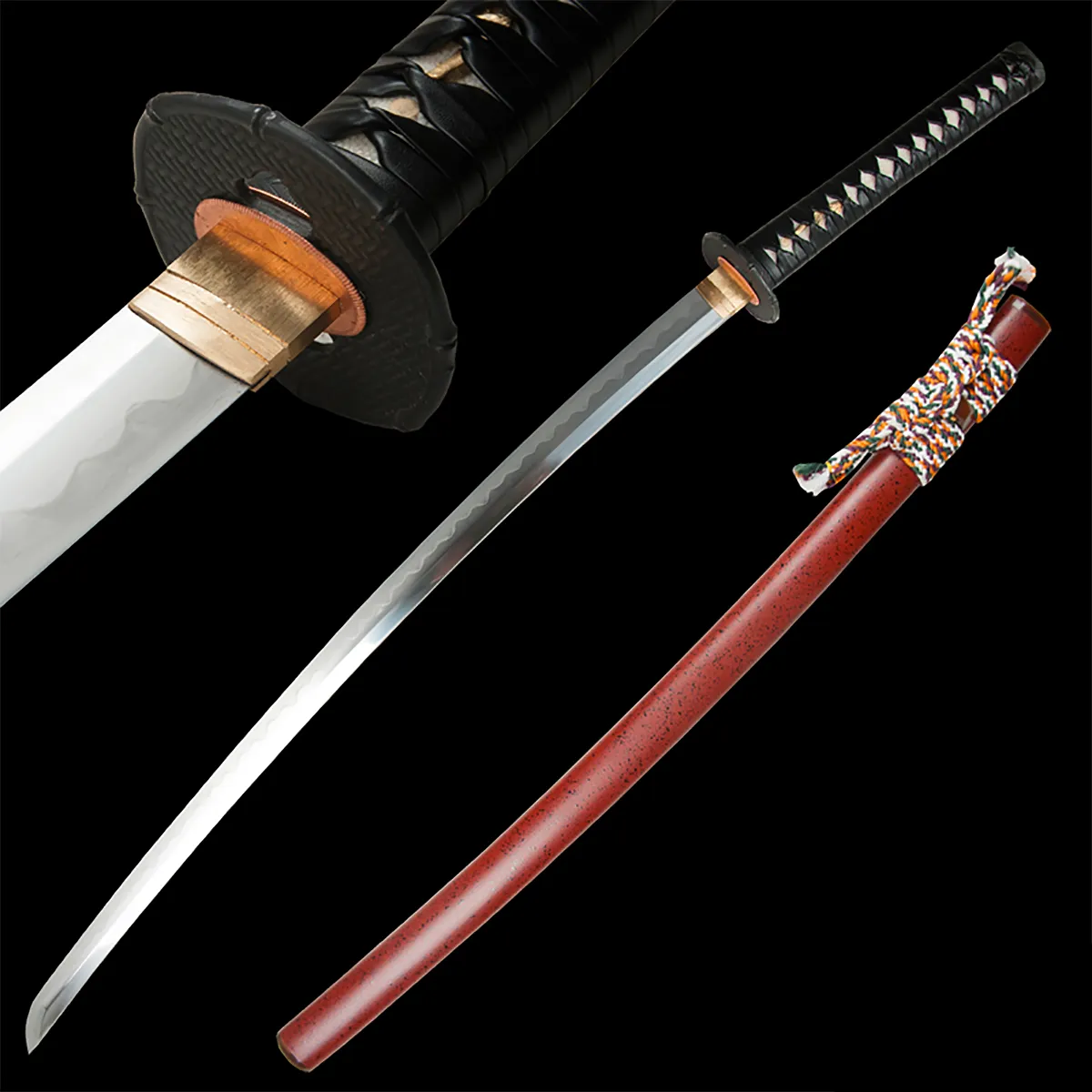
Iron-Fitted Sanmai Japanese-Polished Katana

¥1,513.00

PRODUCT OPTIONS

Configure this sword.

Choose the product-specific options below.

CUSTOMIZE THIS KATANA
Each katana is configured individually.
Multiple katana purchases are placed as separate orders.

KATANA CUSTOMIZER

Customize Your Katana.

Choose from the configuration options available for this katana.

WORKSHOP NOTES

Hello, I'm Lao Yan from ZYSWORD.

Today I'm showing you the three-tone polished version of our sanmai katana.

You can tell a lot about the configuration at a glance: a horn-fitted saya and a sanmai blade.

It also has stainless-steel fittings, a leather handle wrap, and a thick sageo.

And I put together the fittings myself— a combination many sword enthusiasts seem to like.

I think the overall look works quite well. And no, I won't admit my design looks bad!

I introduced this three-tone finish in response to demand. Many customers prefer it to a plain mirror finish.

I'll also show you the mirror-polished version, so you can see how striking that finish can be.

There's another important consideration.

My throat isn't feeling great today.

Scratches from test cutting—or even light rust— can be difficult to repair on this kind of finish.

Minor marks on a mirror-polished blade are often easier to polish out.

Let's move closer and look at the three-tone blade. And yes, it has a true geometric yokote.

For the outer steel, I start with 608 patterned steel. The original pattern isn't quite fine enough for my taste.

So I fold the 608 steel several more times for the outer layers. The core steel is T10.

These stainless-steel fittings can also be chosen and changed.

Everyone has their own idea of how a katana should look.

Once you've chosen the blade, the other fittings are comparatively easy to change.

With the three-tone polish, you can see a white edge, gray ji, and bright shinogi.

I wouldn't call this an advanced traditional polish. A lot of polishing steps have been reduced.

That means it isn't as refined as a full advanced polish, but the price is more approachable.

My throat really isn't cooperating today.

Personally, I just can't quite fall in love with this finish.

It still brings out a little of the steel grain.

The bright edge looks good too, but it isn't my personal favorite.

This one has a hand-polished mirror finish.

If I'm not doing a full advanced polish, I personally prefer this mirror-like finish.

Now let's have a look under stronger light.

Compared with the three-tone polish, the steel grain is less obvious here.

That light is too harsh on the eyes. Let's switch back.

One last look at the complete configuration. I think it looks better the longer you look at it.

That's all for today. Thanks for watching. Goodbye!

Technical Overview

Core specifications.

Nagasa
710 mm
Motohaba
32 mm
Motokasane
7 mm
Tsuka Length
250 mm
Overall Length
1000 mm
Weight without Saya
1010 g
Weight with Saya
1290 g
Handmade product dimensions may vary slightly.
Blade & Craft

Blade craftsmanship.

Outer Steel
608 Patterned Steel (Further Folded)
Core Steel
T10 Carbon Steel
Construction
Sanmai Construction
Heat Treatment
Clay Tempering
Hamon
Clay-Tempered Hamon
Hamon Pattern
Gunome
Polish
Japanese-Style Polish

Description

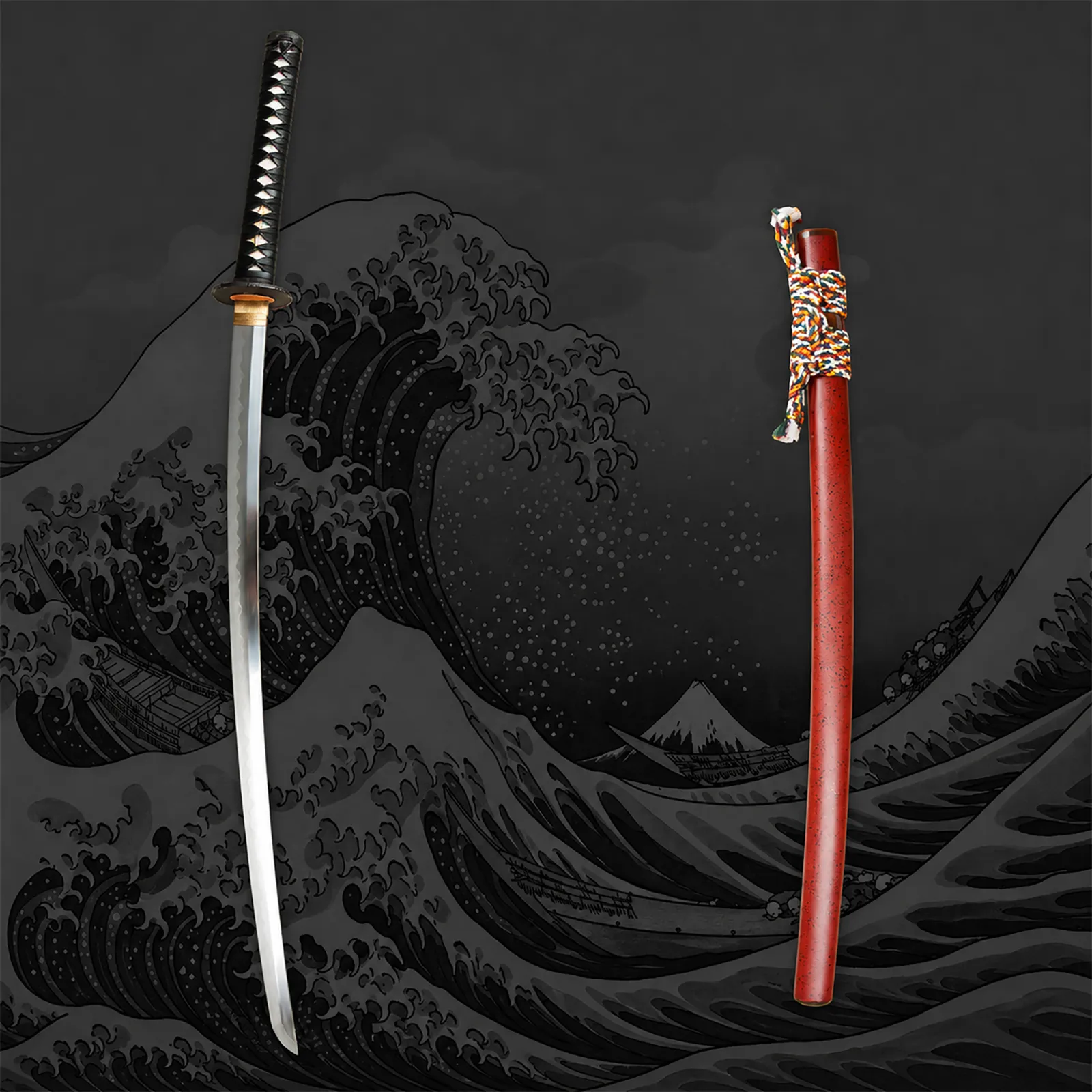
Iron-Fitted Sanmai Katana beside its reddish-brown saya against a monochrome Great Wave background
Iron-Fitted Sanmai Katana — blade and saya against a monochrome wave composition.
01 / THE STRUCTURE WITHIN

Layered Steel. Singular Purpose.

The character of this katana begins beneath its polished surface. Its blade is built using Sanmai Construction, bringing together carefully prepared outer steel and a distinct inner core in a traditional composite blade structure.

The outer layers are made from 608 Patterned Steel, further folded to refine the appearance of the steel's layered texture. Within this construction lies a core of T10 Carbon Steel, forming the central component of the three-layer assembly.

By combining these materials within a single blade, the construction brings together the characteristics of its outer and inner steels. The result reflects a deliberate approach to blade making, in which material selection, forging structure, and subsequent heat treatment are considered as parts of the same craft.

A blade defined not only by what is visible, but by the structure forged within.

02 / CRAFTSMANSHIP IN DETAIL

The Character of the Details.

Beyond the construction of its blade, this katana reveals its character through the materials and workmanship of its fittings. Textured iron, black leather, natural rayskin, and a richly finished scabbard create a distinctive interpretation of traditional Japanese sword mountings.

THE IRON FITTINGS

Iron, Copper and Brass.

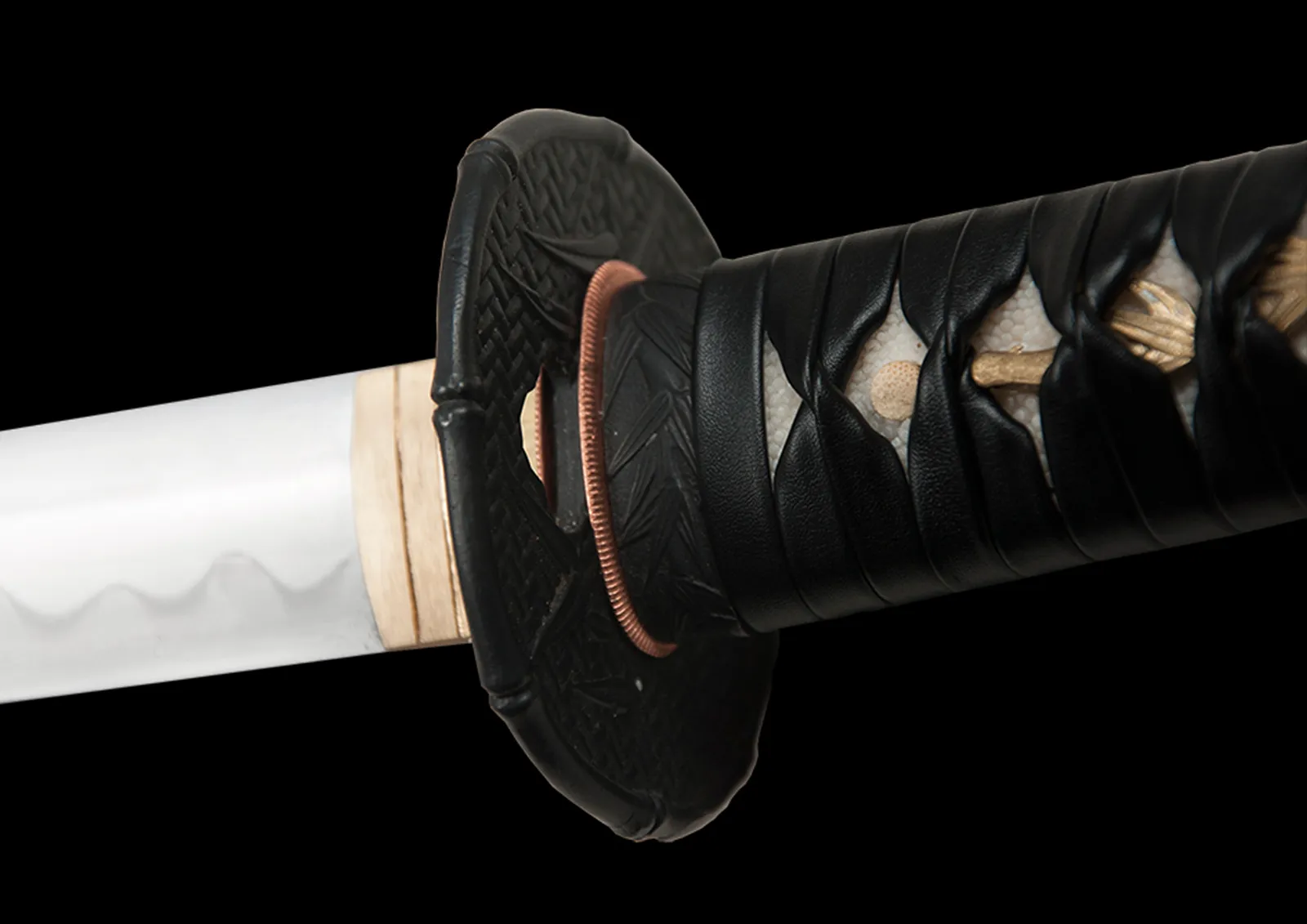
An openwork iron tsuba anchors the dark fittings. The reverse reveals the textured iron fuchi, while copper seppa and a brass habaki introduce warmer tones around the blade. Decorative brass menuki appear through the handle wrapping.
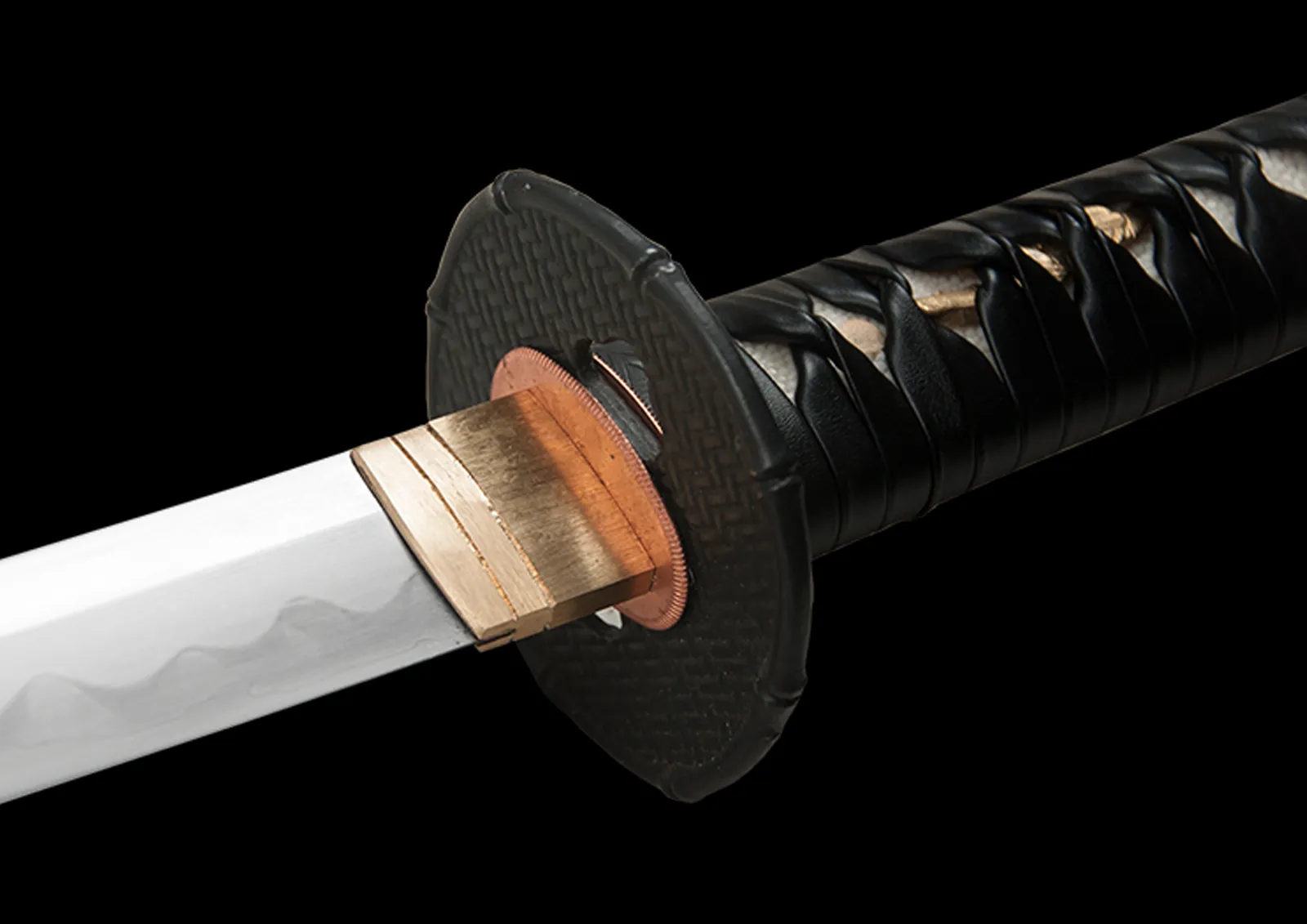
Iron tsuba, brass habaki and copper seppa on the WK-290 Sanmai Katana
Textured iron tsuba, brass habaki, and copper seppa.
Reverse view of iron tsuba and fuchi with copper seppa, brass menuki and black leather handle wrapping
The reverse of the tsuba, iron fuchi, and decorative menuki.

THE HANDLE

Leather Over Rayskin.

The handle is wrapped in black cowhide leather tsuka-ito, forming a distinctive variation on traditional Japanese sword wrapping. Beneath it lies genuine samegawa, visible through the repeating diamond openings. The pale rayskin and small metallic ornaments provide a restrained contrast with the leather.
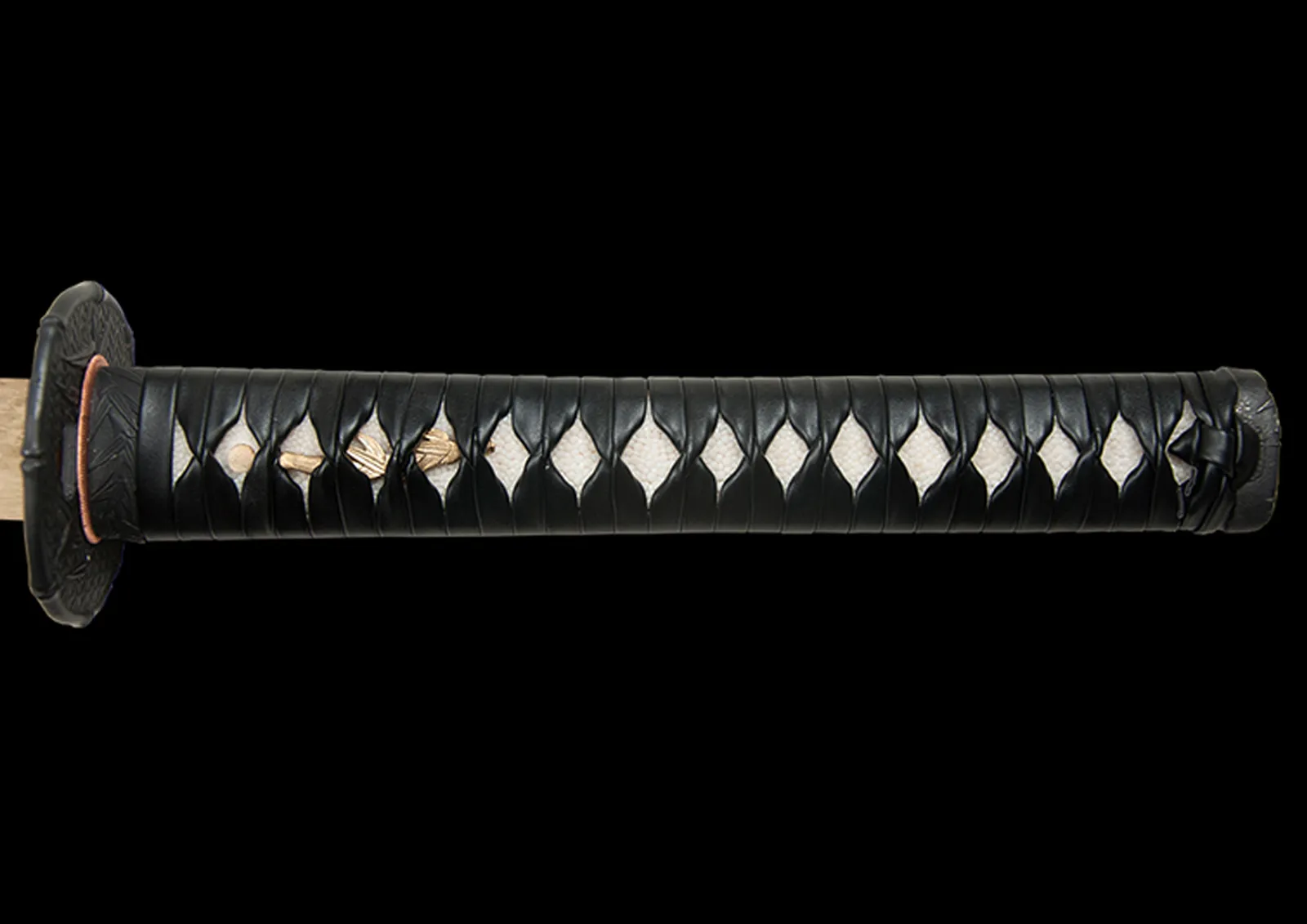
WK-290 black cowhide leather tsuka-ito wrapped over genuine rayskin with brass menuki visible through diamond openings
Black cowhide leather wrapping over genuine rayskin.

THE SAYA

Color Beneath the Quiet.

The reddish-brown saya adds warmth to the otherwise dark mountings. Its Qingpi wood body has a finely speckled finish, with horn components and a vividly colored braided cord bringing together wood, horn, and textile in one composition.
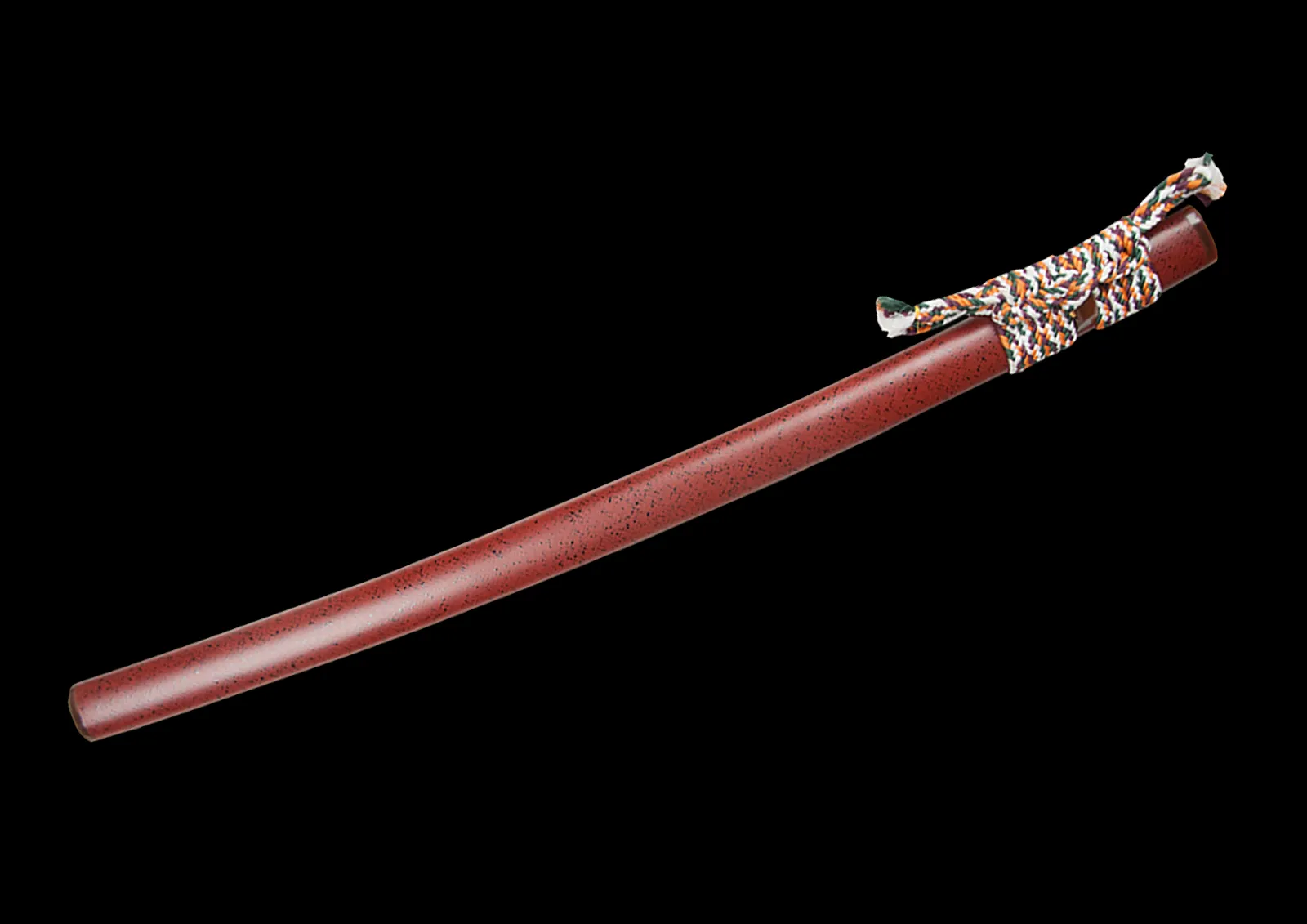
Reddish-brown speckled horn-fitted saya of WK-290 with a thick multicolored sageo
The reddish-brown saya with horn fittings and multicolored sageo.

THE BRAIDED CORD

A Rhythm of Color.

A thick, multicolored sageo is arranged in an elaborate shigeuchi-style braid. The kurigata provides the attachment point, while horn details around the koiguchi complete the traditional scabbard presentation.
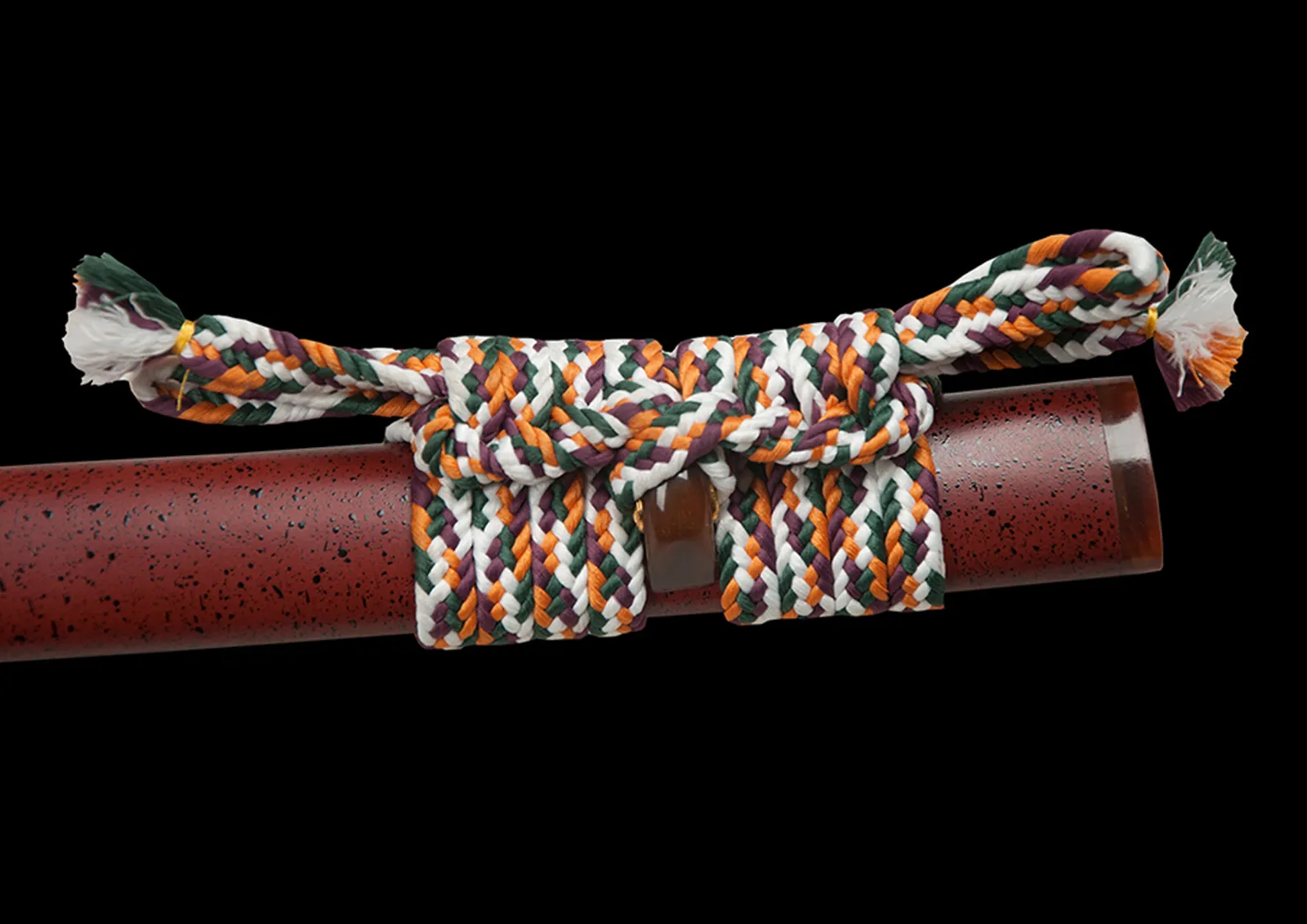
Close-up of multicolored shigeuchi-style sageo beside horn fittings and a speckled reddish-brown saya
Multicolored braiding and the horn-fitted scabbard details.

STEEL / FIRE / POLISH

The Flow of Gunome.

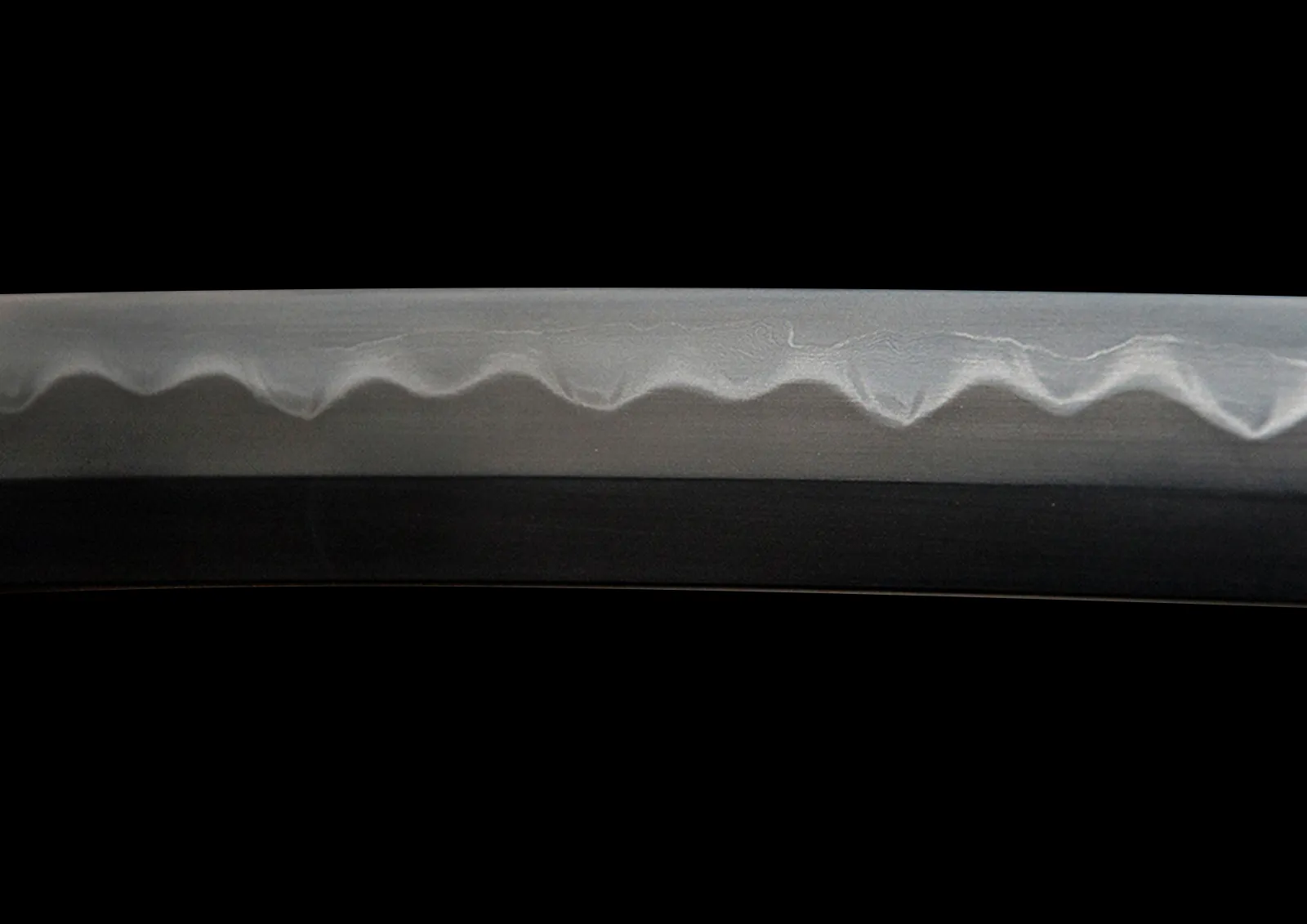
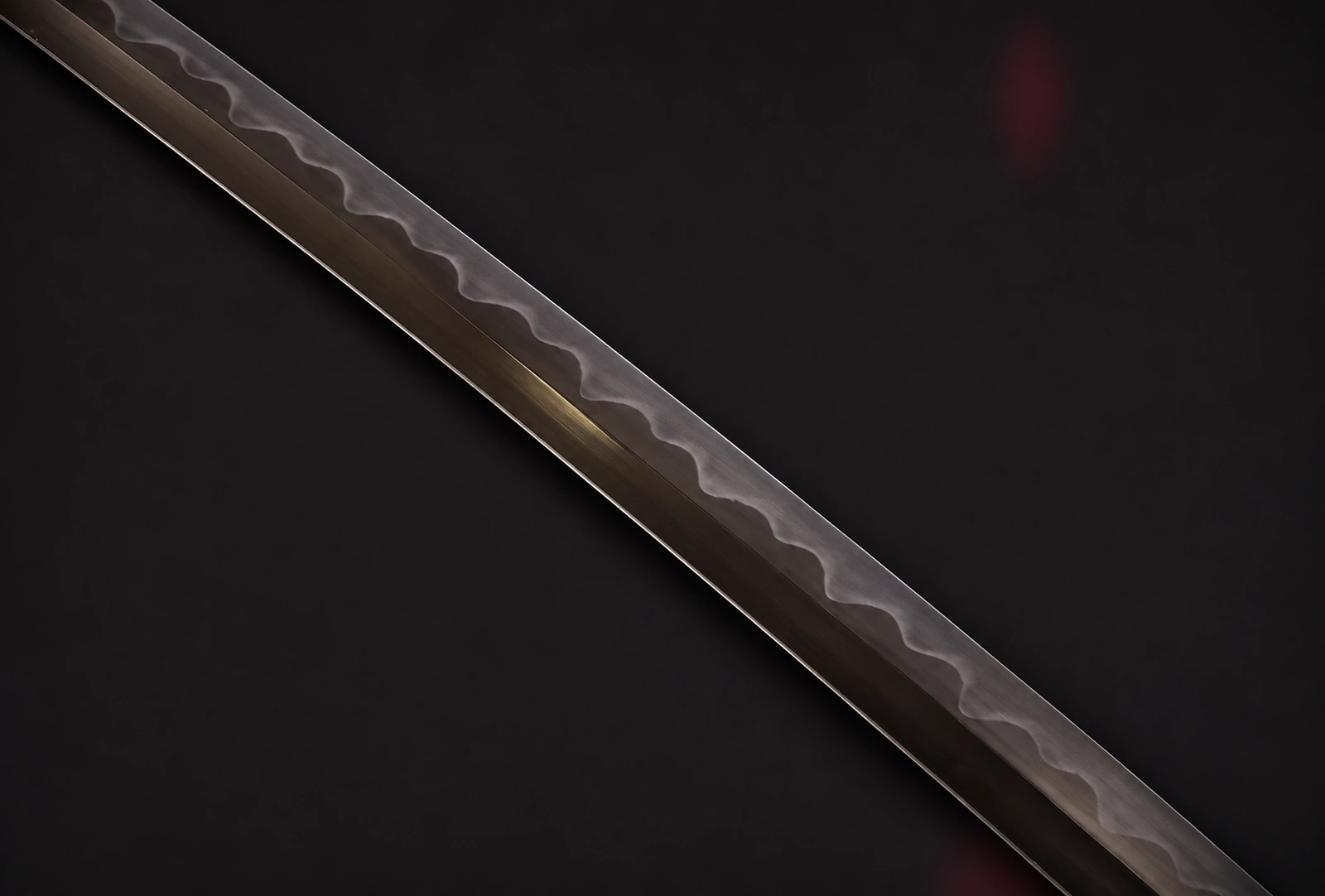
The flowing Gunome pattern is a form of hamon produced through differential clay hardening. Rounded rises follow the cutting edge. Japanese-style polishing reveals the visual contrast between the bright edge region, the subdued gray blade surface, and the more reflective shinogi.
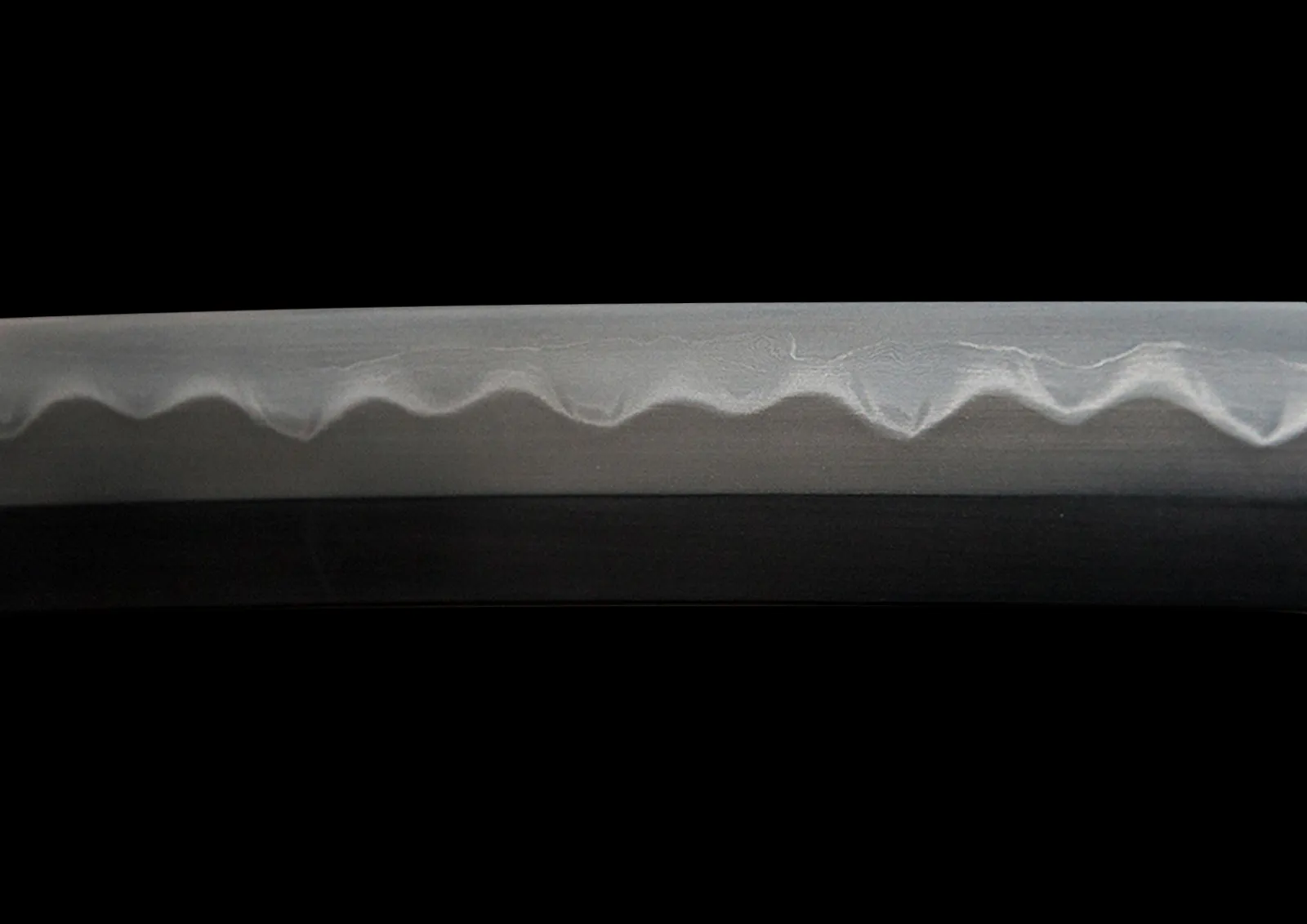
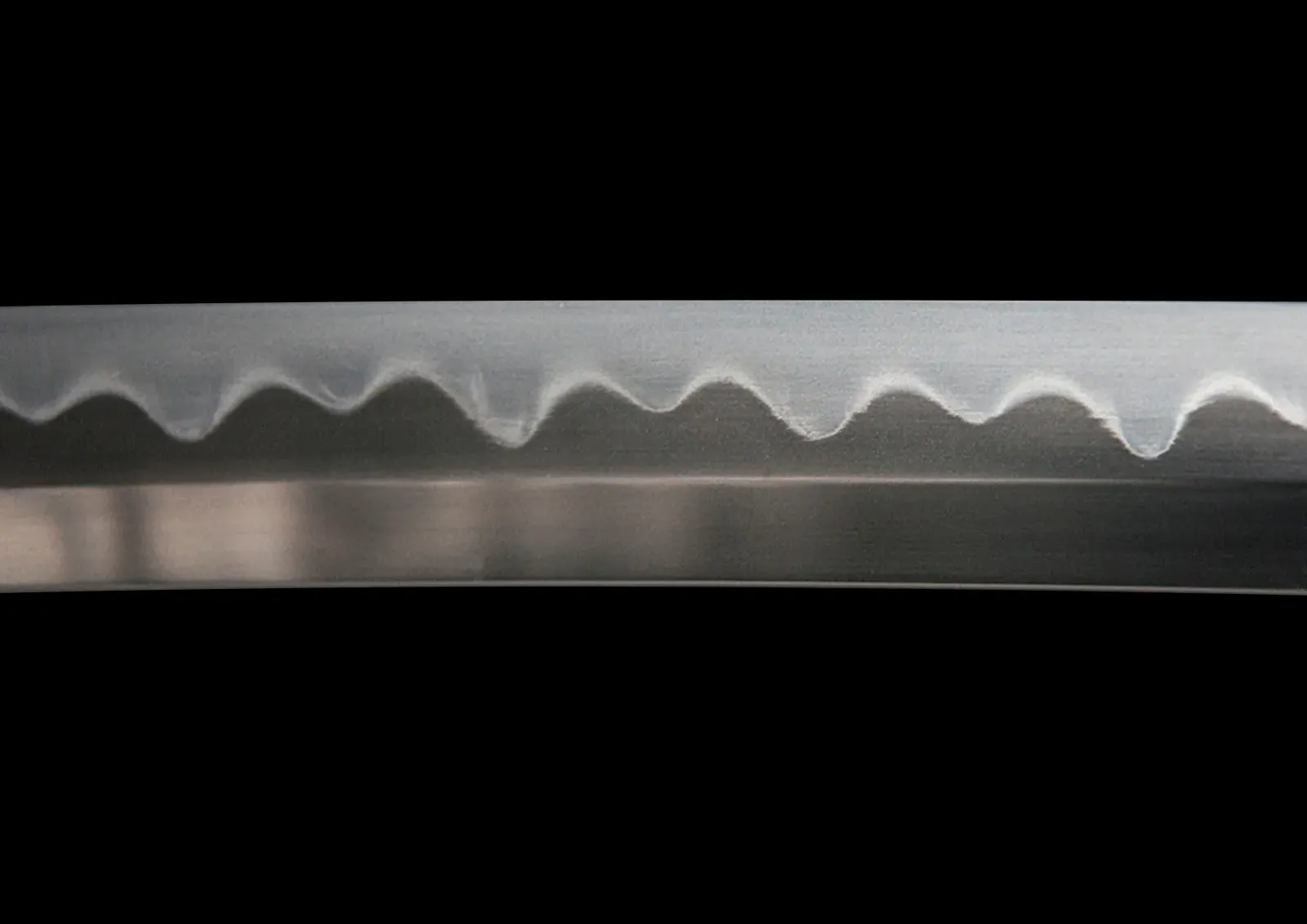
WK-290 blade detail showing an undulating gunome hamon and contrasting polished steel surfaces
Gunome hamon — first close view.
WK-290 blade detail showing rounded gunome peaks and the contrast of Japanese-style polishing
Gunome hamon — second close view.
Extended WK-290 Sanmai Katana blade close-up showing continuous gunome hamon and contrasting polished steel tones
The continuous movement of the Gunome hardening pattern.

THE INDIVIDUAL CHARACTER OF STEEL

No Two Lines Alike.

Although the Gunome pattern follows a recognizable style, its precise form naturally varies from one blade to another. Each finished hamon carries subtle differences in its rises, transitions, and fine surface details. Together with the iron fittings, leather wrapping, and horn-fitted saya, these variations give the katana its individual character.

03 / THE COMPLETE PORTRAIT

Composed in Contrast.

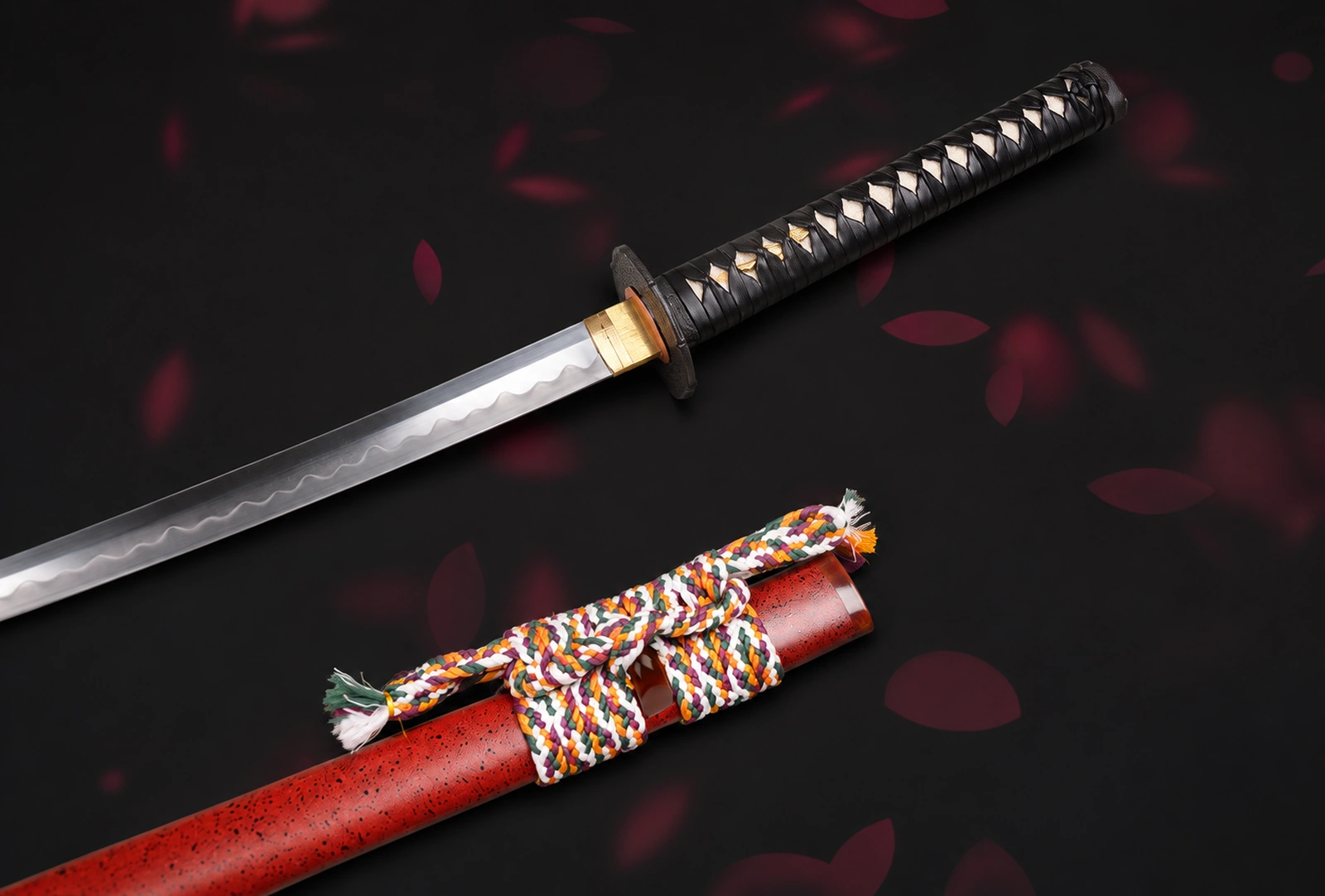
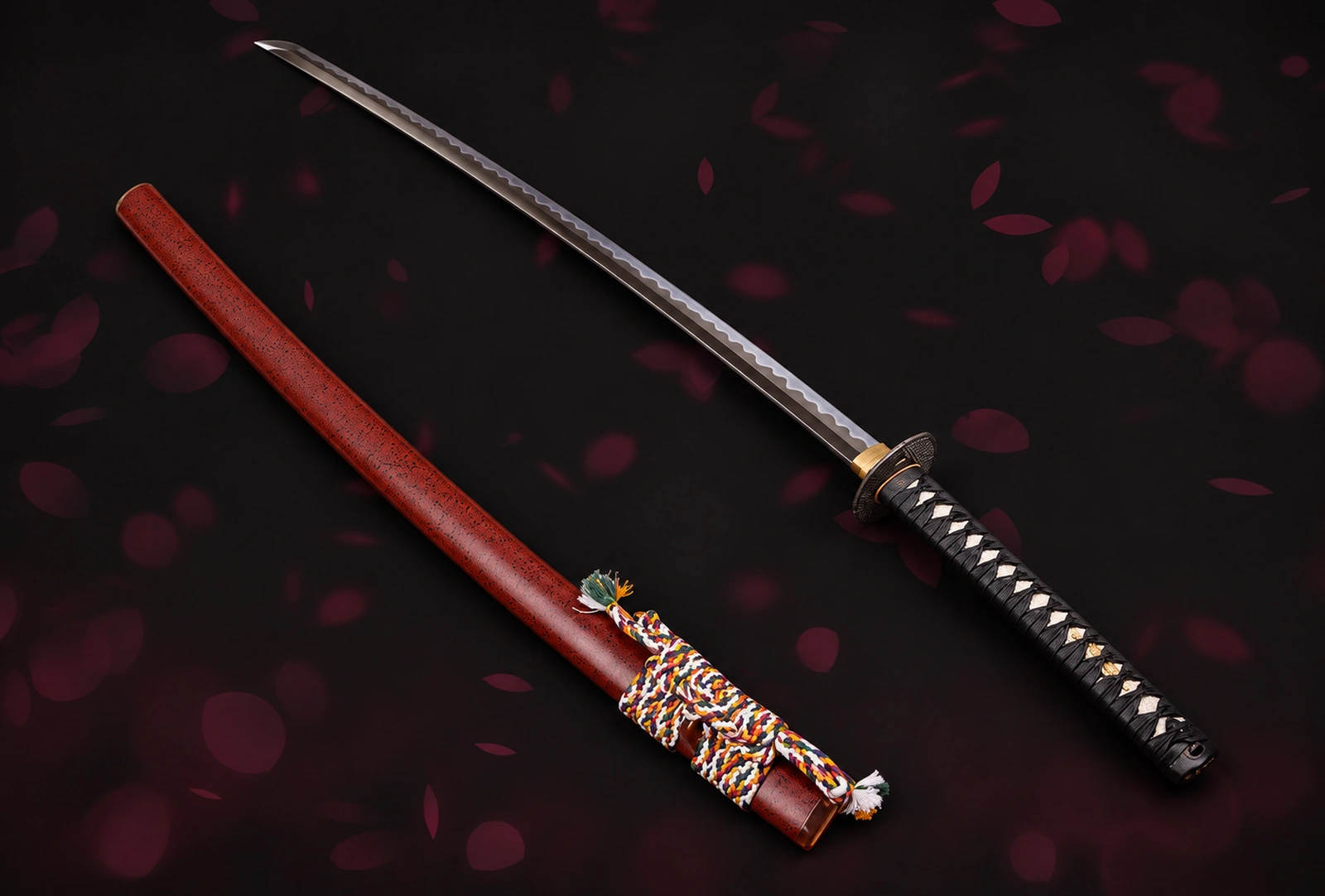
Seen in full, the Iron-Fitted Sanmai Katana brings together a dark wrapped handle, a polished curved blade, and the warm reddish-brown of its saya. The quiet black-and-red palette of the photographs lets those details stand on their own.
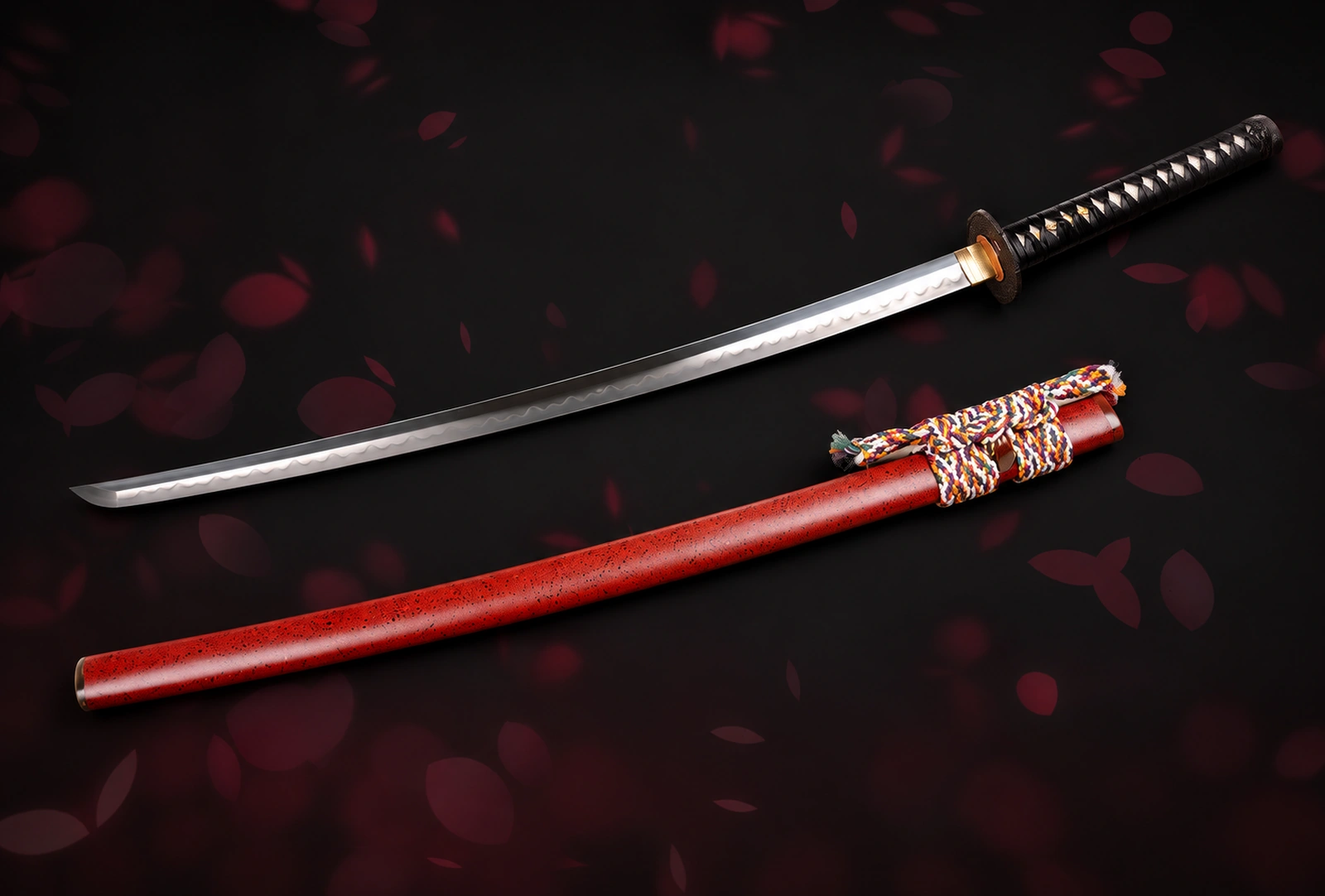
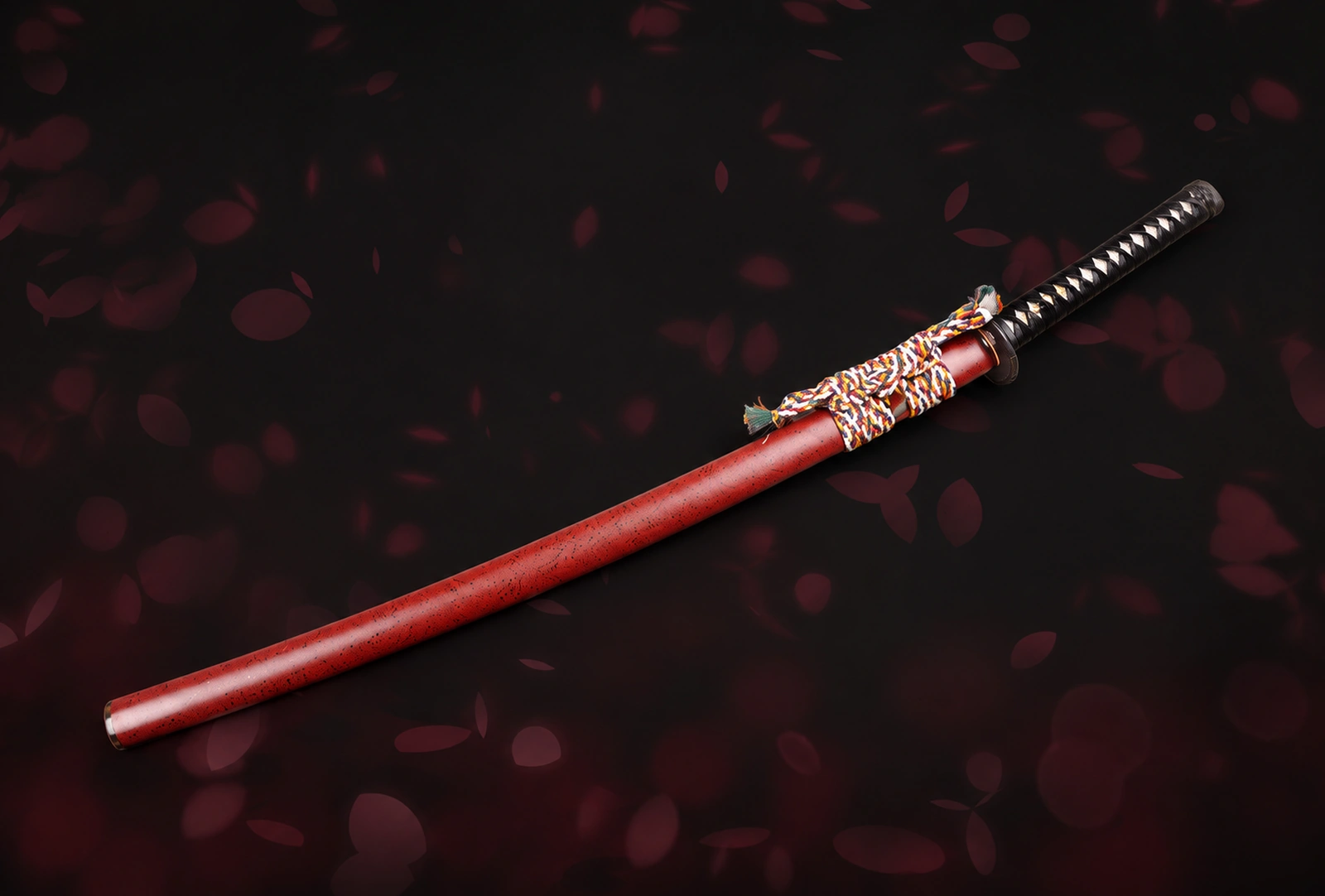
Unsheathed WK-290 Sanmai katana displayed beside its reddish-brown saya on a dark background with scattered red petals
A complete view of the drawn blade and its reddish-brown saya.
Fully sheathed WK-290 katana shown diagonally with its reddish-brown scabbard and dark handle
The sheathed silhouette, photographed on a dark floral backdrop.
Angled close-up of the WK-290 blade and black-wrapped handle beside the red-brown saya and braided sageo
Steel, handle wrapping, and braided cord in one composition.

04 / THE DRAWN BLADE

A Line of Polished Steel.

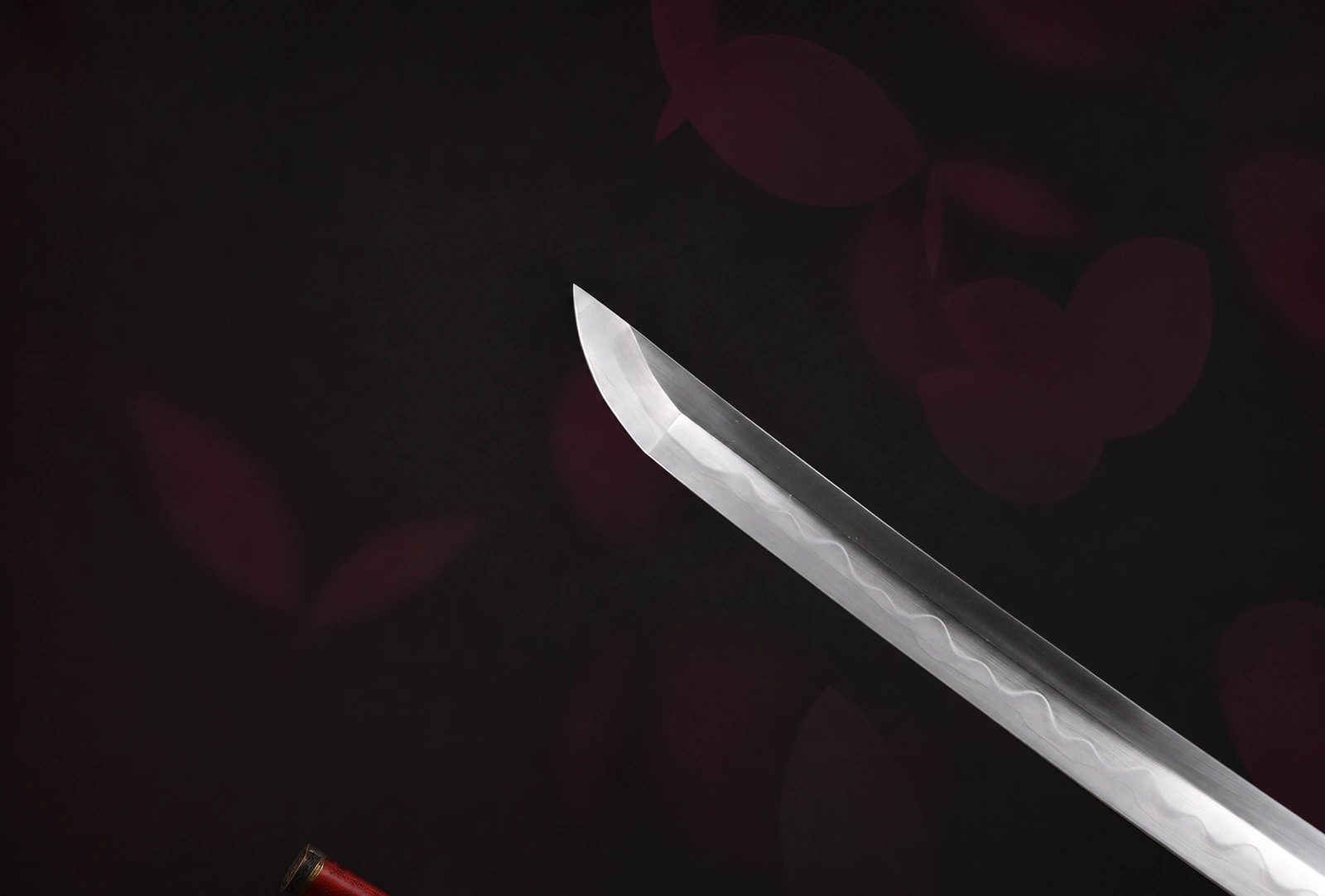
With the blade out of its scabbard, the curvature becomes the central feature. The long diagonal views reveal its proportions; closer photographs move toward the tip and the changing reflections of the polished surface.
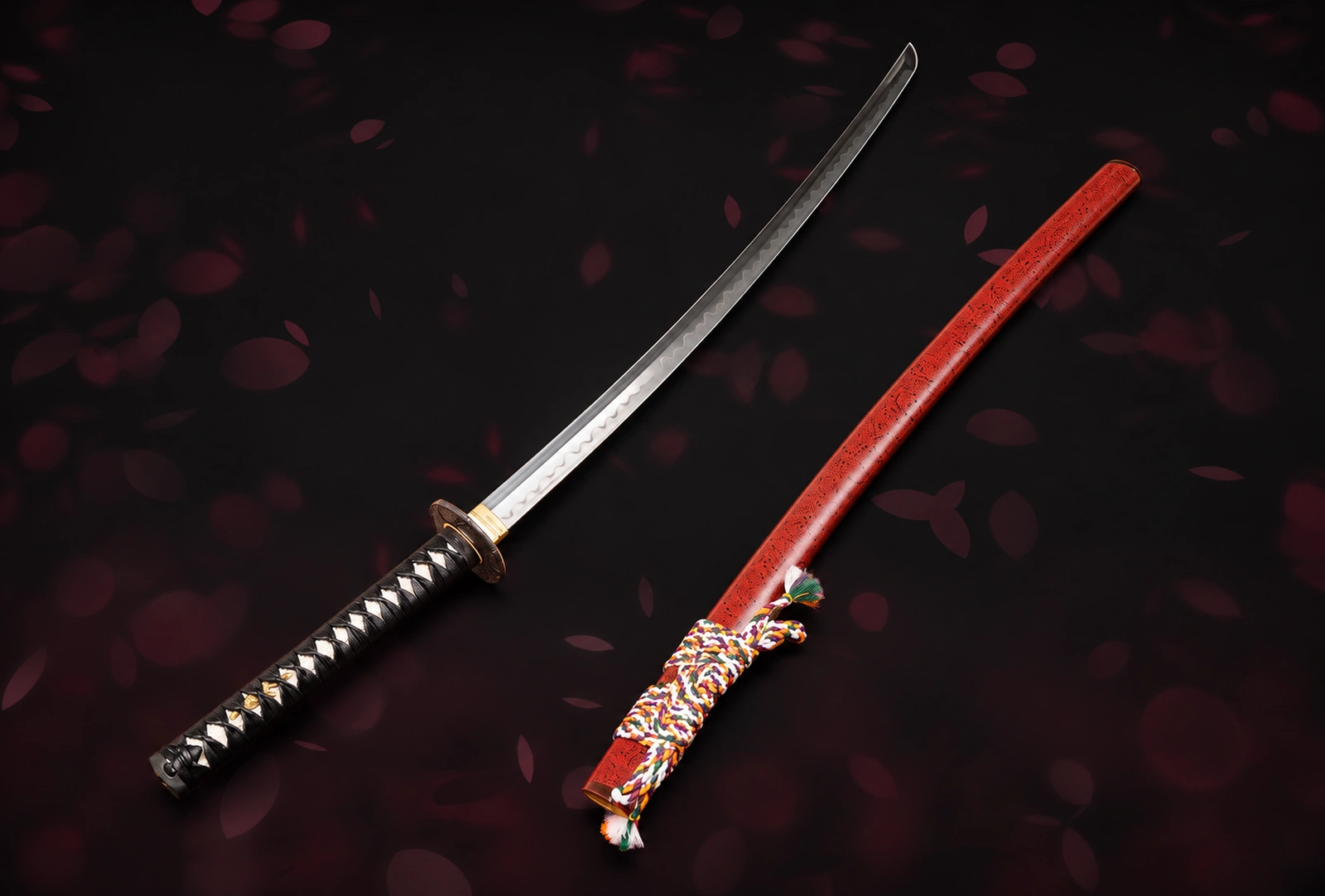
Unsheathed WK-290 Sanmai katana and reddish-brown saya arranged diagonally over a dark red-petal background
The full blade, seen in a sweeping diagonal composition.
Close-up photograph of the polished kissaki tip of the WK-290 katana against a dark background
The polished tip, where the blade's curvature comes to a point.
Macro view of the WK-290 blade showing the flowing temper pattern and layered reflections along the steel
A closer view of the flowing Gunome hamon and polished steel.
WK-290 unsheathed katana and reddish-brown scabbard placed across one another on a dark petal-patterned background
The unsheathed blade and saya, viewed from another angle.

05 / FINAL PORTRAIT

The Last Details.

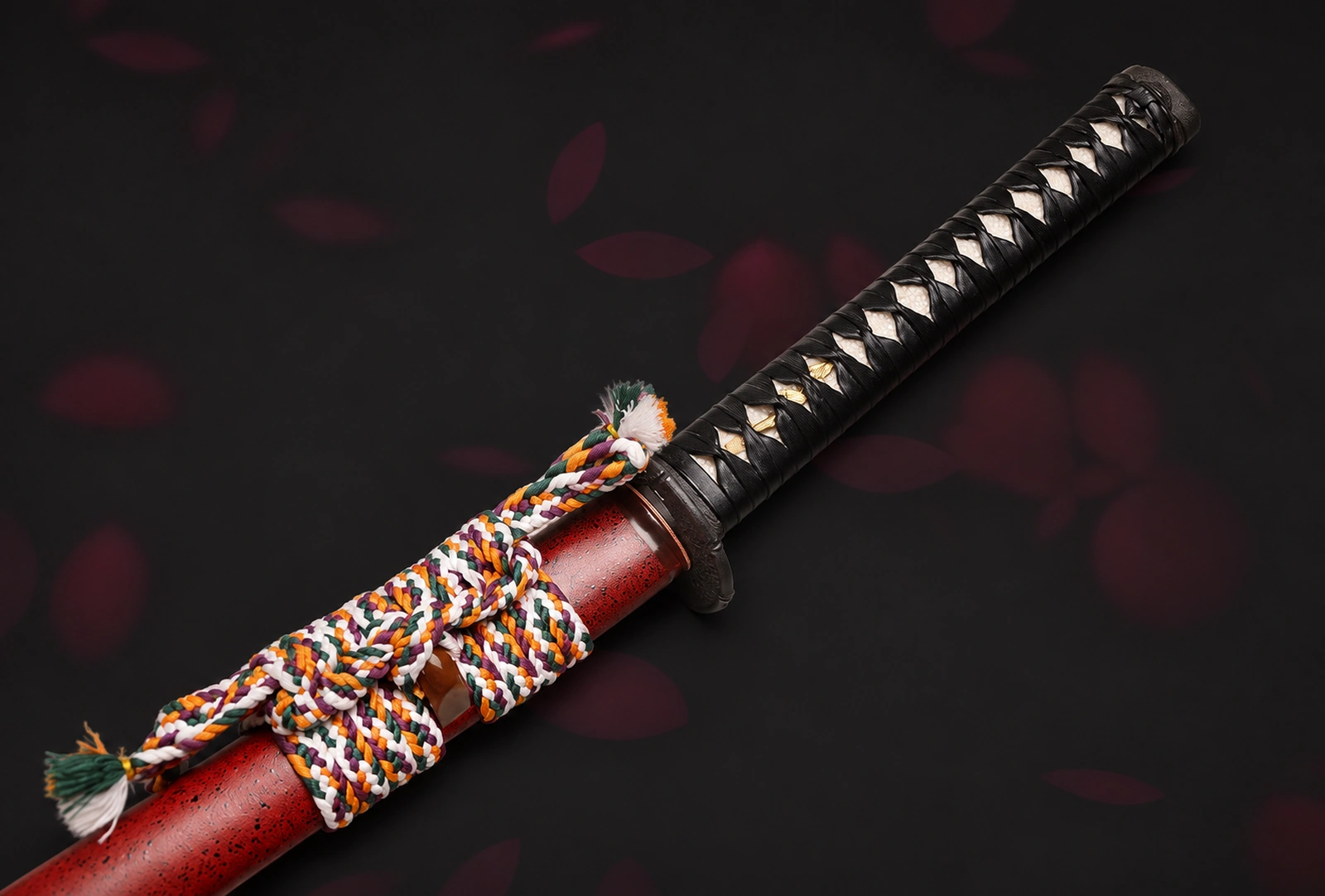
The finishing images return to the sword's tsuka and saya. Textured black fittings, leather wrapping, and the multicolored cord provide a close-range counterpoint to the long, bright line of the blade.
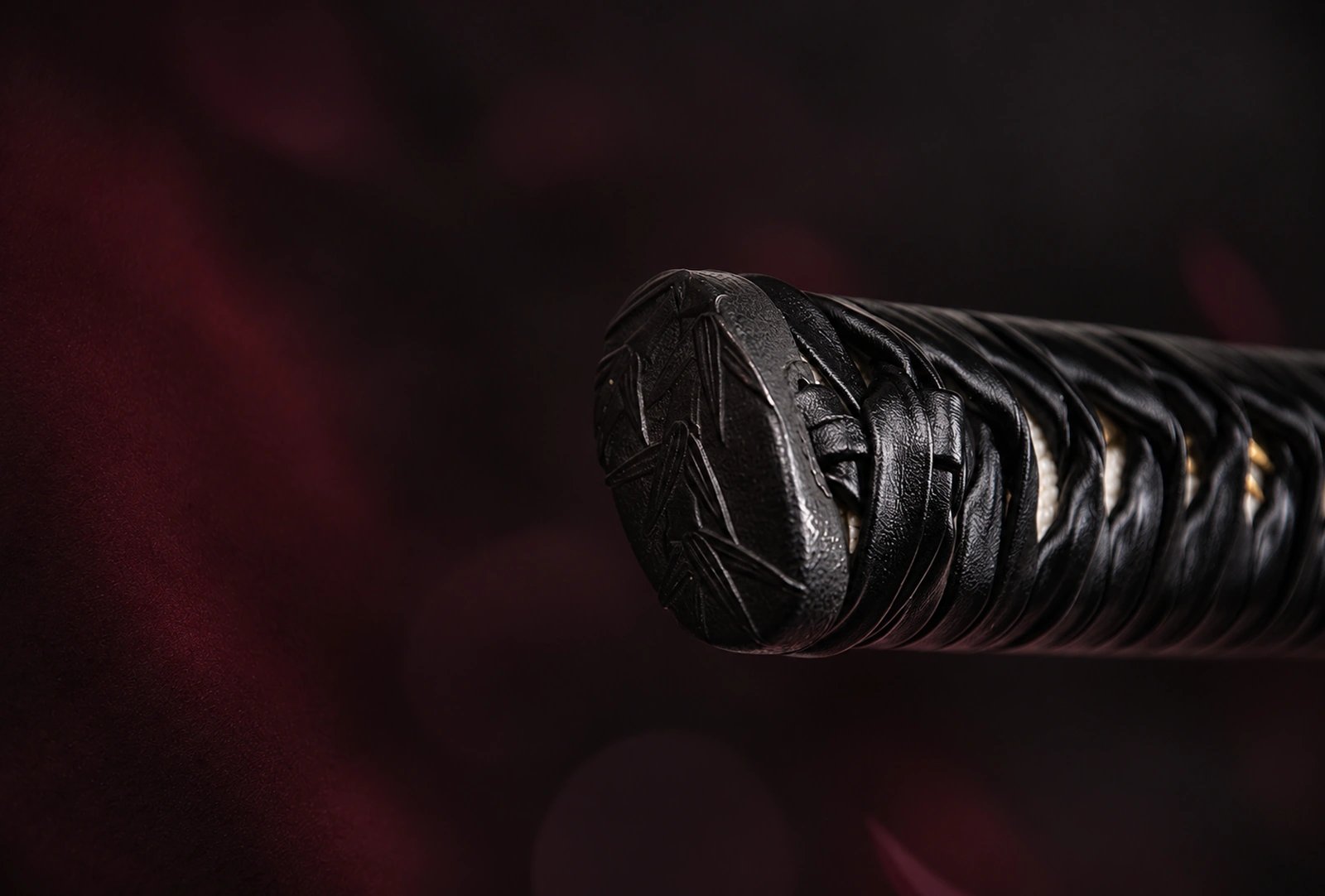
Close-up of the black leather-wrapped handle end and dark iron fittings on the WK-290 Sanmai katana
The dark-wrapped handle, seen from the end.
Final diagonal portrait of the WK-290 iron-fitted Sanmai katana in its reddish-brown saya with black handle and multicolored cord
The complete katana in its traditional mountings.

Reviews

There are no reviews yet.

Be the first to review “Iron-Fitted Sanmai Japanese-Polished Katana”

Your email address will not be published. Required fields are marked *